
LTIFR (Lost Time Injury Frequency Rate) measures how many lost-time injuries occur per 1,000,000 hours worked. It is a lagging EHS indicator used to compare serious injury frequency across sites, contractors and sectors.
LTIFR is the lost-time injury frequency rate per 1,000,000 hours worked.
Its practical origin sits in industrial accident statistics systems, especially in European, Australian, Brazilian and global corporate reporting that expresses injuries per million exposure hours.
For organizations that also report OSHA metrics, LTIFR creates a normalization challenge: OSHA rates use a 200,000-hour base, while LTIFR usually uses 1,000,000 hours. The base must be converted before comparing performance.
LTIFR is used globally in construction, manufacturing, energy, mining, logistics and contractor management because it normalizes serious injury frequency by actual exposure rather than workforce size.
LTIFR turns serious injury events into a comparable exposure-based rate, which makes trend analysis and contractor benchmarking more credible.
The EHS manager uses LTIFR to identify high-risk sites, check classification consistency and explain lost-time injury performance in a language recognised by clients and auditors.
For executives, LTIFR connects safety performance with productivity, insurance pressure, contract eligibility, operational resilience and the cost of absence.
HR and Operations use LTIFR to understand staffing impact, return-to-work pressure, shift planning and the practical effect of serious injuries on continuity.
LTIFR = (Number of lost-time injuries × 1,000,000) ÷ Hours worked
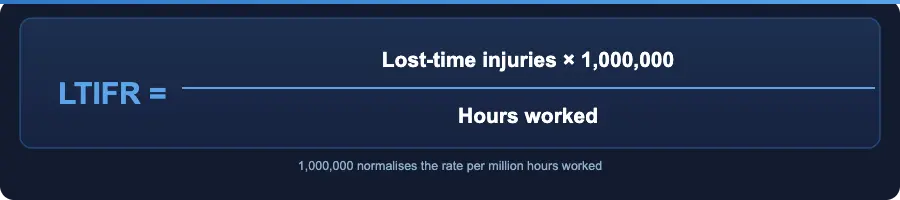
1,000,000 is the most common LTIFR normalising constant. It expresses expected lost-time injury frequency per million hours worked, making comparisons across sites, contractors and reporting periods more meaningful.
The 200,000 base is OSHA's standard for rates per 100 full-time workers: 100 workers × 40 hours per week × 50 weeks per year = 200,000 hours. The 1,000,000 base is common in global, European, Australian and Brazilian reporting because it reads as a rate per million exposure hours.
Conversion is simple only when the numerator is the same: rate per 1,000,000 hours = rate per 200,000 hours × 5. In reverse, rate per 200,000 hours = LTIFR ÷ 5. Do not convert metrics with different numerators: DART includes restricted work and job transfer, while LTIFR includes only lost-time injuries.
Step 1: Define scope. Example: employees + contractors under direct operational control in the reporting year.
Step 2: Count only lost-time injuries. Example: 3 employee LTIs and 2 contractor LTIs; numerator = 5.
Step 3: Consolidate hours. Example: 1,450,000 employee hours + 550,000 contractor hours = 2,000,000 exposure hours.
Step 4: Apply the formula. LTIFR = (5 × 1,000,000) ÷ 2,000,000 = 2.50.
Step 5: For an OSHA-style 200,000-hour comparison using the same numerator, convert: 2.50 ÷ 5 = 0.50.
If a company records 5 lost-time injuries and 2,000,000 exposure hours, the full calculation is: 5 × 1,000,000 = 5,000,000; 5,000,000 ÷ 2,000,000 = 2.50. The result means 2.50 lost-time injuries per million exposure hours.
A good LTIFR depends on sector, reporting scope and the definition of time away. The BLS table below uses 2024 days-away-from-work rates per 100 FTE and converts them to an approximate LTIFR per million hours by multiplying by five.
BLS and HSE figures are not directly comparable: BLS rates use OSHA-style cases and a 200,000-hour base, while RIDDOR reporting in Great Britain uses different legal thresholds and rates per 100,000 employees.
Classification should be based on consistent recordkeeping rules, because the same event can be treated differently across countries if local legal criteria are applied without a corporate taxonomy.
RIDDOR uses specific UK reporting thresholds, including over-seven-day incapacitation. Organisations calculating LTIFR for international benchmarking should define whether they are using OSHA-style days away, RIDDOR thresholds, or both in separate views.
Not every lost-time injury has Serious Injury & Fatality (SIF) potential, and not every SIF-potential event causes time away. LTIFR becomes more useful for SIF governance when each LTI is also tagged by severity potential, hazardous energy, failed critical control and actual or potential outcome.
LTIFR is strongest when read with recordable, severity and leading indicators.
The most useful relationship is between LTIFR and leading indicators. If inspections, hazard reports and corrective actions fall before LTIFR rises, the organisation has an early warning system it can act on.
Base conversion between LTIFR and OSHA-style rates is valid only when the numerator is equivalent. If the numerator is DART, multiplying by five does not produce LTIFR because DART includes restricted work and job transfer.
LTIFR does not explain injury severity, control effectiveness, fatal-risk exposure, reporting culture or investigation quality by itself.
A very low LTIFR can show strong performance, but it can also reflect under-reporting, classification pressure or too small a data set.
Track near misses, safety observations, inspections completed, critical-risk controls verified, corrective actions closed on time and training by critical task.
LTIFR does not predict fatalities by itself, but it is valuable for SIF prevention when each LTI is enriched with potential severity, hazardous energy, failed critical barriers and recurring causes. That separates frequent low-potential injuries from rare events that could have caused death or permanent impairment.
The accident pyramid is useful as a reminder that lost-time injuries are late signals of a broader system of weak controls, deviations and unaddressed exposure.
LTIFR has often been calculated in spreadsheets after month-end, which delays action and creates disputes over source data.
Digital EHS platforms can connect hours worked, incident classification, investigations and CAPAs into a live performance view with fewer manual errors.
The strongest use case is correlation: when LTIFR is viewed alongside leading indicators, teams can see whether inspections, corrective actions or near-miss reporting are weakening before serious injuries recur.
.webp)
LTIFR stands for Lost Time Injury Frequency Rate. It measures lost-time injuries per 1,000,000 hours worked.
Multiply lost-time injuries by 1,000,000 and divide by total exposure hours in the period. The denominator should consolidate employees and contractors included in scope.
A good LTIFR depends on the sector and reporting scope. It should be compared with industry benchmarks and the organisation's own trend.
No. TRIR covers all recordable cases, while LTIFR focuses only on injuries that cause time away from work.
It should include subcontractors when their hours are also included in the denominator. Scope consistency is essential.
Yes. If there are no lost-time injuries in the period, LTIFR is zero. Leading indicators should still be monitored.
DART includes days away, restricted work and job transfer. LTIFR includes only lost-time injuries and usually uses a 1,000,000-hour base, while DART uses the OSHA 200,000-hour base.
Yes when the corporate rule treats a fatal occupational injury as permanent lost time. It must still be reported separately as a fatality and SIF event.
LTIFR is not a universal legal requirement, but it is often derived from required injury records and from national or client-specific frequency-rate practices.
Clients use LTIFR to assess supplier safety performance, especially in high-risk sectors such as construction, energy, mining and logistics.
Request your demo
Start your EHSQ software journey with Glartek and become a leader in your industry.
Schedule Demo.webp)
Discover the power of the only AI-Native EHSQ software built for the frontline

.webp)