
Near Miss Frequency Rate: formula, calculator and reporting maturity

Knowledge Base

What is NMFR?

NMFR, or Near Miss Frequency Rate, is the rate of reported near misses relative to the hours worked during the same period.

It is not a legally standardised OSHA or BLS rate in the same way as recordable injury and illness metrics. It is a management KPI aligned with incident investigation, leading indicators and ISO 45001-style incident learning. Each organisation must therefore define clearly what counts as a near miss, dangerous occurrence, unsafe condition and hazard report.

Globally, NMFR is used across construction, manufacturing, logistics, utilities, oil and gas, mining, healthcare and facilities. The number alone does not prove safety performance; it shows reporting frequency and must be read with potential severity, investigation quality and corrective action closure.

Why does NMFR matter?

For the EHS Manager

For the EHS manager, NMFR identifies exposure before injury. A short-term increase after a reporting campaign can be a healthy signal, provided reports are triaged, investigated and closed with effective corrective actions.

For the C-Suite and CFO

For executives, NMFR is a view of culture and operational risk. A site with low TRIR and very low NMFR may be making risk invisible; a site with higher reporting and timely action closure is often learning earlier and preventing larger losses.

For HR and Operations

For HR and Operations, NMFR supports onboarding, contractor management, supervisor planning and workforce communication. It also shows whether people trust the organisation enough to report weak signals without fear of blame.

Formula and how to calculate it

Formula: NMFR = (Reported near misses × 200,000) ÷ Total hours worked in the period
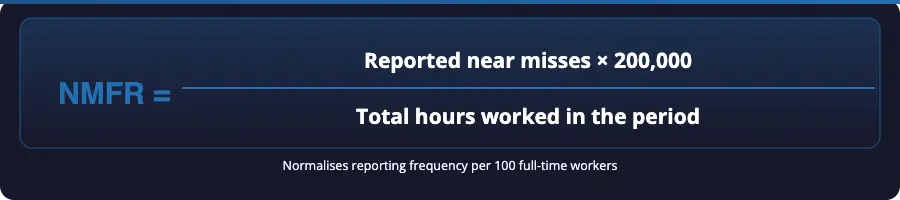
Normalising constant

The 200,000 constant represents 100 full-time workers working 40 hours per week for 50 weeks. Some multinational organisations use 1,000,000 hours; that is acceptable when the corporate standard is explicit, but comparisons must use one consistent base.

Worked example

If a site reported 18 near misses and worked 300,000 hours in a quarter, NMFR is (18 × 200,000) ÷ 300,000 = 12.0. This means 12 reported near misses per 100 full-time equivalent workers.

What to include

  • Events with potential to cause injury, ill health, property damage, environmental harm or operational disruption.
  • Events where no harm occurred, but a small change in timing, position or condition could have caused harm.
  • Near misses involving employees, temporary labour and contractors within operational control.
  • Reports captured through inspections, toolbox talks, mobile forms, audits, safety walks and field observations.

What NOT to include

  • Recordable injuries, medical treatment cases, restricted work, lost time or fatalities; these belong in TRIR, DART, LTIFR or equivalent metrics.
  • Generic hazards with no event where the organisation uses a separate hazard reporting metric.
  • Improvement suggestions with no credible risk exposure.
  • Duplicate reports of the same event unless the taxonomy defines separate sub-events.

Common pitfalls

  • Assuming that a low NMFR is automatically good performance.
  • Comparing sites without harmonising definitions, worked hours and contractor inclusion.
  • Measuring volume without measuring potential severity and corrective action closure.
  • Blaming or disciplining reporters, which destroys the trust required for the metric to work.

Interactive Calculator

NMFR calculator — Glartek
NMFR calculator
Calculate near miss frequency rate per 200,000 hours worked.
NMFR
Sector average
Formula: NMFR = (reported near misses × 200,000) ÷ hours worked

What is a good NMFR? Industry benchmarks

There is no official universal BLS benchmark for NMFR because BLS publishes employer-reported injury and illness rates, not internal near miss reporting rates. For NMFR, use initial reporting maturity ranges, then replace them with internal baselines by site, activity and contractor.

Sector Initial NMFR reference How to interpret it
Construction 12.0 per 200,000 h High project variability and contractor exposure; very low values may indicate under-reporting.
Manufacturing 9.0 per 200,000 h Useful starting point for production, maintenance and internal logistics environments.
Oil & Gas 11.0 per 200,000 h Pair with potential severity, critical barriers and SIF-potential classification.
Utilities 9.0 per 200,000 h Relevant for field crews, maintenance, substations, energy and essential services.
Health and social care 7.0 per 200,000 h Read alongside violence, biological exposure, ergonomics, slips and patient safety indicators.
Logistics 9.0 per 200,000 h Useful for vehicle movement, forklifts, loading docks, warehouses and transport.
Agriculture 7.0 per 200,000 h Adjust for seasonality, dispersed work and reporting maturity.
Private sector general 8.0 per 200,000 h Initial reference for organisations without enough history; replace with internal baseline after 6-12 months.

Method note: BLS, HSE, Eurostat/ESAW and local datasets are not directly comparable with NMFR because they measure different legal outcomes, denominators and scopes. Use them as context for lagging performance, not as a near miss target.

Sector HSE RIDDOR 2023/24 rate per 100,000 Use in NMFR analysis
Agriculture, forestry and fishing 559 Context only; not a near miss benchmark.
Construction 448 Context only; compare with reporting maturity and SIF potential.
Manufacturing 285 Context only; combine with machine, maintenance and process safety trends.
Transport and storage 329 Context only; combine with vehicle and material handling near misses.
Health and social work 394 Context only; combine with violence, biological exposure and slips data.
All industries 289 Context only; legal reporting thresholds differ from NMFR.
  • Very low is not automatically good; it may signal fear, friction or poor reporting visibility.
  • A temporary increase after launching a programme can be positive if investigation and action closure also improve.
  • High NMFR combined with high TRIR, high DART or overdue actions indicates real exposure and control weakness.

What counts as a near miss?

Recordable internally

  • An object falls near a worker without striking anyone.
  • A forklift nearly collides with a pedestrian in an aisle or loading dock.
  • A worker slips, regains balance and avoids a fall.
  • A tool, load or component is released but causes no harm.
  • Electrical, chemical, mechanical or stored-energy contact is narrowly avoided.
  • A reversing vehicle nearly strikes a person, structure or item of equipment.

Not recordable as a near miss

  • An injury, first aid case, medical treatment case, restricted work, lost time or fatality; classify it through the incident decision tree.
  • An unsafe condition without an event where the organisation has a separate hazard reporting category.
  • A behavioural observation without credible exposure to harm.
  • A hypothetical event that did not occur and has no operational evidence.

Critical boundary: near miss, first aid and medical treatment

The critical boundary is the outcome. If there was no injury, ill health or damage but there was credible potential, the event may be a near miss. If there was treatment, discomfort, exposure or damage, classify it through the applicable incident, first aid, medical treatment and legal reporting criteria.

For European organisations

European organisations should harmonise the corporate near miss taxonomy while keeping statutory reporting separate for each country. ISO 45001, EU-OSHA resources and ESAW-style classifications can help create a common internal language.

For UK organisations under RIDDOR

RIDDOR uses specific legal thresholds and should not be treated as the same dataset as NMFR. Keep RIDDOR reporting compliant, then use NMFR internally for earlier learning and operational prevention.

For UAE organisations

Operations in the UAE may need to align corporate EHSQ policy, MoHRE expectations, Emirate-level requirements and client or contractor reporting rules. NMFR is most useful when it sits above those local requirements as a consistent management KPI.

NMFR vs. Other Metrics

NMFR should sit beside lagging outcomes and execution metrics so teams can separate reporting culture, actual exposure and response capability.

Metric What it measures Main difference from NMFR
TRIR Total recordable incidents per 200,000 hours worked. TRIR measures harm that already occurred; NMFR measures no-harm events that could have caused harm.
DART Cases with days away, restricted work or transfer. DART focuses on work capacity consequences; NMFR focuses on upstream learning.
LTIFR Lost time injuries per million or 200,000 hours, depending on standard. LTIFR measures lost time after injury; NMFR measures signals before injury.
AFR Accident frequency rate, commonly used in UK/EU contexts. AFR usually covers actual accidents; NMFR covers near misses without harm.
Hazard Reporting Rate Unsafe conditions identified before an event happens. Hazard reports may involve no event; near misses involve an event or almost-event.
CAPA Closure Rate Corrective and preventive actions closed on time. CAPA measures response; NMFR measures the input signals that trigger learning.

The most important relationship is between NMFR and CAPA. A programme that collects near misses but leaves actions open creates fatigue. A programme that reports, investigates, prioritises and closes actions shows that the system learns.

NMFR as a Leading Indicator: Limitations and Complements

What NMFR does not tell you

NMFR does not prove that work is safer. It measures reporting frequency, which can rise because trust has improved or because exposure has increased.

The reporting paradox

For near misses, zero may be a weak signal. A complex operation with zero NMFR for months is unlikely to have no risk; it may simply have no reporting.

Quality over quantity

Weak, duplicated or vague reports inflate the metric without improving control. A useful report includes date, location, activity, description, potential severity, failed barriers, owner and action.

Essential complements

  • Potential severity of near misses.
  • Corrective action closure rate.
  • Average response time after report.
  • Completed safety observations and inspections.
  • TRIR, DART, LTIFR and environmental indicators where relevant.

How to Improve your NMFR

Short term: reduce friction and fear

  • Create a mobile form that takes less than 60 seconds and allows photo, location, activity and short description.
  • Communicate a non-punitive policy and reinforce that reporting a near miss is expected behaviour.
  • Acknowledge every report within 24 hours, even when the full investigation comes later.

Medium term: improve investigation and prioritisation

  • Classify potential severity and recurrence risk.
  • Use 5 Whys, barrier analysis or root cause analysis for higher-potential events.
  • Connect near misses to CAPA, owners, due dates and effectiveness checks.
  • Review trends by area, shift, contractor, asset and energy source.

Long term: build a learning culture

  • Turn near misses into toolbox talk topics, planned inspections and training.
  • Recognise teams that report well and close high-quality actions.
  • Create internal baselines by site and compare maturity, not only volume.
  • Connect NMFR to risk governance, audits and management review.

The Role of Technology in NMFR

Near misses were historically captured on paper, spreadsheets or late manual reports. That model loses evidence, slows investigation and makes it difficult to see patterns across sites, contractors and shifts.

With EHSQ software, workers can report on mobile, attach photos, identify location and activity, and trigger automated workflows for triage, potential severity, investigation and CAPA. Dashboards consolidate NMFR by site, sector, contractor and risk type.

Technology also makes it possible to correlate NMFR with TRIR, DART, inspections, audits, observations, permits to work and overdue actions. That turns near misses into operational intelligence rather than a reporting count.

See how Glartek automates NMFR calculation and real-time reporting

Request a Demo
Laptop and two smartphones displaying Glartek software dashboards and workflows for work orders and incident reports.

Frequently Asked Questions

What does NMFR mean?

NMFR means Near Miss Frequency Rate. It measures reported near misses against a normalised base of hours worked.

How do you calculate NMFR?

Divide reported near misses by total hours worked and multiply by 200,000. Some organisations use 1,000,000 hours, but the basis must remain consistent.

What is a good NMFR?

A good NMFR depends on reporting maturity and operational risk. Very low values may indicate under-reporting; high values require review of potential severity, trends and action closure.

Are NMFR and Near Miss Rate the same thing?

They are often used interchangeably. NMFR is more precise because it states the frequency basis and allows comparison between periods and sites of different sizes.

Does NMFR include subcontractors?

It should include subcontractors when they are within operational control or the EHSQ reporting scope. Their worked hours should also be included in the denominator.

How does NMFR affect insurance costs?

NMFR is not normally a direct premium input, but it can evidence risk management maturity. Insurers and clients value reporting, investigation, CAPA closure and loss prevention.

Can NMFR be 0?

Yes, mathematically. In a meaningful-risk operation, however, zero should trigger management questions about reporting confidence and process friction.

What is the difference between NMFR and DART?

DART measures injury and illness cases with days away, restricted work or transfer. NMFR measures no-harm near misses before those outcomes occur.

Is NMFR legally required?

Usually not as a standardised rate. It may still be required by corporate systems, client contracts, audits, ISO 45001-aligned programmes or contractor management rules.

How is NMFR used in tenders?

Clients use NMFR to assess preventive culture, especially when it is shown with TRIR, LTIFR, audits, training, contractor safety and corrective action closure.

Request your demo

It's time to elevate Safety, Quality, and Performance in your operations

Start your EHSQ Connected Worker journey with Glartek and become a leader in your industry.

Schedule Demo
mockup glartek

Subscribe now to get our latest insights and updates 🚀

Discover the power of the only AI-Native EHSQ solution built for the frontline

Thank you! Your submission has been received!
Oops! Something went wrong while submitting the form.