
SIF (Serious Injuries and Fatalities) are workplace events that result in death, amputation, loss of sight, neurological injury or any permanent disability. The concept also includes SIF precursors (pSIF): situations where critical energy was released or barriers failed but no one was harmed, events with the same severity potential regardless of the outcome.
SIF (Serious Injuries and Fatalities) is the set of workplace events that result in death or permanently disabling injury, such as amputations, loss of sight, neurological injuries and irreversible occupational diseases. The acronym, which originated in the US, has become the global benchmark for the highest-severity classification in EHS management, replacing approaches based only on overall accident frequency.
The National Safety Council (NSC) and the Campbell Institute, primary references for the SIF framework, define the concept at two complementary levels: confirmed SIF (a fatal or permanently disabling outcome) and SIF precursor (pSIF), an event with uncontrolled critical energy and the failure of one or more control barriers, regardless of whether anyone was harmed. The distinction is operational: a confirmed SIF measures the outcome, while a pSIF measures exposure to risk before harm occurs.
In the US, OSHA classes hospitalisations, amputations and loss of an eye as “severe injury” (29 CFR 1904.39), with mandatory immediate reporting to the regulator. In January 2026 ASTM issued the first consensus-standard definition for the sector, ASTM E2920-26. In Europe, the EU Framework Directive 89/391/EEC and ISO 45001:2018 require employers to prioritize risks by severity potential, the same logic that underpins the SIF framework.
The SIF framework shifts the focus of safety management from record volume to severity potential. In practice, an organisation can have a low TRIR, indicating few minor accidents, and still be highly exposed to fatalities if SIF precursors are not monitored. For the EHS manager, working with SIF means directing prevention resources to where the worst outcome is death or irreversible injury, not where the frequency of minor events is highest. This reshapes the agenda for inspections, audits, training and risk assessments.
Fatalities and permanent injuries generate legal liabilities, regulatory investigations, operational shutdowns, negative media coverage and a direct impact on insurance costs. An NSC analysis estimates the average cost of a fatal workplace accident, including lost productivity, medical expenses and administrative costs, exceeds USD 1.3 million. For the C-suite, the SIF framework is a governance mechanism that links safety performance to measurable financial and reputational risk.
Most serious injuries affect experienced workers doing routine tasks, not newcomers in unusual situations. Research from the IOGP and other bodies shows that chronic exposure to critical-energy tasks without periodic review of barriers is the leading risk factor. For HR and operational leaders, SIF redefines what counts as a safe situation: not the absence of minor accidents, but the integrity of the barriers that protect against the worst possible outcome.
SIF is often confused with neighbouring terms such as hazard, near miss and recordable incident. The most critical distinction is between confirmed SIF and SIF precursor, because it determines whether the organisation is managing consequences (lagging) or exposure (leading).
%20(1).webp)
The most strategic distinction is between a SIF precursor and a conventional near miss. A near miss may involve only the probability of minor harm, such as a trip without injury. A SIF precursor necessarily involves critical energy (electrical, mechanical, chemical, kinetic) with an actual control failure, conditions that, in a slightly different scenario, would have caused death. The pSIF to confirmed-SIF ratio is typically 5 to 10 to 1, which makes monitoring pSIFs a powerful leading indicator.
For decades industrial safety was guided by Heinrich's triangle (1931): for every fatal accident there would be 29 minor injuries and 300 no-injury incidents. The resulting logic was simple: reduce minor incidents and fatalities will fall automatically.
.webp)
The problem is that empirical evidence does not support this correlation for high-severity events. The researcher Fred Manuele documented, in publications from 2002 to 2011 in Professional Safety (ASSP), that companies with a below-average TRIR, indicating good performance on minor incidents, kept recording fatalities at a frequency similar to companies with a high TRIR. The BP Texas City case (2005) is the most cited example: the refinery had significantly reduced lost-time accidents in the years before the explosion that killed 15 workers and injured 180, while critical-energy process risks remained inadequately controlled.
The SIF approach breaks with this logic by proposing that fatalities and serious injuries have structurally different causes from minor injuries. SIFs are linked to critical-energy tasks (high voltage, confined spaces, work at height, reactive chemicals, large equipment), to physical barrier failures and to management-system failures, not to isolated careless behaviours. This means the path to zero SIF runs through identifying and controlling hazardous energy, not merely counting and recording minor incidents.
On continuous production lines, the most frequent SIFs involve entanglement in moving machine parts, especially when LOTO (lockout/tagout) procedures are not followed or equipment is run in maintenance mode without energy isolation. Finger and hand amputations are recurrent serious injuries; electrocutions during work on live electrical panels represent the most lethal profile. Typical SIF precursors include unreported removed guards and incomplete isolations tolerated as informal practice.
High-voltage work, confined spaces (tanks, ducts, underground chambers) and work at height are the three categories that account for most SIFs in the sector. Utilities across Europe and the UAE report that a significant share of fatal accidents occurs in routine activities carried out by contractor teams, where the permit-to-work chain shows failures. SIF precursor monitoring in this sector includes tracking open PTWs (permits to work), PPE found faulty in the field and confined-space atmosphere readings that fall outside specification.
The chemical industry combines chemical energy (exothermic reactions, flammable products, acute toxins) with elevated pressure and temperature, conditions that make any barrier failure a potential SIF. Toxic gas releases such as ammonia, chlorine and hydrogen sulphide are the events with the highest mass-fatality risk. The SIF framework is applied here alongside Bow-Tie and barrier analysis, identifying which lines of defence have the lowest operational reliability for each critical scenario.
Large equipment in continuous motion (rolls, presses, wood chippers), high temperatures in pulping processes and process chemicals such as chlorine dioxide and sodium hydroxide define the SIF exposure profile. Historical fatalities in the sector include entanglement in paper-machine rolls and severe burns from contact with hot white liquor. The most monitored SIF precursors are emergency-stop sensor failures and interventions on equipment that has not fully decelerated.
The SIF profile in pharmaceuticals combines process risks (reactors with flammable solvents, exposure to high-potency substances) with ergonomic and load-handling risks in internal logistics. Although the sector has historically low TRIR, chronic exposure to potentially carcinogenic substances and accidents with encapsulation and compression machinery represent an underestimated serious-injury risk. SIF prevention programmes here focus on barrier analysis in chemical reactions and on occupational exposure control as a SIF indicator.
Industrial cutters, mixers and thermal process equipment (pasteurisers, autoclaves) are the most common SIF sources in the sector. Amputations on meat-processing and vegetable-cutting equipment are among the serious injuries most reported to OSHA in this industry. Slips and falls on wet surfaces, although usually associated with minor injuries, can result in a SIF when they occur near operating equipment or on elevated platforms. The most recurrent SIF precursor is the removal of guard rails to ease cleaning without shutting the equipment down.
Under-reporting of serious accidents is documented globally. Pressure for a low TRIR creates perverse incentives to classify serious injuries as minor, to treat fatalities as non-work-related personal accidents, or not to report events to the regulator. Across many jurisdictions, a considerable share of workplace accidents is not reported, especially in highly informal sectors and in the supplier chains of large industries.
The biggest operational challenge is not identifying a confirmed SIF, since a fatality or amputation is undeniable. The challenge is classifying SIF precursors systematically. Identifying a pSIF requires technical judgement: did the event involve critical energy? Which barrier failed? What would the worst case have been? Without documented criteria and specific training, workers and supervisors tend to report only the outcome and not the exposure, missing the most valuable prevention window.
There is a perception that SIFs occur mainly in unusual tasks or extraordinary maintenance. The data contradict this: analyses by the IOGP and others show that a significant proportion of fatalities occur in routine activities, such as driving company vehicles, operating forklifts and carrying out scheduled preventive maintenance. This illusion leads organisations to concentrate risk analysis on rare tasks and underestimate exposure in daily operations.
For the SIF framework to work as a predictive indicator, SIF precursors must be captured in the field in real time, with information on the type of energy, the barrier that failed and the location. In organizations that still rely on paper forms or disconnected EHS systems, this capture does not happen consistently. The result is that analysis is limited to confirmed SIFs, which are, by definition, already irreversible events.
The effectiveness of a SIF precursor programme depends directly on the willingness of field workers to report consequence-free events involving critical energy. If the organizational culture penalises reporting, or if the reporting process is bureaucratic, the volume of reported pSIFs drops sharply, not because exposure fell, but because visibility was suppressed. Digital tools accessible on mobile devices and positive-recognition programmes are critical factors in sustaining a reporting culture.
An effective SIF prevention programme is not a one-off project but a management system that integrates classification criteria, data capture, barrier analysis and a continuous improvement cycle.
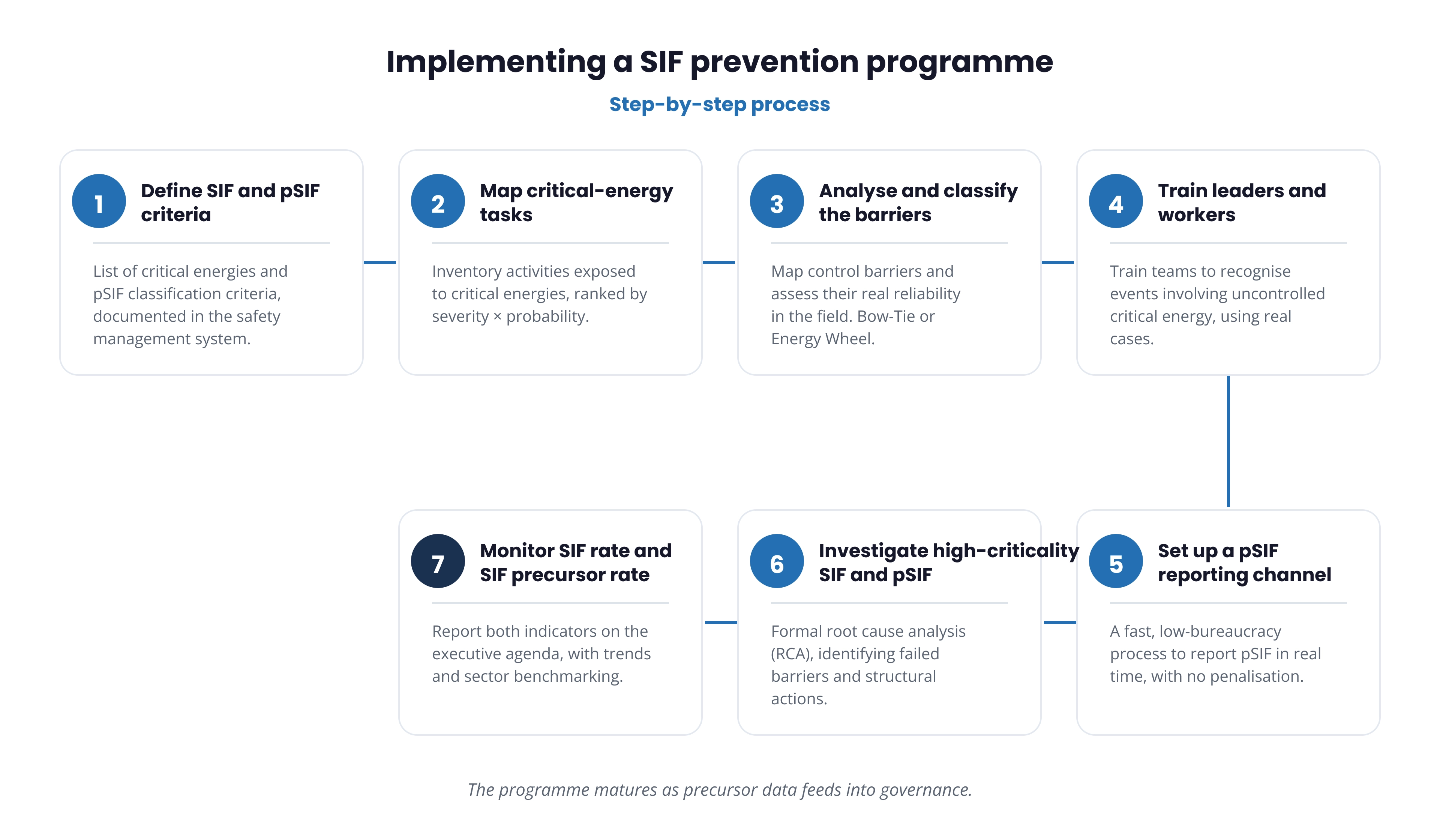
1. Define SIF and SIF precursor criteria. Establish the list of critical energies relevant to the operation (electrical, mechanical, chemical, kinetic, thermal, gravitational potential) and the pSIF classification criteria. Document them within the risk assessment as an extension of critical-risk analysis.
2. Map critical-energy tasks. Inventory all routine and non-routine activities that involve exposure to critical energies. Prioritise by the product of severity potential × probability of barrier failure, not only by accident history.
3. Analyze and classify existing barriers. For each critical task, map the control barriers (engineering, administrative, PPE) and assess their real reliability in the field, not only on paper. Use Bow-Tie or Energy Wheel analysis where applicable.
4. Train leaders and workers to identify pSIFs. Train supervisors and operators to recognize events with uncontrolled critical energy, regardless of the outcome. Use real examples from the operation itself and documented sector cases.
5. Deploy a SIF precursor reporting channel. Create an accessible, fast and non-bureaucratic reporting process so field workers can report pSIFs in real time. Ensure reporting is encouraged and that there is no penalty for reporting consequence-free events.
6. Investigate every confirmed SIF and every high-criticality pSIF. Every fatality or serious injury requires formal root cause analysis (RCA), with identification of the barriers that failed and structural corrective actions. High-criticality SIF precursors deserve the same analytical rigour.
7. Monitor the SIF rate and the SIF precursor rate as governance KPIs. Report both indicators on the executive agenda, with trend, sector benchmark and breakdown by area, energy type and task category. Use the data to adjust investment priorities in engineering controls.
Neither European nor UAE legislation uses the SIF acronym formally, but the logic of prioritizing by severity potential is embedded across the regulatory framework.
The EU Framework Directive 89/391/EEC and ISO 45001:2018 together require employers to assess risks and put preventive measures in place proportionate to severity. Organisations that structure their risk assessment with the SIF approach, mapping critical energies and assessing barrier reliability, meet the regulatory requirement and align with international best practice. In the UAE, MoHRE and the emirate-level OSH frameworks (OSHAD-SF in Abu Dhabi, Dubai Municipality OSH) require serious injuries and fatalities to be reported and investigated.
SIF is, by definition, a lagging indicator: it records what has already happened and cannot be undone. Its power as a management tool grows when combined with the SIF precursor rate, a leading indicator that measures the frequency of exposure to SIF-potential conditions before harm occurs.
The SIF rate formula is: (number of confirmed SIFs ÷ hours worked) × 200,000. The SIF precursor rate follows the same structure, replacing the numerator with the number of pSIFs classified in the period. A consistently low pSIF to SIF ratio, below 5 to 1, may indicate under-reporting of precursors rather than an absence of exposure.
The relationship between SIF and other indicators such as TRIR and LTIFR is limited: a strong correlation between low TRIR and low SIF is not guaranteed by the empirical evidence. Organisations with excellent TRIR can have a high SIF rate if critical-energy controls are insufficient. For this reason, monitoring SIF as a standalone metric is recommended, not as a subset of TRIR.
To understand how TRIR is calculated and how it relates to SIF and other lagging indicators, refer to the full page: TRIR — Total Recordable Incident Rate
For decades SIF management relied on paper forms, local spreadsheets and monthly reports consolidated by the safety team. In that model, visibility into SIF precursors was almost nil: an event was reported only if it caused visible harm, and analysis arrived weeks late, while exposure to the risk continued uncontrolled.
EHSQ software your whole team actually uses, from the frontline to the management, changes this cycle. With digital forms accessible on mobile devices, field workers can record SIF precursors at the moment and place they occur, with a photo, location and guided classification. The data reaches the manager in real time, allowing immediate intervention before the exposure recurs. Integrations with permit-to-work systems (PTW) and digital LOTO ensure that critical-energy activities have full traceability across the authorization cycle.
Aggregated analysis of SIF precursors by energy type, area, team and shift reveals systemic patterns that do not appear in the individual analysis of each occurrence. With leading indicators monitored in real time, EHS leadership stops reacting to confirmed SIFs and starts acting preventively on the barriers that protect against them, turning SIF management from reactive to predictive.
.webp)
SIF stands for Serious Injuries and Fatalities. It is the highest-severity category in occupational health and safety management, covering events that result in death, amputation, loss of sight, neurological injury or any permanent disability. The concept is used by reference organizations such as the NSC (National Safety Council), the Campbell Institute and OSHA, and since January 2026 it has been formalized in the ASTM E2920-26 standard.
A confirmed SIF is an event that has already resulted in death or permanent injury, a lagging indicator. A SIF precursor (pSIF) is an event in which critical energy was released or a control barrier failed, but no one was harmed at that moment, a leading indicator. The importance of the pSIF is precisely this: it occurs 5 to 10 times more often than a confirmed SIF and represents the prevention window before irreversible harm.
ISO 45001:2018 does not use the SIF acronym directly, but Clause 6.1 (actions to address risks and opportunities) and Clause 10.2 (incident, nonconformity and corrective action) cover the requirements for identifying critical risks and investigating events with serious potential. Organisations certified to ISO 45001 that embed the SIF framework in their management system demonstrate maturity above the normative minimum, aligning leading indicators (pSIF) with the standard's continuous improvement logic.
TRIR (Total Recordable Incident Rate) measures the frequency of all recordable incidents, regardless of severity. An organisation can successfully reduce minor accidents and still retain significant exposure to fatalities if critical-energy activities are not treated with specific rigour. Fred Manuele documented this dissociation in multiple studies, and the BP Texas City case (2005) is the most cited example: a steadily falling TRIR in the years before the explosion that killed 15 workers.
An event is classified as a SIF precursor when it meets two criteria at once: first, it involves critical energy with the potential to cause death or permanent injury (high-voltage electrical energy, mechanical energy from large equipment, toxic or flammable chemicals, work at height, confined spaces, among others); second, at least one control barrier failed or was absent, even if no worker was harmed. The key is to assess the worst-case scenario, not the actual outcome.
The energy types with the highest documented frequency of SIF and pSIF include: electrical energy (electrocution, arc flash), mechanical energy from large equipment (entanglement, crushing), kinetic energy in vehicles and cranes (being struck, collision), gravitational energy in work at height (falls), chemical energy (exposure to toxic gases, exothermic reactions, explosions) and pressure energy in hydraulic and pneumatic systems (sudden release). Each industrial sector has a predominant critical-energy profile.
In the UK, RIDDOR 2013 requires deaths, specified injuries and dangerous occurrences to be reported to the HSE. Across the EU, reporting obligations follow national transpositions of the Framework Directive. In the UAE, serious injuries and fatalities must be reported to MoHRE and to the applicable emirate OSH authority. Failure to report is an offence under the relevant framework, and dangerous occurrences frequently map to the concept of a SIF precursor.
The main process metric is the SIF precursor rate. If the volume of reported pSIFs grows in the first months after the programme is launched, that indicates the reporting culture is working, not that exposure worsened. Over time, the programme should show a reduction in the confirmed SIF rate and, ideally, an improvement in barrier quality documented in field audits. Companion indicators include the average time to close CAPAs originating from pSIFs and the percentage of critical tasks with an up-to-date barrier analysis.
Not entirely, but it does correct its main flaw. The Heinrich triangle remains useful for illustrating that minor incidents are far more frequent than serious ones. What the SIF framework rejects is the assumption that reducing minor incidents automatically reduces fatalities. Empirical evidence shows that SIFs have different causes, linked to critical energy and barrier failures, so they require dedicated management rather than being treated as a by-product of overall accident reduction.
EHSQ software your whole team actually uses, from the frontline to the management, lets field workers report SIF precursors in real time on a mobile device, with classification guided by energy type and the barrier involved. The system aggregates the data by area, team, risk type and frequency, generating the analytical visibility that paper forms cannot. Automatic alerts for managers, CAPA tracking and integration with digital permit-to-work close the prevention loop, turning pSIF reporting from an administrative task into a real-time risk-management tool. This is the role of platforms such as Glartek.
Request your demo
Start your EHSQ software journey with Glartek and become a leader in your industry.
Schedule Demo.webp)
Discover the power of the only AI-Native EHSQ software built for the frontline

.webp)