Behaviour-based safety (BBS), also called behavioural safety, is an occupational health and safety approach that observes at-risk and safe behaviours in the workplace, measures the proportion of safe behaviours and uses structured peer feedback to reinforce safe practices and reduce exposure to incidents.
Behaviour-based safety (BBS), also known as behavioural safety, is a prevention approach built on an observable premise: most incidents involve, at some point in the causal chain, a human behaviour that can be observed, measured and influenced. Rather than waiting for the incident, BBS observes work as it happens, distinguishes safe behaviours from at-risk behaviours and uses immediate peer feedback to reinforce safe practices.
Its theoretical basis comes from applied behaviour analysis and the ABC model: antecedent, behaviour, consequence. Attention falls on safety-critical behaviours, defined from the analysis of previous incidents, and on the consequences that sustain them. BBS treats observation and feedback as a learning tool, not as punitive enforcement.
In Europe, BBS is not mandated as such, but it operationalises requirements that already exist. ISO 45001:2018 and EU Framework Directive 89/391/EEC both require worker participation, consultation and the assessment of risks at their source. Behavioural observation is one of the most concrete ways to meet the participation requirement and to feed field evidence back into the risk assessment. In the UAE, frameworks such as OSHAD-SF and MoHRE guidance similarly expect worker engagement in hazard identification.
BBS produces safety data before the incident occurs. While the recordable incident rate only moves after harm, the proportion of safe behaviours observed gives a continuous, actionable signal about where exposure is rising. That turns opinion-led safety meetings into conversations anchored in field data.
A serious incident costs far more than prevention. According to the National Safety Council, a lost-time injury costs on average around USD 48,000 and a fatality around USD 1.54 million once direct and indirect costs are counted. A consistent behavioural observation programme lowers the probability of these events by acting on precursors long before they turn into losses.
Done well, BBS engages the operator as the owner of their own safety rather than the target of an audit. Peer-to-peer observation strengthens trust and communication within the team, and the data helps plan training and adjust procedures that, in practice, push people towards the unsafe shortcut.
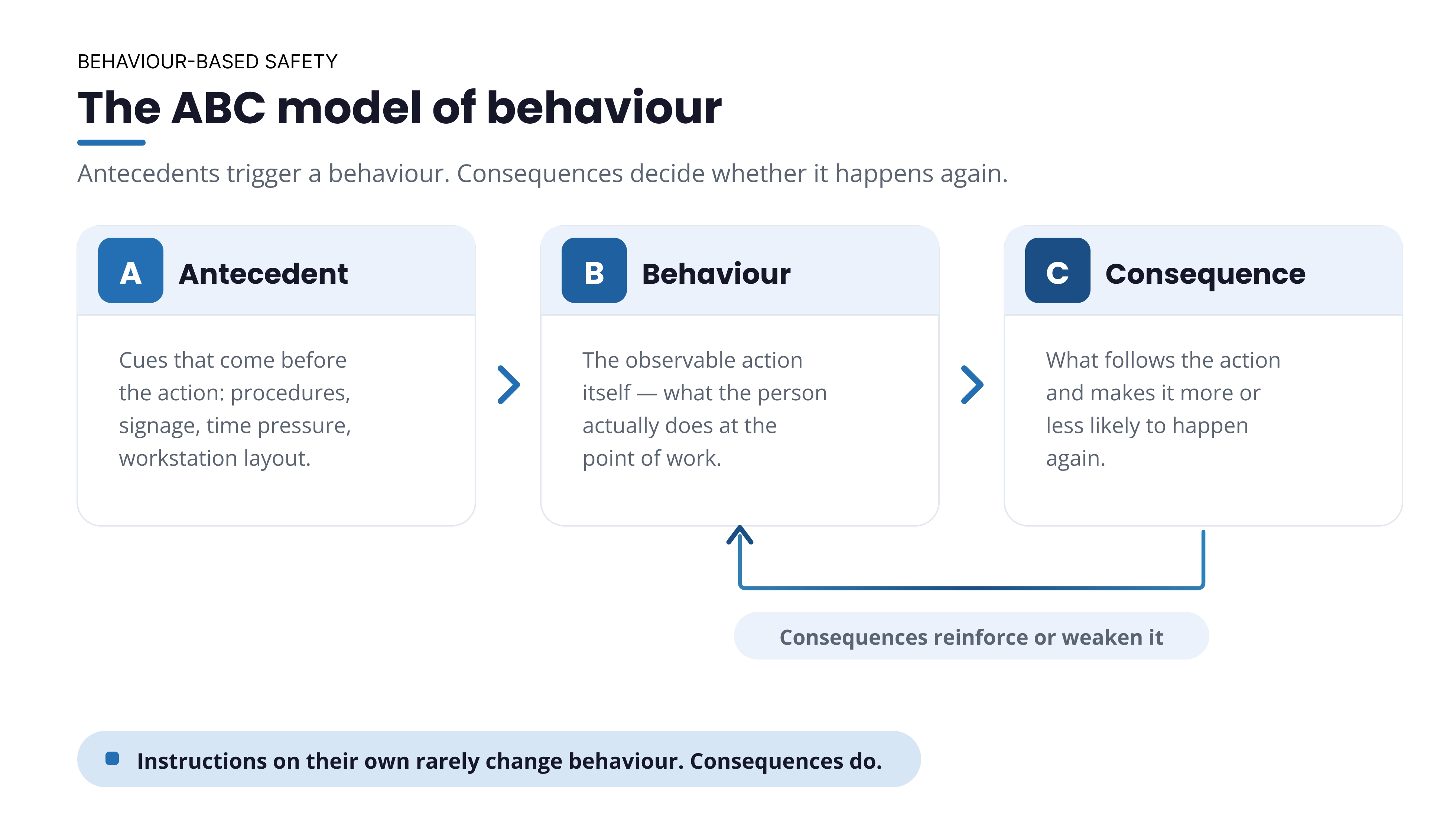
Behaviour does not happen in a vacuum. The ABC model explains it in three elements: the antecedent that triggers the behaviour, the behaviour itself and the consequence that follows. Antecedents start a behaviour; consequences decide whether it recurs. A safety rule pinned to the wall is a weak antecedent; the immediate relief of finishing the task faster without protective equipment is a strong consequence. That is why instructions on their own rarely change behaviour for long.
BBS also inherits the logic of the safety triangle. In 1931, Herbert Heinrich proposed that for every serious injury there are many minor incidents and an even larger base of at-risk behaviours. The modern reading corrects two excesses of that theory. First, the attribution of roughly 88% of accidents to people’s “unsafe acts” is now contested, because it shifts attention away from conditions and management failures. Second, the fixed ratio between minor occurrences and fatalities does not hold: reducing cuts and slips does not automatically reduce serious and fatal events, which often have different precursors.
A mature programme follows a short, repeatable cycle. E. Scott Geller, one of the field’s central authors, summed it up in the DO IT process: Define the target behaviours, Observe, Intervene with feedback and Test the effect of the intervention. The cycle repeats, refining the list of critical behaviours as data arrives.
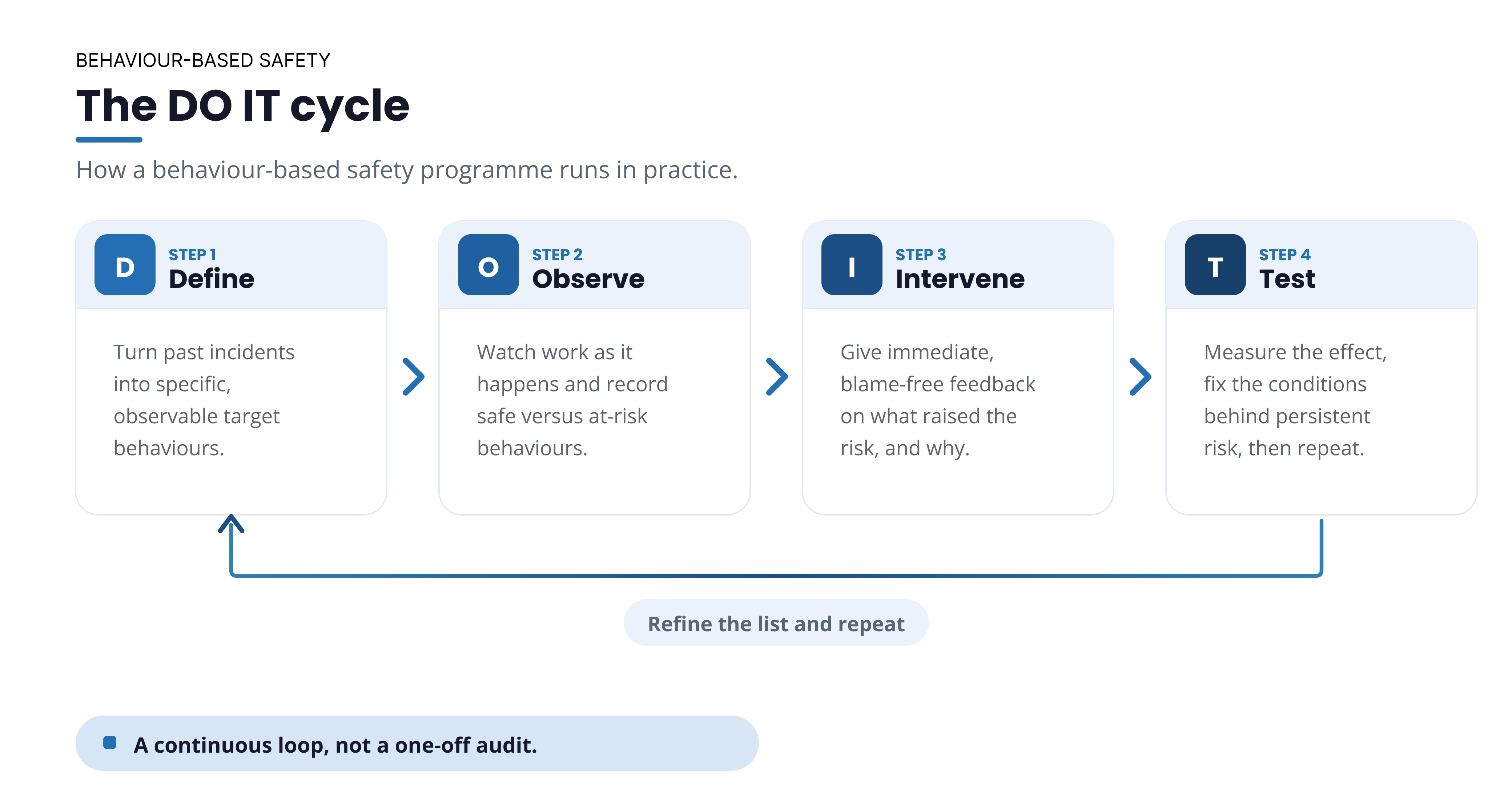
The team analyses previous incidents and near misses and translates the causes into specific, observable behaviours. “Working safely” is not observable; “keeping hands out of the pinch point during adjustment” is. That list becomes the observation checklist.
Trained observers, often peers, record what they see over a short period and classify each behaviour as safe or at-risk. The goal is not to catch the person out but to measure the proportion of safe behaviours and understand what drives the at-risk behaviour.
Right after the observation, the observer talks to the worker: acknowledges what was done safely and discusses, without blame, what raised the risk and why. The focus on consequence and antecedent is what separates BBS from a simple reprimand.
Aggregated data shows trends by area, shift and behaviour type. When an at-risk behaviour persists despite feedback, the signal points to a condition or procedure to fix, not an individual failing. The action plan is updated and the cycle starts again.
BBS is often confused with safety culture and, more recently, set against human and organisational performance approaches. All three look at the human factor, but from different angles, and confusing them explains much of the poor implementation seen in the field.
The most current reading does not treat BBS as a rival to human and organisational performance (HOP) or to the Safety-II perspective. Behavioural observation remains useful as a source of field data, provided the question shifts from “why did the person err?” to “what about the work made the at-risk behaviour the easier option?”. That shift preserves the value of BBS and neutralises its main pitfall.
On an assembly line, behavioural observations often reveal that operators remove machine guards to clear parts faster. The aggregated data shows the behaviour clustering on a specific shift, which points to production pressure, and leads to a review of the cycle and the guard design rather than a reprimand for the operator.
In electrical grid fieldwork, BBS tracks behaviours tied to the permit to work and to energy lockout/tagout. Observing the real energising and de-energising sequence exposes shortcuts that procedures alone do not detect, especially in dispersed teams without direct supervision.
In chemical plants, correct use of respiratory protection and adherence to confined-space procedures are critical behaviours. Structured observation helps separate equipment-availability failures from adherence failures, guiding different actions for each cause.
In paper and pulp mills, interaction with rollers, presses and steam produces critical behaviours around body positioning and energy isolation. Observation programmes in these zones reduce exposure to crush and burn points by exposing risk patterns by workstation.
In pharmaceutical production, behaviours around containment, gowning and handling of active ingredients affect safety and quality at once. Behavioural observation intersects here with contamination control, which reinforces the value of handling safety and quality in the same flow.
In food and beverage plants, sanitation behaviours, protection in cold zones and operation of cutting equipment concentrate much of the risk. Behavioural observations feed both safety indicators and food-safety prerequisites in a single improvement cycle.
BBS earned a poor reputation where it was applied badly, and the criticisms are legitimate. The central pitfall is reducing safety to the worker’s behaviour and ignoring the conditions, equipment and management decisions that shape that behaviour. When that happens, BBS becomes a blame mechanism.
The second pitfall is underreporting. If observation feeds targets, rankings or punishment, people stop reporting near misses and minor injuries to protect the number. The programme then shows statistical improvement while real risk stays intact or grows. Unions and researchers have documented this effect in programmes that tie rewards to low incident rates.
The third pitfall is confusing observation with surveillance. Without trust, observation becomes monitoring and destroys the communication that makes it useful. And there is a conceptual limit: BBS acts on frequent, visible behaviours, but many serious and fatal events have rare precursors that routine observation does not capture. For that reason BBS does not replace risk assessment, the hierarchy of controls or incident investigation.
A sound implementation starts by flipping the question. Instead of asking who failed, it asks what about the work made the at-risk behaviour the easier choice. That stance keeps the focus on the system and preserves the trust that observation depends on.
Separating observation data from any disciplinary process or individual target is the condition for the data to be honest. Observation should be voluntary, peer-to-peer, with immediate feedback and no punitive named record. When an at-risk behaviour persists, the correct response is to fix the condition or procedure that causes it, not to repeat the feedback to the same person.
BBS works best as a layer within an ISO 45001 management system, not as a standalone programme. The standard requires worker participation and consultation, and behavioural observation is one of the most concrete ways to deliver it. Linking observations to the risk register, the action plan and the investigation cycle closes the loop between what is observed and what actually changes in the work.
BBS is one of the richest sources of leading indicators. The central metric of a programme is the proportion of safe behaviours observed, often called percent safe, calculated in plain terms as follows:
Percent safe = (safe observations ÷ total observations) × 100
Observation frequency per period and observer participation rate complete the picture. These indicators anticipate the outcome that lagging rates only reveal after harm, which is what makes predictive management possible. To understand how leading indicators work alongside lagging ones and support the reading of safety over time, refer to the full page: [LEADING VS. LAGGING INDICATORS — Proactive and Reactive Safety Indicators].
For decades, behavioural observation lived on paper cards and spreadsheets. The method worked, but the data died in a drawer: slow to consolidate, late to reach the manager and rarely cross-referenced with incidents, near misses and corrective actions. The observation effort existed; the payoff in decisions was small.
EHSQ software (Environment, Health, Safety and Quality) digitises observation at the point of execution. The observer records the behaviour on a mobile device, even without connectivity, with later synchronisation, and the data enters the same system where risks, investigations and the CAPA cycle already live. The manager no longer waits for manual consolidation and sees trends by area and shift in real time.
With structured behavioural data linked to the rest of the EHS records, artificial intelligence helps correlate at-risk behaviours with the precursors of serious events and flag where exposure is rising before the incident. The value is not in observing more, but in turning every observation into a leading indicator that guides action.

It is an occupational health and safety approach that observes safe and at-risk behaviours at work, measures the proportion of safe behaviours and uses structured peer feedback to reinforce safe practices and reduce exposure to incidents.
BBS stands for behaviour-based safety, also called behavioural safety. It focuses on observable behaviours rather than opinions or after-the-fact reports.
It is the antecedent-behaviour-consequence model. The antecedent triggers the behaviour and the consequence decides whether it recurs. BBS acts on both to make the safe behaviour the easier option.
BBS focuses on observable behaviours at the workstation; safety culture focuses on shared values, norms and leadership. BBS is a concrete practice that can strengthen culture, but it is not the same thing.
It should not. Applied well, BBS asks what about the work made the at-risk behaviour easier, and treats a persistent behaviour as a signal of a condition or procedure to fix, not an individual failing.
Not as such. ISO 45001 and EU Directive 89/391/EEC require worker participation and risk assessment, and behavioural observation is one way to meet those requirements, but a specific BBS programme is not mandated.
Reducing safety to individual behaviour, ignoring conditions and management accountability, and driving underreporting when observation is tied to targets or punishment.
By the proportion of safe behaviours observed (percent safe), observation frequency and participation rate. These are leading indicators that anticipate the outcome of lagging rates.
No. BBS acts on frequent, visible behaviours, but serious events have rare precursors. It complements, and never replaces, risk assessment, the hierarchy of controls and incident investigation.
EHSQ software such as Glartek digitises observation at the point of execution, works offline and links behavioural data to risks, investigations and CAPA, turning every observation into a real-time leading indicator.
Request your demo
Start your EHSQ software journey with Glartek and become a leader in your industry.
Schedule Demo
Discover the power of the only AI-Native EHSQ software built for the frontline