EU Directive 89/391/EEC: complete guide to the OSH Framework Directive
EU Directive 89/391/EEC (the "OSH Framework Directive") is the foundational European Union legislative act on occupational safety and health. Adopted on 12 June 1989, it establishes the general principles for the prevention of occupational risks, the protection of worker safety and health, the elimination of risk factors, and the obligation for employers to evaluate and manage workplace hazards. It applies to all sectors of activity, both public and private, across all EU and EEA Member States.
EU Directive 89/391/EEC, known as the OSH Framework Directive, is the overarching European Union legislative instrument that defines the fundamental obligations of employers and rights of workers regarding occupational safety and health. It was adopted by the Council of the European Communities on 12 June 1989 and forms the legal basis for all subsequent EU occupational safety and health legislation.
The directive applies to all sectors of activity, both public and private, including industrial, agricultural, commercial, administrative, service, educational, cultural and leisure activities. Only specific public service activities where characteristics inherently conflict with it (armed forces, police, certain civil protection) are excluded. It covers every employer and worker in the EU and EEA, regardless of size.
Before 1989, European OSH legislation was fragmented, sector-specific, and focused on technical safety rather than systematic prevention. The Framework Directive introduced a paradigm shift: from reactive compensation to proactive prevention, from prescriptive technical rules to a risk-based management system, responding to Article 118a of the EEC Treaty.
The directive functions as a "framework" because it sets general principles elaborated through over 24 "daughter directives" addressing specific risks. National legislation in each Member State transposes both framework and individual directives. In the UK (pre-Brexit), transposed via Management of Health and Safety at Work Regulations 1999. In the UAE, principles are referenced by multinational companies and the OSHAD System Framework.
Why does the Framework Directive matter?
For the EHS manager
The directive is the legal anchor for every risk assessment, safe system of work, and preventive measure within an EU operation. It defines the employer's non-delegable duty and establishes that protective measures cannot transfer cost to workers. Understanding its articles is the legal foundation of every EHSQ programme.
For the C-suite and CFO
Non-compliance triggers enforcement action: prohibition notices, fines, and criminal prosecution of directors. The prevention hierarchy is the most cost-effective approach to reducing injury costs, absence, and liability (ISSA/DGUV: €2.20 return per €1 invested in OSH).
For compliance and legal
As a framework directive, 89/391/EEC creates minimum requirements. Member States may introduce more stringent measures. Compliance teams must track base obligations plus national additions, and intersections with working time, pregnant workers, young workers, and REACH.
Structure of the directive: section and article map
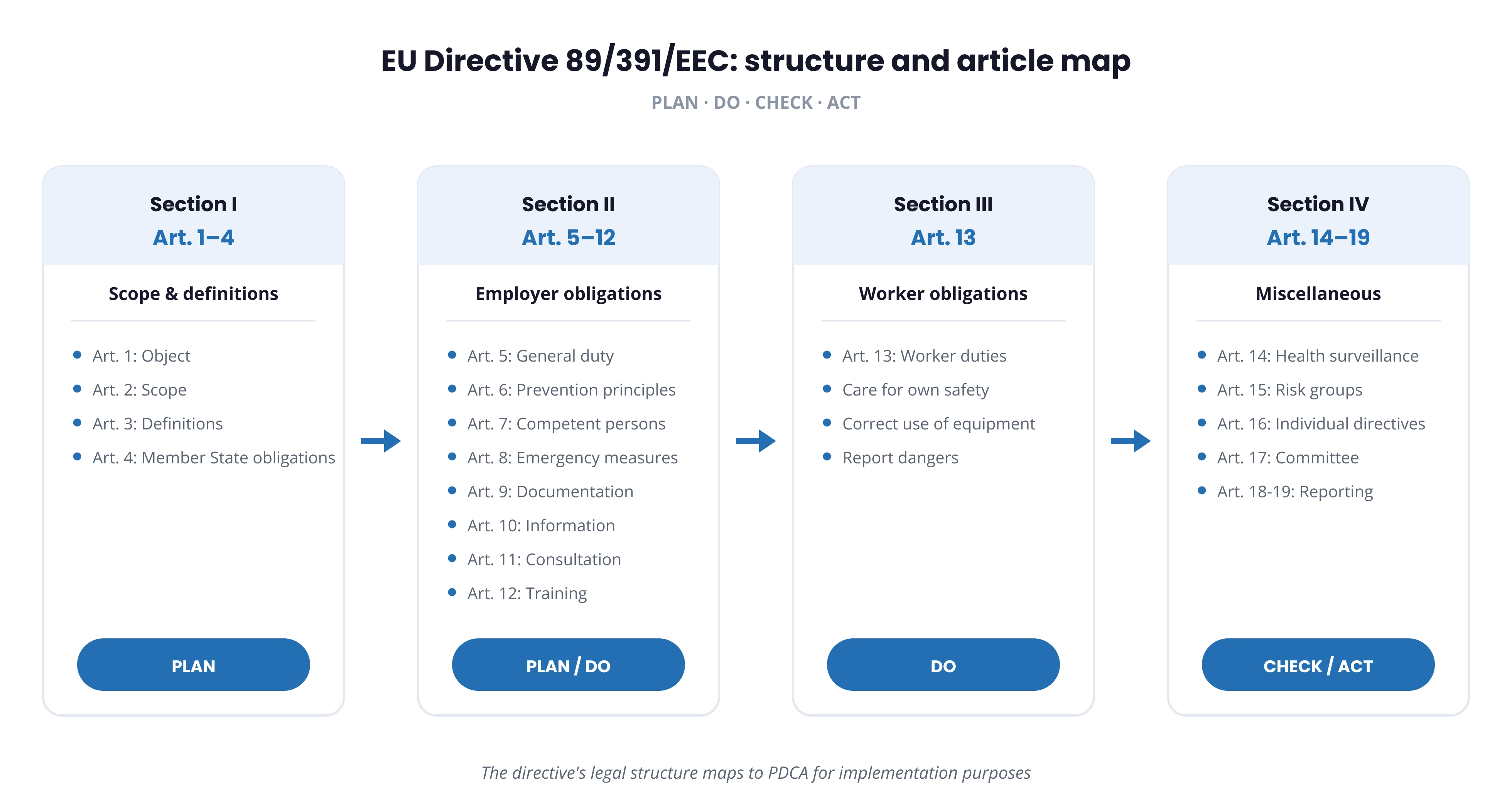
The directive is organised in four sections containing 19 articles. Unlike ISO standards following PDCA, it follows a legal structure: scope, employer obligations, worker obligations, and miscellaneous provisions. Its content maps naturally to PDCA for implementation.
The directive functions as a coherent legal system. Section II creates a cascade: the general duty (Art. 5) is operationalised through prevention principles (Art. 6), delivered through protective services (Art. 7), information (Art. 10), consultation (Art. 11), and training (Art. 12).
Practical guide: article by article
This guide translates the directive's legal language into operational requirements, with evidence expectations and compliance failures identified by labour inspectorates across EU Member States.
Article 5 — General employer duty
The employer has a comprehensive, non-delegable duty to ensure safety and health in every aspect related to work. External services do not discharge responsibility.
Key requirement
Evidence expected
Common compliance gap
Duty to ensure safety and health in every aspect of work
Documented OSH policy signed by top management; evidence of resource allocation (budget, personnel, time)
Treating OSH as delegated entirely to a single safety officer without management accountability
Non-delegable responsibility even when using external services
Contracts with competent services specifying advisory role; management review records
Assuming external consultants absorb the legal duty
Workers' obligations do not affect employer's responsibility
Evidence that worker non-compliance triggers corrective action, not blame-shifting
Using worker behaviour as defence for systemic organisational failures
Article 6 — General obligations (prevention principles)
The directive's operational core: employers must take measures for safety including prevention, information, training, and organisation. It establishes the nine principles and mandates risk assessment and coherent planning.
Key requirement
Evidence expected
Common compliance gap
Apply general principles of prevention (Art. 6.2)
Risk assessments demonstrating hierarchy followed; documented justification when higher controls not practicable
Jumping to PPE without documenting why elimination or engineering controls were ruled out
Evaluate risks that cannot be avoided
Written risk assessments for all activities, updated after incidents or changes
Static risk assessments not reviewed since initial creation
Integrate prevention into all activities
OSH considerations in procurement, design, project planning, operational procedures
OSH treated as parallel silo disconnected from operational decisions
Adapt work to the individual
Ergonomic assessments; task rotation; adjustments for vulnerable workers
Generic safety instructions not tailored to specific hazards
Article 7 — Protective and preventive services
The employer must designate competent persons for prevention activities. Where internal capacity is insufficient, external competent services must be enlisted.
Key requirement
Evidence expected
Common compliance gap
Designate competent persons for prevention
Appointment letters; competence records; defined scope
No formal appointment or unclear scope of authority
Provide necessary capabilities, means, and time
Training records; allocated budget; time in job descriptions
Safety role as add-on without dedicated time
Enlist external services where internal capacity insufficient
Contracts with verified competent providers; clear deliverables
Using external services without verifying competence
Article 8 — First aid, fire-fighting, evacuation
Employers must take measures for emergencies, designate trained workers, and liaise with external services, adapted to establishment size and hazards.
Key requirement
Evidence expected
Common compliance gap
Designate trained workers for first aid, fire-fighting, evacuation
Appointment records; valid certificates; sufficient numbers for shift coverage
Insufficient trained personnel on night shifts or remote sites
Adapt measures to size and specific hazards
Emergency plans referencing specific risks; scenario drills
Generic emergency plans not tailored to site risks
Liaise with external emergency services
Evidence of contact with fire, ambulance, poison centre
No documented communication with emergency services
Article 9 — Documentation obligations
Employers must possess risk assessments, determine protective measures, keep accident lists (>3 days incapacity), and prepare reports for authorities.
Key requirement
Evidence expected
Common compliance gap
Possess assessment of risks
Written risk assessments covering all activities, accessible to inspectors
Risk assessments not documented or not accessible
Determine protective measures and equipment
Link between risks and documented controls; PPE selection based on assessment
Disconnect between assessment findings and measures implemented
Keep list of occupational accidents (>3 days)
Accident register with dates, descriptions, lost time, corrective actions
Incomplete recording, especially for temporary workers
Prepare reports for competent authorities
Copies of national reports (RIDDOR equivalent); evidence of timely submission
Late reporting or failure to report qualifying events
Article 10 — Worker information
Each worker must receive adequate information on risks and protective measures, both general and specific to their workstation. External workers included.
Committees meet but no evidence of influencing outcomes
Balanced participation
Worker representatives in risk assessments, investigations, training planning
Consultation as one-way briefing, not two-way dialogue
Representatives cannot be disadvantaged
No reduced hours, blocked promotion, or disciplinary action linked to role
Informal penalties for representatives who raise concerns
Article 12 — Training
Adequate training at recruitment, on change, on new equipment, repeated periodically, adapted to risks, at no cost to workers, during working hours.
Key requirement
Evidence expected
Common compliance gap
Training at recruitment and change of function
Induction records; role-specific training before unsupervised work
Workers starting tasks before completing safety training
Training on new equipment or technology
Records linked to equipment introductions; competence assessments
New equipment installed without operator safety training
Training repeated periodically, adapted to new risks
Refresher schedules; training needs analysis after changes
Static programmes not evolved with workplace changes
Training at no cost, during working hours
Training scheduled within paid hours
Training on workers' personal time
Article 13 — Workers' obligations
Workers must take care of own and others' safety, use equipment correctly, and report dangers. These obligations do not reduce employer responsibility.
Workers must receive health surveillance appropriate to workplace risks, with results used to improve prevention.
Key requirement
Evidence expected
Common compliance gap
Health surveillance appropriate to risks
Risk-based programme (audiometry for noise, spirometry for dust)
Generic checks not linked to workplace exposures
Results used to improve prevention
Findings feed back into risk assessments and controls
Data collected but not analysed for trends
General principles of prevention
Article 6(2) establishes nine principles in priority order. This hierarchy is the legal backbone of risk management and must be applied in sequence, not selectively.
Priority
Principle
Practical meaning
Example
1
Avoiding risks
Eliminate the hazard entirely
Remove toxic substance; automate dangerous task
2
Evaluating unavoidable risks
Conduct formal risk assessment
Assess noise levels, ergonomic strain, chemical exposure
3
Combating risks at source
Control where hazard originates
Install LEV at emission point, not at worker
4
Adapting work to the individual
Design for human variability
Adjustable workstations; task rotation; account for experience
5
Adapting to technical progress
Adopt safer technologies available
Replace solvent-based with water-based processes
6
Replacing dangerous with less dangerous
Substitution
Replace carcinogen with less hazardous alternative
7
Coherent overall prevention policy
Integrated approach
OSH management system integrated into operations
8
Collective over individual measures
Collective controls before PPE
Guardrails before harnesses; ventilation before respirators
9
Appropriate instructions to workers
Effective communication
Task-specific SOPs; multilingual safety briefings
When a higher-order principle is not applied, the assessment must explain why. This documented justification is what inspectorates examine.
Documentation and record-keeping requirements
The directive requires specific documented information. National transpositions typically expand these. Digital EHSQ platforms enable structured, accessible documentation.
Document
Article
Mandatory/Recommended
Description
Risk assessment
Art. 9(1)(a)
Mandatory
Assessment of risks covering all activities and workstations
Protective measures
Art. 9(1)(a)
Mandatory
Record of protective measures based on risk assessment
Accident list (>3 days)
Art. 9(1)(c)
Mandatory
Register of occupational accidents with incapacity >3 days
Documented first aid, fire-fighting, evacuation measures
Training records
Art. 12
Mandatory (implied)
Evidence training obligations met at all trigger points
Consultation records
Art. 11
Mandatory (implied)
Evidence of consultation with workers on OSH matters
Health surveillance
Art. 14
Mandatory
Individual and aggregate surveillance data
Information records
Art. 10
Recommended
Records that risk information was communicated effectively
National laws expand these: UK requires written policy for 5+ employees; France requires DUERP; Germany requires Gefährdungsbeurteilung regardless of size.
Implementation and transposition
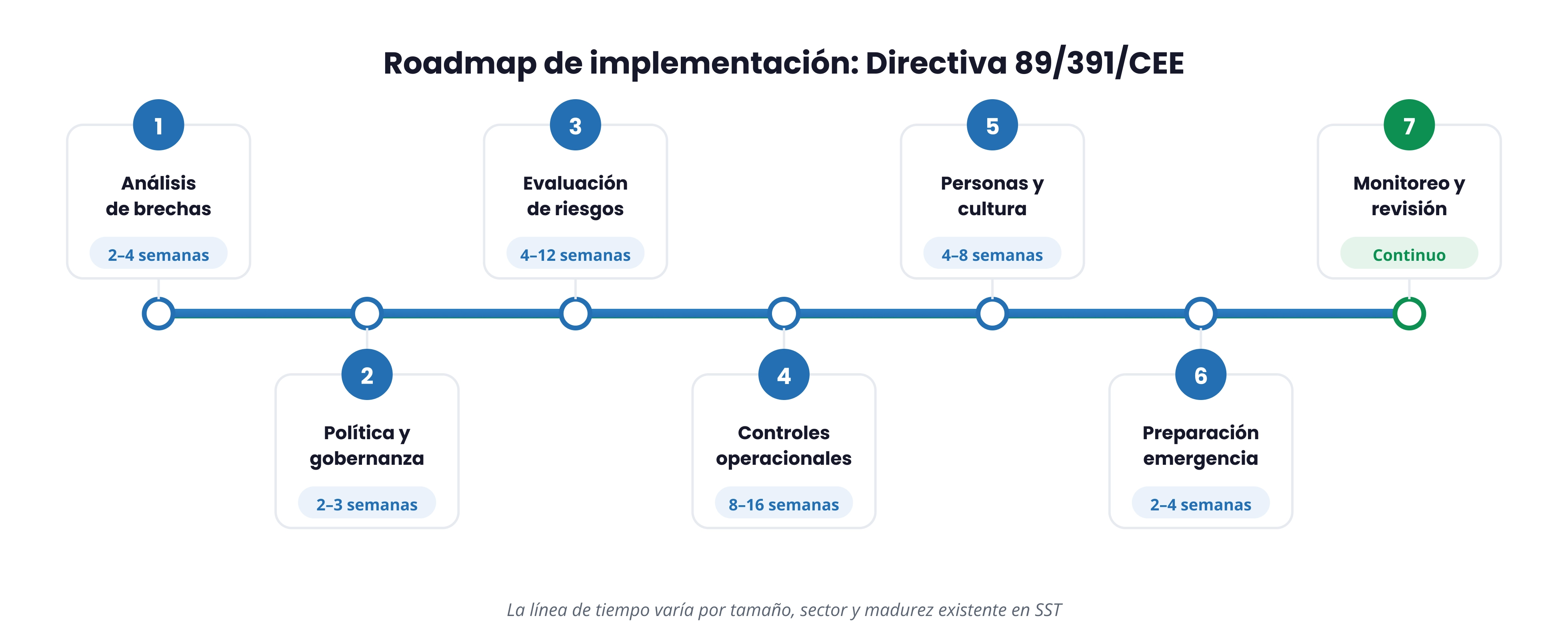
Unlike voluntary ISO standards, the Framework Directive is mandatory legislation transposed into national law. Implementation means integrating obligations into daily operations.
Phase
Duration
Key activities
Resources
Milestone
1. Gap analysis
2–4 weeks
Compare current OSH vs directive article by article; identify national requirements
Existing ISO 45001 or OHSAS 18001 system (most requirements already met)
Strong senior management commitment and visible leadership
Digital EHSQ platform enabling structured documentation and automation
Mature worker consultation culture with active representatives
Competent internal OSH professionals with sectoral experience
Prior experience with regulatory audits by national inspectorates
Factors that delay implementation
Multiple sites across Member States with varying transposition requirements
High workforce turnover requiring continuous training cycles
Complex contractor arrangements with unclear duty boundaries
Paper-based systems making documentation retrieval impractical
Cultural resistance to worker participation and consultation
Lack of dedicated OSH budget competing against production priorities
Most common compliance gaps
Labour inspectorates consistently identify recurring patterns. This table synthesises findings from national enforcement bodies and EU-OSHA ESENER survey results.
Article
Common non-compliance
Root cause
Resolution
Art. 6 — Hierarchy
PPE as first-line control; hierarchy not documented
Misunderstanding of hierarchy; lack of engineering competence
Require documented justification for each control level in risk assessments
Art. 6 — Risk assessment
Assessments outdated, generic, or missing psychosocial risks
No review triggers; insufficient competence; psychosocial not in scope
Establish triggers (incidents, changes, periodic); expand to all hazard types
Art. 7 — Competent persons
Designated persons lack time, authority, or competence
Safety added as secondary duty; no CPD; insufficient support
The transversal pattern: organisations create systems for documentation without embedding them into operational decision-making. When inspectorates find repeated non-compliance, they look for CAPA evidence.
Comparison with related standards and legislation
Framework Directive vs. ISO 45001:2018
Aspect
EU Directive 89/391/EEC
ISO 45001:2018
Practical implication
Nature
Mandatory EU legislation
Voluntary international standard
Directive is legal minimum; ISO 45001 goes beyond
Scope
All EU/EEA employers and workers
Any organisation worldwide
Directive applies by law; ISO by choice
Certification
Not certifiable; enforced by inspectorates
Certifiable by third-party bodies
Directive compliance is legal duty; ISO is competitive differentiator
Structure
4 sections, 19 articles (legal)
10 clauses, HLS/Annex SL
ISO provides management structure; directive provides legal requirements
Risk approach
General principles with defined hierarchy
Actions to address risks and opportunities
Directive hierarchy is prescriptive; ISO more flexible
Worker participation
Art. 11: balanced participation required
Clause 5.4: consultation at all levels
Both require it; directive gives legal force
Continual improvement
Implied (adapt to technical progress)
Clause 10.3: explicit requirement
ISO makes improvement formal; directive implies it
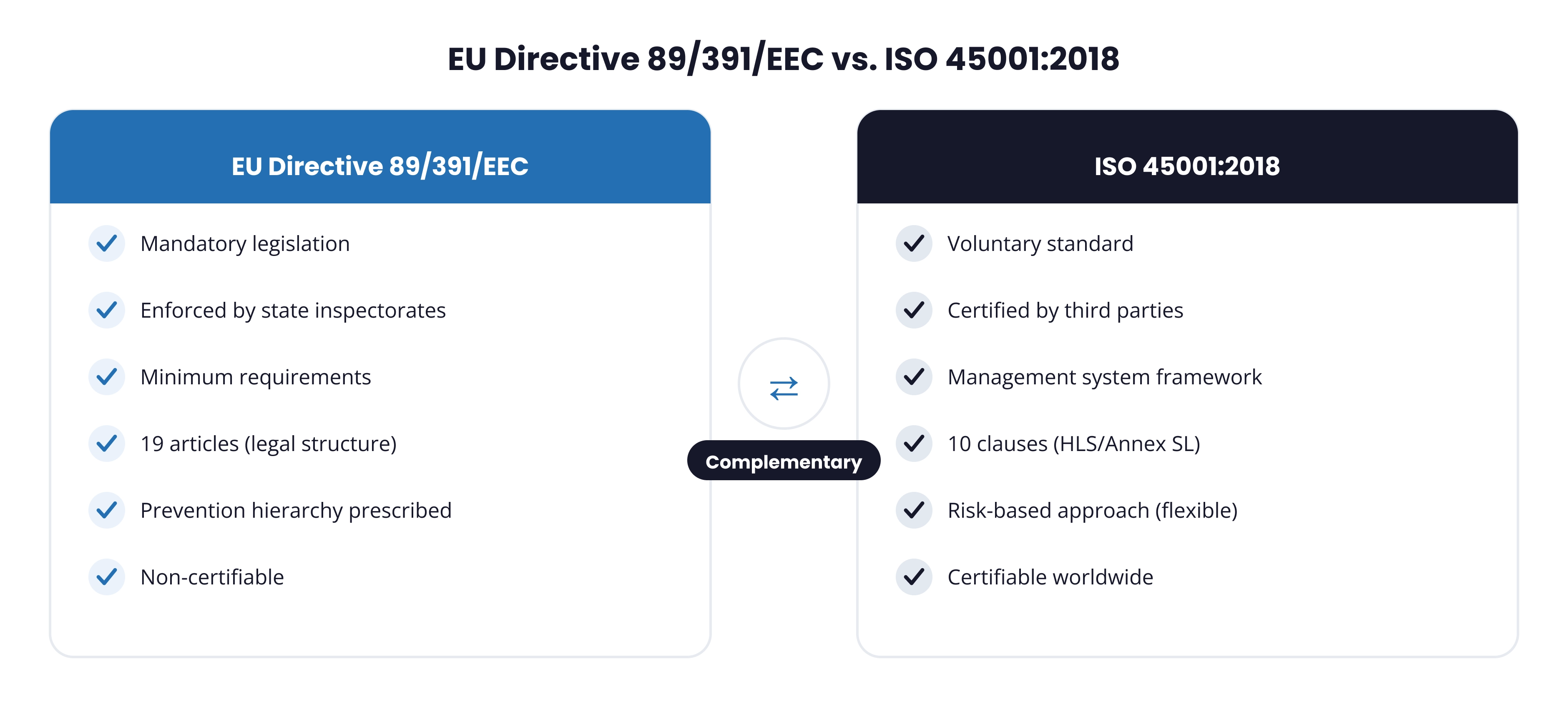
Organisations implementing ISO 45001 meet and exceed directive requirements. The reverse is not always true. The directive provides the legal floor; ISO 45001 the management architecture.
Not a daughter directive; satisfies and exceeds requirements
Provides management structure for directive obligations
REACH (EC 1907/2006)
Chemical registration/restriction
Complements Art. 6 substitution and risk evaluation
REACH data informs workplace chemical risk assessments
A digital EHSQ platform manages all interlinked obligations from a single system, ensuring chemical assessments link to substitution analysis, health surveillance, and worker information.
Industry examples
The directive applies identically across sectors, but practical compliance challenges vary significantly. The table maps how core obligations manifest across priority industries.
The role of technology in Framework Directive compliance
Digital EHSQ platforms transform compliance, replacing fragmented paper systems with integrated, real-time management of risk assessments, controls, training, consultation, and documentation.
Directive area
Requirement
Technology solution
Benefit
Art. 6 — Risk assessment
Evaluate all risks; update after changes
Digital risk assessment with automated review triggers and version control
Assessments always current; complete audit trail; alerts when overdue
Art. 9 — Documentation
Maintain assessments, accident register, reports
Centralised document management with structured fields and workflows
Instant retrieval for inspectors; no lost records; automated reporting
Art. 10 — Information
Adequate information for all workers including contractors
Mobile-first communication with multilingual content and read-receipts
Verified delivery; accessible in workers' language; real-time updates
Art. 11 — Consultation
Consult workers; balanced participation
Digital suggestion systems; consultation workflow with tracking
Evidence of consultation; higher participation; transparent outcomes
Art. 12 — Training
Training at recruitment, change, new equipment; periodic
Training management with competence matrix and automated scheduling
No expired training; triggers on role change; compliance evidence
Art. 14 — Surveillance
Surveillance appropriate to risks; results improve prevention
OH integration with trend analysis and automatic risk assessment triggers
Early trend detection; data-driven prevention; individual and aggregate
An integrated platform connects these elements into a coherent system mirroring the directive's architecture: risk finding triggers control, generates training requirement, communicated to worker.
See how Glartek — the EHSQ software your whole team actually uses, from the frontline to the management — automates EU Framework Directive 89/391/EEC compliance
What is EU Directive 89/391/EEC and what does it do?
EU Directive 89/391/EEC is the foundational EU legislation on occupational safety and health. Adopted 12 June 1989, it establishes employer obligations, nine general principles of prevention, worker participation rights, and risk assessment requirements. It is the legal basis for over 24 daughter directives addressing specific workplace risks.
Who must comply with the Framework Directive?
Every employer in all EU and EEA Member States, regardless of sector or size. Covers all activities (public and private). Only excluded: specific public services where characteristics inherently conflict (armed forces, police during operations). Self-employed are not directly covered but may be protected by national measures.
Is the Framework Directive mandatory?
Yes. Unlike voluntary standards such as ISO 45001, it is binding legislation. All Member States must transpose it. Non-compliance exposes employers to enforcement action including notices, fines, and criminal prosecution.
How does it relate to national legislation?
It sets minimum requirements transposed into national law. Examples: UK Management of HSW Regulations 1999; Germany ArbSchG; France Code du travail Part IV; Spain Ley 31/1995; Italy D.Lgs. 81/2008. National law always meets or exceeds directive requirements.
What are the general principles of prevention?
Nine principles in priority order: (1) avoiding risks; (2) evaluating unavoidable risks; (3) combating at source; (4) adapting work to individual; (5) adapting to technical progress; (6) substitution; (7) coherent prevention policy; (8) collective over individual measures; (9) appropriate instructions. Must be applied as hierarchy with documented justification.
What is the difference between the directive and ISO 45001?
The directive is mandatory EU law with legal minimum requirements, enforced by inspectorates. ISO 45001 is a voluntary management system standard certified by third parties. An ISO 45001 system satisfies directive requirements, but directive compliance alone does not equal certification. They are complementary.
What documentation is required?
Article 9 mandates: written risk assessment, protective measures record, accident list (>3 days), reports to authorities. Articles 6-12 imply: OSH policy, emergency procedures, training records, consultation records, information evidence. National laws specify formats and retention.
Does it apply after Brexit?
In the UK, the directive was transposed before Brexit and retained as domestic law under the EU (Withdrawal) Act 2018. Requirements remain essentially the same, though the UK can now amend independently.
What happens if an employer does not comply?
Consequences include: improvement notices, prohibition notices, fines (varying by state, thousands to millions), criminal prosecution of directors, and civil liability for damages. Repeated or wilful non-compliance carries more severe penalties.
How does EHSQ software help with compliance?
Glartek systematically addresses core obligations: digital risk assessments with automated triggers (Art. 6/9); centralised documentation (Art. 9); mobile worker information with tracking (Art. 10); consultation workflows (Art. 11); training management with competence matrices (Art. 12); health surveillance integration (Art. 14); and incident reporting with CAPA linking to risk assessments.
Request your demo
It's time to elevate Safety, Quality, and Performance in your operations
Start your EHSQ software journey with Glartek and become a leader in your industry.