ISO 45003:2021 is the first international standard giving guidelines for managing psychosocial risks within an occupational health and safety management system based on ISO 45001. It is a guidance standard: it is not certifiable and contains no requirements, but it shows how to identify psychosocial hazards, assess risks and promote psychological well-being at work.
ISO 45003:2021 is the international standard that guides organisations in managing psychosocial risks at work. Published by ISO in June 2021 and developed by technical committee ISO/TC 283 (the same committee behind ISO 45001), it carries the official title "Occupational health and safety management — Psychological health and safety at work — Guidelines for managing psychosocial risks".
One point is decisive for using it correctly: ISO 45003 is a guidance standard, not a requirements standard. This means it is not certifiable in the way ISO 45001 is. What an organisation does is integrate psychosocial risk management into its ISO 45001-based OH&S management system, which can be certified by an accredited body.
The scope is broad: it applies to organisations of all sizes and in all sectors, for developing, implementing, maintaining and continually improving psychologically healthy and safe workplaces. It covers identifying psychosocial hazards, assessing and controlling those risks, and promoting well-being. What it does not do is replace ISO 45001 or provide sector- or occupation-specific guidance.
A psychosocial risk is the combination of the likelihood of exposure to work-related hazards of an organisational and social nature and the severity of the injury or ill health that this exposure can cause. In practice, these are aspects of work design, organisation and management (together with the social and environmental context) that have the potential to cause psychological or physical harm. Excessive job demands, lack of control over one's work, harassment, exhausting hours and job insecurity are classic examples.
ISO 45003 organises these hazards into three broad categories. The first is how work is organised: workload and pace, autonomy and control over tasks, working hours and job security. The second gathers the social factors at work, from relationships and leadership to harassment and violence, recognition, and the support and respect between people. The third is the work environment and hazardous tasks: workplace conditions, inadequate equipment, lack of resources and exposure to hazardous tasks.
ISO 45003 provides an internationally recognised method to identify psychosocial hazards, assess risks and define controls, using the same risk-management logic the team already applies to physical safety. It means moving stress and harassment out of the "HR problem" box and managing them like any other occupational risk, with structured evidence for audits.
The business case is direct: every unit invested in prevention returns more. ISSA/DGUV points to a return of €2.20 for every €1 invested in prevention; OSHA cites 4 to 6 dollars per dollar. Poorly managed psychosocial risks show up as absenteeism, turnover, lost productivity, litigation and reputational damage. Aligning with ISO 45003 reduces that risk in an auditable way.
The standard connects psychological health to the actual design of work: hours, pace, autonomy, role clarity, team relationships. For HR and operations, it is the bridge between a well-being policy and the reality on the shop floor or in the field, backed by data rather than perception.
ISO 45003 follows ISO's Harmonized Structure, the same as ISO 45001. This makes integration easy: anyone already running an ISO 45001 system immediately recognises the logic of clauses 4 to 10, which follow the Plan-Do-Check-Act cycle.
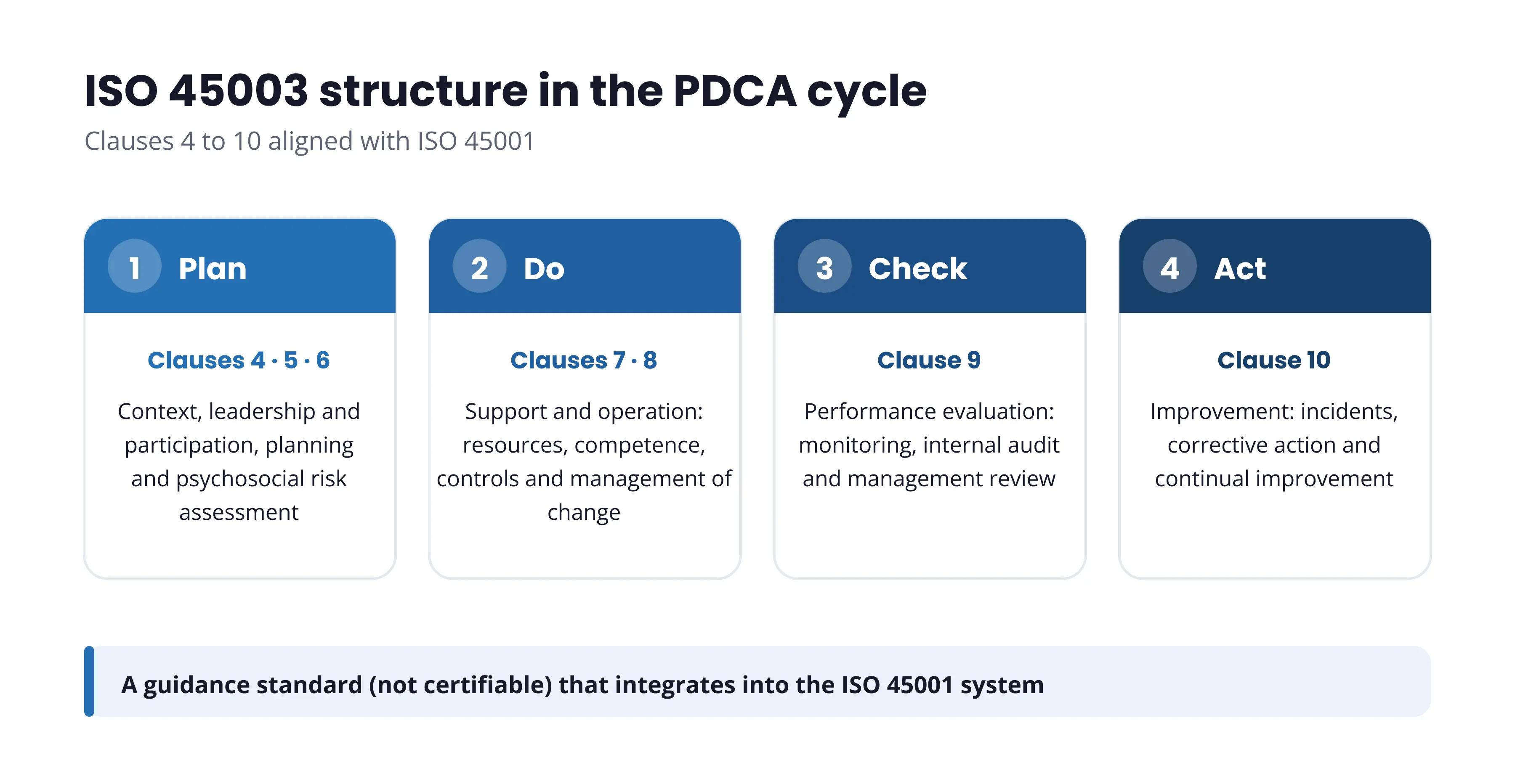
As a guidance standard, ISO 45003 does not impose formal requirements but describes expected practices. The table below turns each block into concrete evidence that supports conformity and feeds the management system.
A practical ISO 45003 implementation usually follows six steps, integrated into the existing management-system cycle.
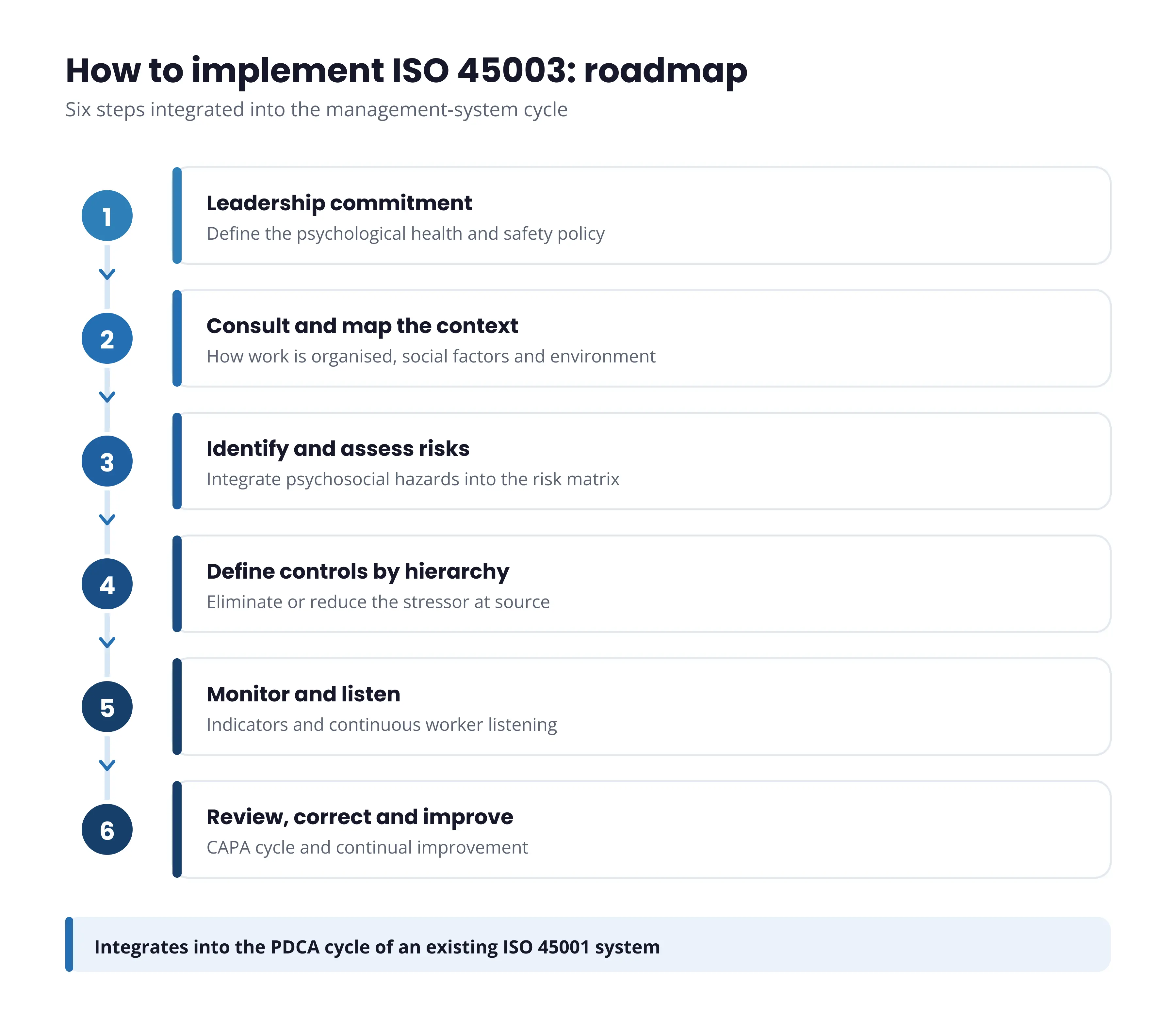
1. Secure leadership commitment and define a psychological health and safety policy.
2. Consult workers and map the context: how work is organised, social factors and the environment.
3. Identify psychosocial hazards and assess the risks, integrating them into the risk matrix.
4. Define controls by the hierarchy, eliminating or reducing the stressor at source before acting on individual cases.
5. Monitor with indicators and listen to workers continuously.
6. Review, correct and continually improve (CAPA).
Because ISO 45003 is not certifiable, an organisation does not receive an "ISO 45003" certificate. The route is different: demonstrate alignment through (1) integrating psychosocial risk management into the ISO 45001 system (certifiable by an accredited body); (2) a gap assessment against the ISO 45003 guidelines; and (3) internal audit and management review. Some bodies offer non-accredited verification against ISO 45003, distinct from ISO 45001 certification.
Psychosocial risks take different shapes depending on the operation. Some examples across sectors where OH&S management is most critical:
ISO 45003 does not stand alone. It works alongside the OH&S management system and the legal requirements of each market.
Across Europe and the UAE, psychosocial risk management is increasingly treated as part of the employer's core duty of care, not an optional add-on.
For decades, managing psychosocial risks relied on annual paper surveys and scattered spreadsheets, data that aged before it turned into action. Digitalisation changes that: mobile reporting channels, real-time indicators and the same corrective-action cycle already used for physical safety.
An EHSQ software lets the same operator who reports a safety near miss also flag a psychosocial condition (overload, conflict, fatigue) in the same interface, with the same CAPA cycle. The psychosocial risk stops being invisible and gains an owner, a deadline and traceability, integrating into the OH&S system without rework.
.webp)
No. It is a guidance standard with no requirements. An organisation integrates psychosocial risk management into its ISO 45001 system, which is certifiable, and demonstrates alignment through internal audit and gap assessment.
ISO 45001 is the OH&S management system, with requirements and certifiable. ISO 45003 is the complementary guide detailing how to manage psychosocial risks specifically within that system.
The standard itself is voluntary. However, under the EU Framework Directive 89/391/EEC employers already must assess and control all occupational risks, including psychosocial ones, and ISO 45003 is the most complete guide to doing so.
Aspects of how work is organised, social factors and the work environment that can cause psychological or physical harm, such as excessive demands, lack of control, harassment, isolation and job insecurity.
Aspects of how work is organised; social factors at work; and the work environment, equipment and hazardous tasks.
A psychological health policy, records of worker consultation, a psychosocial risk matrix, action plans, indicators and CAPA with owner, deadline and effectiveness verification.
Yes. It applies to organisations of all sizes and sectors. The depth of implementation is proportional to the organisation's size and context.
With leadership commitment and structured worker consultation, followed by hazard identification and risk assessment integrated into the existing management system.
The UK HSE Management Standards define six stress risk areas that align well with the psychosocial hazards described in ISO 45003, and can support the assessment step
An EHSQ software centralises reporting, assessment and action: the same operator reports safety and psychosocial risks in one interface, with real-time indicators and a traceable CAPA cycle, as Glartek does.
Request your demo
Start your EHSQ software journey with Glartek and become a leader in your industry.
Schedule Demo.webp)
Discover the power of the only AI-Native EHSQ software built for the frontline

.webp)