
A recordable incident is a work-related injury or illness serious enough to require formal recording against objective criteria: death, days away from work, restricted work or job transfer, medical treatment beyond first aid, loss of consciousness, or a significant diagnosis by a health care professional. It is the countable unit behind metrics such as the TRIR.
A recordable incident, sometimes called a recordable injury or recordable case, is a work-related injury or illness that meets at least one objective severity criterion and therefore has to be entered in the organisation's official log of occupational injuries and illnesses. What separates a recordable incident from a minor mishap is not how serious it felt at the time, but whether it crosses a closed list of criteria. Either the injury leads to lost days, restricted work, medical treatment beyond first aid, loss of consciousness or death, or it receives a significant diagnosis. If none of those triggers applies, the event still happened, but it does not enter the record.
The canonical definition comes from OSHA, the United States occupational safety agency, in regulation 29 CFR 1904.7. The text states that a case is recordable if it results in death, days away from work, restricted work or transfer to another job, medical treatment beyond first aid, or loss of consciousness, and also when it involves a significant injury or illness diagnosed by a physician or other licensed health care professional. ISO 45001:2018 does not use the word "recordable", but defines an incident in clause 3.35 as an occurrence arising out of, or in the course of, work that could result or does result in injury and ill health, giving the broader concept within which the recordable case sits.
Europe does not use the OSHA recordable concept directly, and the terminology differs in an important way. In the UK, RIDDOR 2013 governs what must be reported to the HSE, which is closer to OSHA's reportable than to its recordable. At EU level, the Framework Directive 89/391/EEC obliges employers to keep a list of occupational accidents resulting in more than three days of incapacity, and Eurostat consolidates national data through the ESAW methodology. In the UAE, MoHRE and the OSHAD framework set their own duties to record and notify workplace injuries. Many European and Gulf operations within multinational groups keep the OSHA-style recordable log in parallel, because it is the language their global EHS reporting speaks.
Recording is the backbone of the safety programme. Every case classified correctly feeds trend analysis, points to where root-cause investigation is needed and supports comparison between sites. When classification is inconsistent, the manager loses the ability to see what is getting worse: an apparent drop in the rate may be nothing more than under-reporting dressed up as improvement. Classifying well is the precondition for any lagging indicator to mean anything at all.
The number of recordable incidents becomes direct cost and legal exposure. Across the EU, EU-OSHA estimates that work-related accidents and ill health cost around €476 billion a year. Each recordable case carries its own bill in absence, cover and, in many instances, litigation. For the board, the recordable rate is one of the few safety indicators that speaks directly to financial results and to exposure in audits and claims.
For HR, recording connects safety to absence, return-to-work and workforce morale. A recordable case usually means a role to cover and a phased return to manage. For operations, correct classification avoids two equally costly distortions: treating a first-aid case as serious and inflating the indicator, or pushing a genuine injury out of the record and creating a hidden liability that surfaces later.
The strength of the concept is that it is a binary decision anchored in a closed set of criteria, not in subjective judgement. Under the OSHA rule, a work-related injury or illness is recordable if it produces at least one of the outcomes below. One is enough for the case to enter the log.
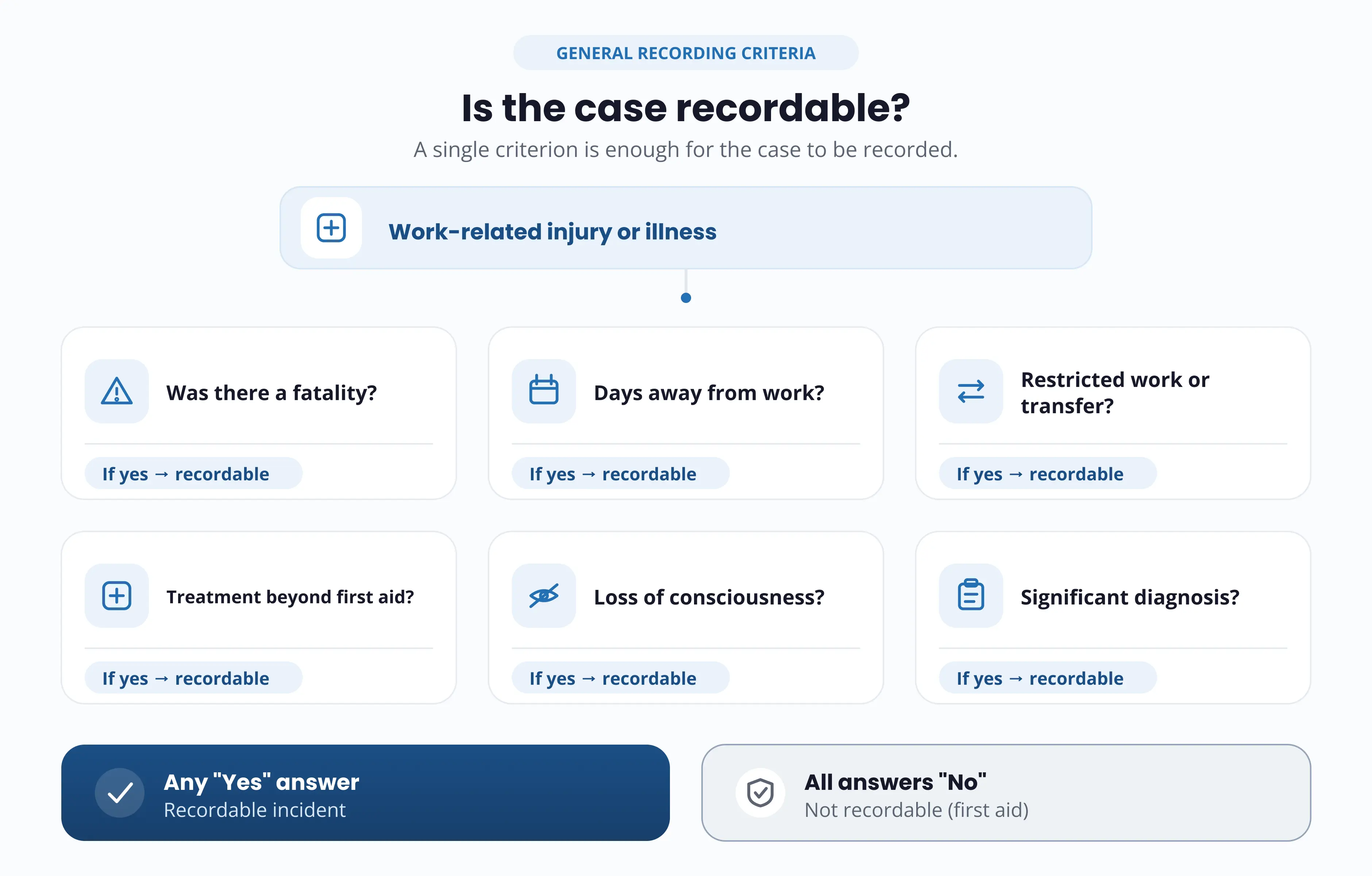
The count of days away begins on the day after the event and includes weekends, holidays and days off, provided the worker was unable to work because of the injury. That detail explains why two apparently identical cases can produce very different numbers: what counts is the health professional's recommendation, not the shift roster.
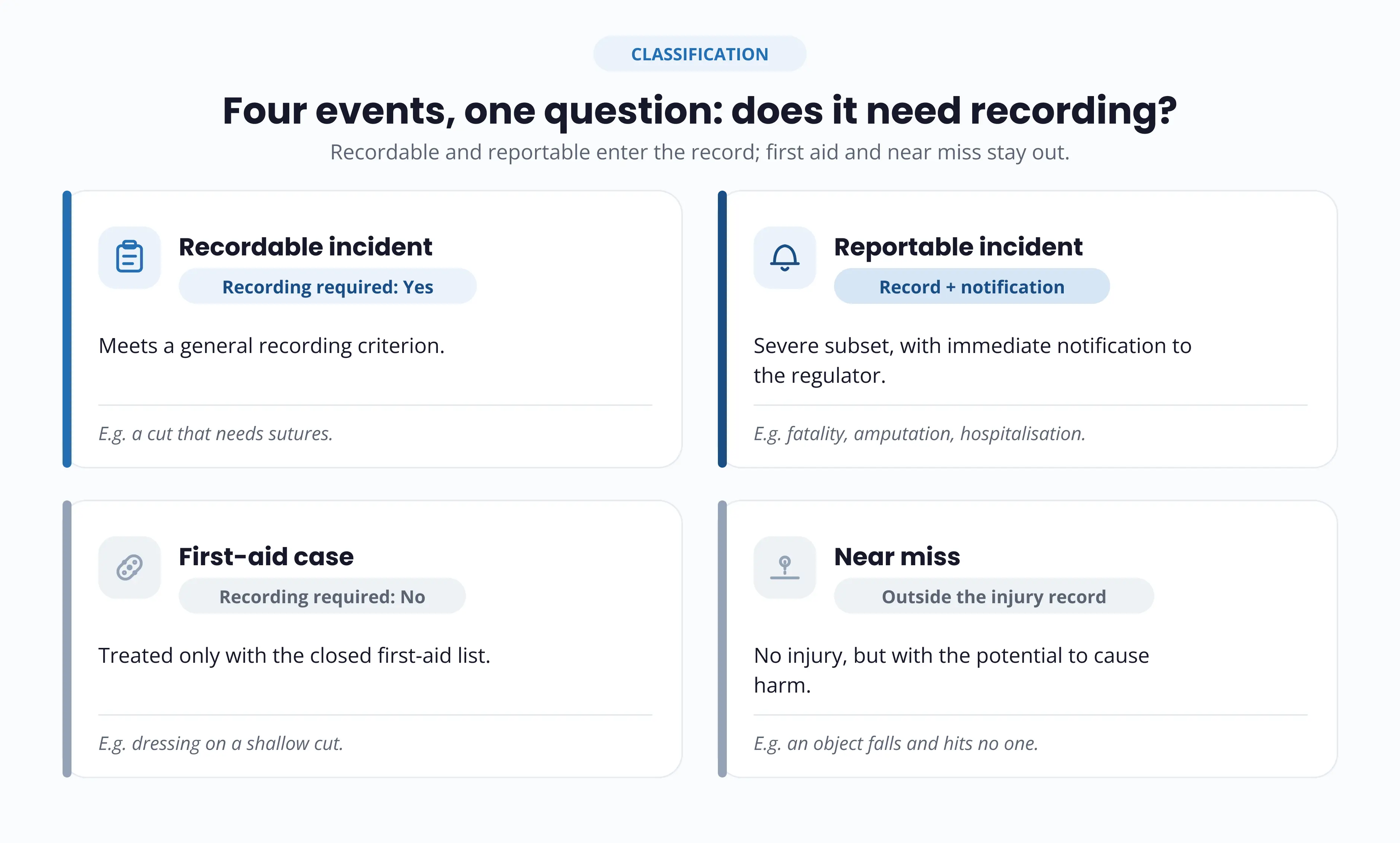
Four categories are routinely confused, and the confusion distorts indicators. Recordable and reportable are not synonyms: every reportable case is also recordable, but the reportable one is the more serious subset that requires immediate notification to the regulator. Under 29 CFR 1904.39, an employer must report any fatality to OSHA within eight hours and any in-patient hospitalisation, amputation or loss of an eye within twenty-four hours. A first-aid case stays out of the record, and a near miss produces no injury, although it should still be captured in the reporting system precisely because it comes before the recordables.
Most classification doubts come down to one question: was the care given first aid or medical treatment? OSHA removes the ambiguity with a closed list. Anything on it is first aid and does not make the case recordable; anything outside it, where care is needed, is medical treatment and makes the case recordable. The rule is explicit that this is a complete list, and that the professional status of whoever provides the care does not change the classification.
On an assembly line, an operator catches a finger in a fixture and receives only a dressing: a first-aid case, outside the record. If the same crush injury needs sutures or rigid immobilisation, the case becomes recordable. The closeness of the two situations is exactly what makes classification discipline decisive on the shop floor.
A field crew working on electrical networks faces typical restricted-work cases: after a strain, the technician returns but is barred from climbing poles for a few days. Even without any lost days, the duty restriction makes the case recordable, and the geographic spread of the crews makes that information hard to capture in time.
Exposure to chemical agents creates occupational-illness cases that escape the pattern of the acute injury. A contact dermatitis that needs prescription medication is recordable; an irritation treated only by washing the skin is not. The challenge here is time, because many conditions appear only weeks after exposure.
Environments with high noise and heavy machinery concentrate hearing loss and crush injuries. A standard threshold shift confirmed by audiometry is a classic example of a case recordable by diagnosis, with no lost days attached.
In clean rooms and active-ingredient handling, exposure to potent substances can produce reactions that need medical treatment. A case of respiratory sensitisation diagnosed by a physician enters the record even if the worker never misses a single day.
Knife cuts, burns in cooking areas and slips on wet floors dominate the profile. A burn treated with an over-the-counter ointment stays out of the record; the same burn that needs debridement or medical follow-up enters it. High turnover in the sector reinforces the need for clear criteria, applied the same way by any supervisor.
The most frequent error is not bad faith, but inconsistency. Different supervisors apply the first-aid list in different ways, and the same event ends up recorded at one site and ignored at another. The result is an indicator that cannot be compared.
Under-reporting is the second risk, and the most dangerous. Pushing out of the record an injury that should be in it lowers the rate artificially, but creates a liability that reappears in an audit, in a claim or in the worsening of the clinical condition itself. Pressure for zero-rate targets, when poorly handled, is one of the main drivers of this behaviour.
There is also the opposite excess: recording as medical what was first aid, out of uncertainty. This inflates the indicator and shifts attention from root-cause analysis to an argument about numbers. All three problems share one origin, the absence of a single criterion, documented and applied the same way across the whole organisation.
Consistency starts by taking the decision out of each supervisor's memory and placing it in a guided flow. Rather than asking "is this serious?", the process should ask, in order, whether there were lost days, a restriction, treatment beyond first aid, loss of consciousness or a significant diagnosis. The right question, always asked in the same sequence, produces the same answer regardless of who classifies.
Three practices sustain the improvement. The first is to standardise the definition of first aid against the closed list in the rule, accessible at the moment of recording. The second is to separate recording from root-cause investigation, so that fear of opening an investigation does not contaminate the decision to record. The third is to audit a sample of cases classified as first aid periodically, because that is where under-reporting tends to hide.
The recordable incident is the unit that gives meaning to the main lagging safety metrics. The most direct is the Total Recordable Incident Rate, which normalises the number of recordable cases by hours worked, making it possible to compare operations of different sizes. The calculation is simple: multiply the number of recordable incidents by 200,000 and divide by total hours worked in the period. The 200,000 constant represents 100 full-time employees working 40 hours a week for 50 weeks, and exists only to give the figure a usable scale.
DART is a more severe subset, counting only cases with days away, restricted work or transfer, using the same 200,000-hour base. LTIFR follows the same logic of lost-time cases but is more common outside the United States and usually uses a base of 1,000,000 hours. All three depend, above all, on a well-made recordable classification: no formula can fix a badly counted numerator.
For the detail of each indicator, refer to the full pages: [TRIR — Total Recordable Incident Rate], [DART — Days Away, Restricted or Transferred] and [LTIFR — Lost Time Injury Frequency Rate].
For decades, incident recording lived on paper and in spreadsheets. The supervisor noted the case, someone transcribed it into the log, and classification depended on the interpretation of whoever filled it in. That model produces delay, lost cases and exactly the inconsistency that undermines indicators.
Digitalisation changes the point of capture. When the operator records the event on site, from a phone, and a guided flow asks the classification questions in the right order, the decision on recordable or not stops being subjective. EHSQ software also keeps the first-aid list within reach at the moment of doubt and connects the record to the investigation and corrective-action cycle, with no transcription rework.
The larger gain appears in correlation. With recordables captured in a structured way and cross-referenced with near misses and leading indicators, the organisation begins to see the precursors of the most serious injuries before they happen, turning a historical record into an instrument of prevention.
Every reportable case is recordable, but the reportable one is the more serious subset that requires immediate notification to the regulator. Under the OSHA rule, fatalities must be reported within eight hours and hospitalisations, amputations or loss of an eye within twenty-four hours, whereas a recordable case only enters the official log.
No. OSHA keeps a closed list of procedures considered first aid, such as dressings, over-the-counter medication and hot or cold therapy. If the care given is on that list, the case is not recordable, regardless of who provided it.
An injury is recordable if it results in death, days away from work, restricted work or job transfer, medical treatment beyond first aid, loss of consciousness, or a significant diagnosis by a health care professional. One of these criteria is enough.
No. Restricted work, medical treatment and a significant diagnosis make the case recordable even without a single lost day. Days away are just one of the criteria, not a mandatory condition.
Not directly. The UK uses RIDDOR, which is closer to OSHA's reportable, and the EU Framework Directive 89/391/EEC requires employers to keep a list of accidents causing more than three days of incapacity. Many European and Gulf operations keep an OSHA-style recordable log in parallel for group reporting.
The count begins on the day after the event and includes weekends, holidays and days off, provided the worker was unable to work because of the injury. What drives the count is the health professional's recommendation.
Under OSHA rule 1904.33, the recording forms must be kept for five years following the year they cover. European and UAE operations follow the retention periods set by their applicable national frameworks.
The recordable incident is the numerator of the TRIR. The metric multiplies the number of recordable cases by 200,000 and divides by total hours worked, which allows operations of different sizes to be compared on the same scale.
No. A near miss produces no injury and therefore stays out of the injury log. It should still be captured in the reporting system, because it comes before recordable cases and reveals the barrier failure before it causes harm.
EHSQ software such as Glartek moves capture to the point of execution, guides the supervisor through the classification questions in the right order, and keeps the first-aid list accessible at the moment of doubt. That reduces inconsistency and links the record directly to investigation and corrective action.
Request your demo
Start your EHSQ software journey with Glartek and become a leader in your industry.
Schedule Demo
Discover the power of the only AI-Native EHSQ software built for the frontline