A toolbox talk is a short, frequent conversation held at the workplace before or during a shift, focused on a single safety topic relevant to the task at hand. It does not replace formal training; it reinforces it, keeps risk present in the daily routine and opens a channel for worker participation.
A toolbox talk is a short conversation about a single safety topic, held at the workplace, usually before a shift or a specific task begins. The same instrument is known in Brazil as DDS (diálogo diário de segurança) and in Spanish-speaking countries as charla de seguridad. The aim is not to teach everything about a subject, but to keep one concrete risk present in the team's attention at the exact moment they are about to face it.
The UK Health and Safety Executive defines a toolbox talk as "a short presentation to the workforce on a single aspect of health and safety". That definition carries two implicit demands: short and focused. A toolbox talk that tries to cover five subjects at once stops being a toolbox talk and becomes a poorly planned meeting.
No European regulation mandates toolbox talks by name. What the law requires is the substance the toolbox talk delivers. The EU Framework Directive 89/391/EEC obliges employers to inform workers about risks and protective measures (Article 10), to consult workers and enable their participation (Article 11), and to provide task-specific training that is repeated periodically and adapted to new or changed risks (Article 12). ISO 45001:2018 frames the same duties through competence (clause 7.2), awareness (7.3), internal communication (7.4.2) and consultation and participation of workers (5.4). The toolbox talk is the practical method that turns those obligations into a daily habit.
In the UAE, the Abu Dhabi OSH framework goes one step further and names the toolbox talk explicitly, describing it as short talks on specific OSH issues that let employers and employees explore risks together. It appears in a technical guideline whose contents are not mandatory; the binding requirement is communication and consultation, and the toolbox talk is the suggested method to meet it.
A safety programme that only discusses risk in annual training and on posters treats safety as an event. The toolbox talk treats safety as a continuous conversation. That change of rhythm is what keeps risk visible between one formal training session and the next, and it is why the value of a toolbox talk looks different depending on who is looking at it.
The toolbox talk is one of the few leading indicators the safety team controls directly. While the accident rate only moves after someone is hurt, the coverage and quality of toolbox talks can be measured every day, before any injury. Burke and colleagues, in a meta-analysis of 95 studies, showed that more engaging training methods produce more knowledge and more safe behaviour than the passive delivery of information. A well-run toolbox talk is exactly that kind of high-frequency, participative contact.
The argument is avoided cost. According to NSC Injury Facts, the average cost of a lost-time work injury runs into tens of thousands of dollars, and a fatality costs well over a million. A toolbox talk does not remove that risk on its own, but it is the lowest unit-cost intervention available: a few minutes per shift, no equipment, delivered by someone already on site. The question for leadership is not whether there is budget for toolbox talks, but what it costs to let the risk conversation go quiet on the floor.
How openly a team talks about risk is a gauge of trust. When the toolbox talk is a monologue nobody interrupts, it reveals a culture where reporting problems does not feel safe. When the team brings observations, disagrees and suggests, the toolbox talk stops being a formality and starts feeding safety culture with the knowledge of the people who understand best the conditions that create hazards: the operators themselves.
Confusing the toolbox talk with other communication formats leads to wrong expectations and to records that serve no purpose. The three formats coexist and do different jobs. The hardest dividing line is between informal team conversations and the formal safety body, which does have its own legal basis.
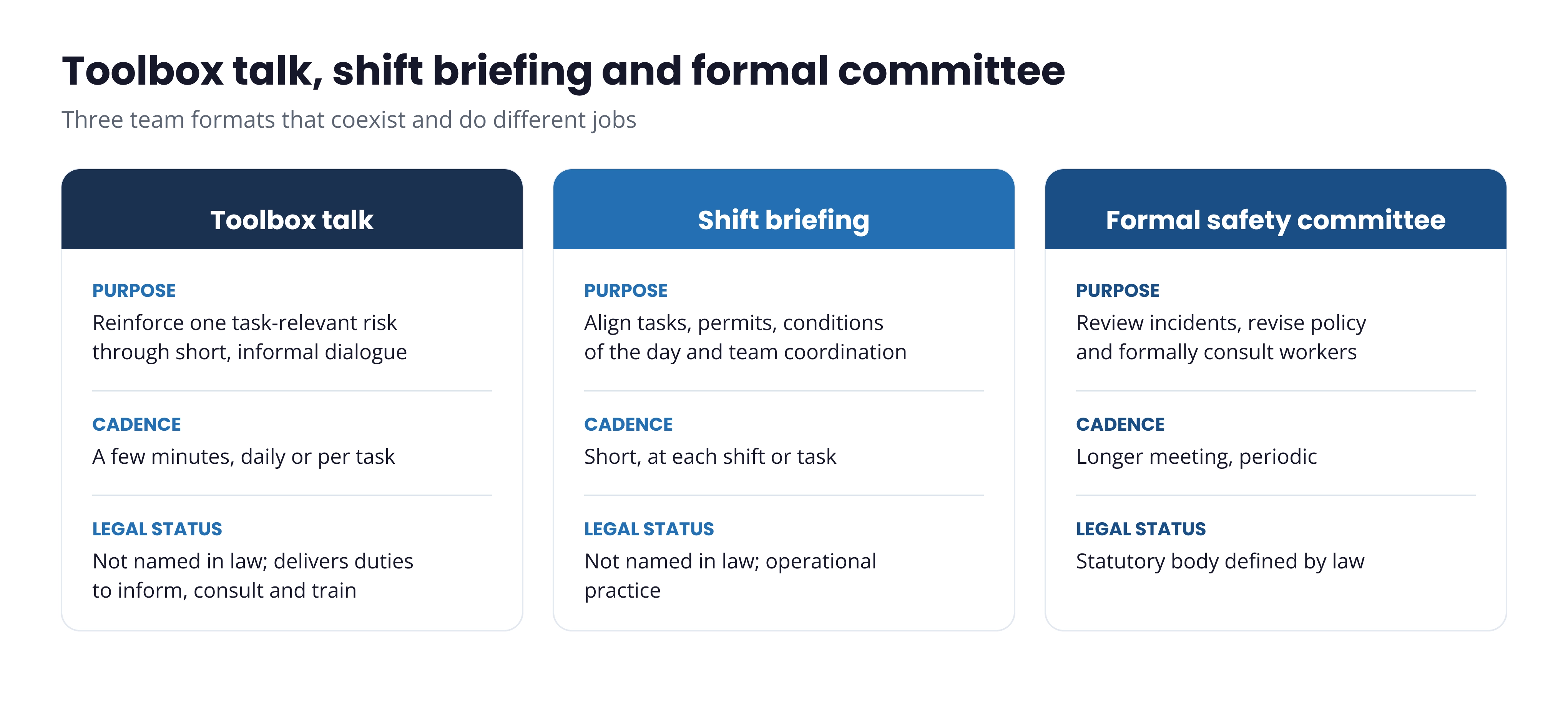
In practice, the toolbox talk and the shift briefing often merge into one conversation: the team receives the plan for the day and, at the same moment, discusses the most relevant risk of the task. That is healthy, provided the safety topic keeps its own space and is not swallowed by logistics.
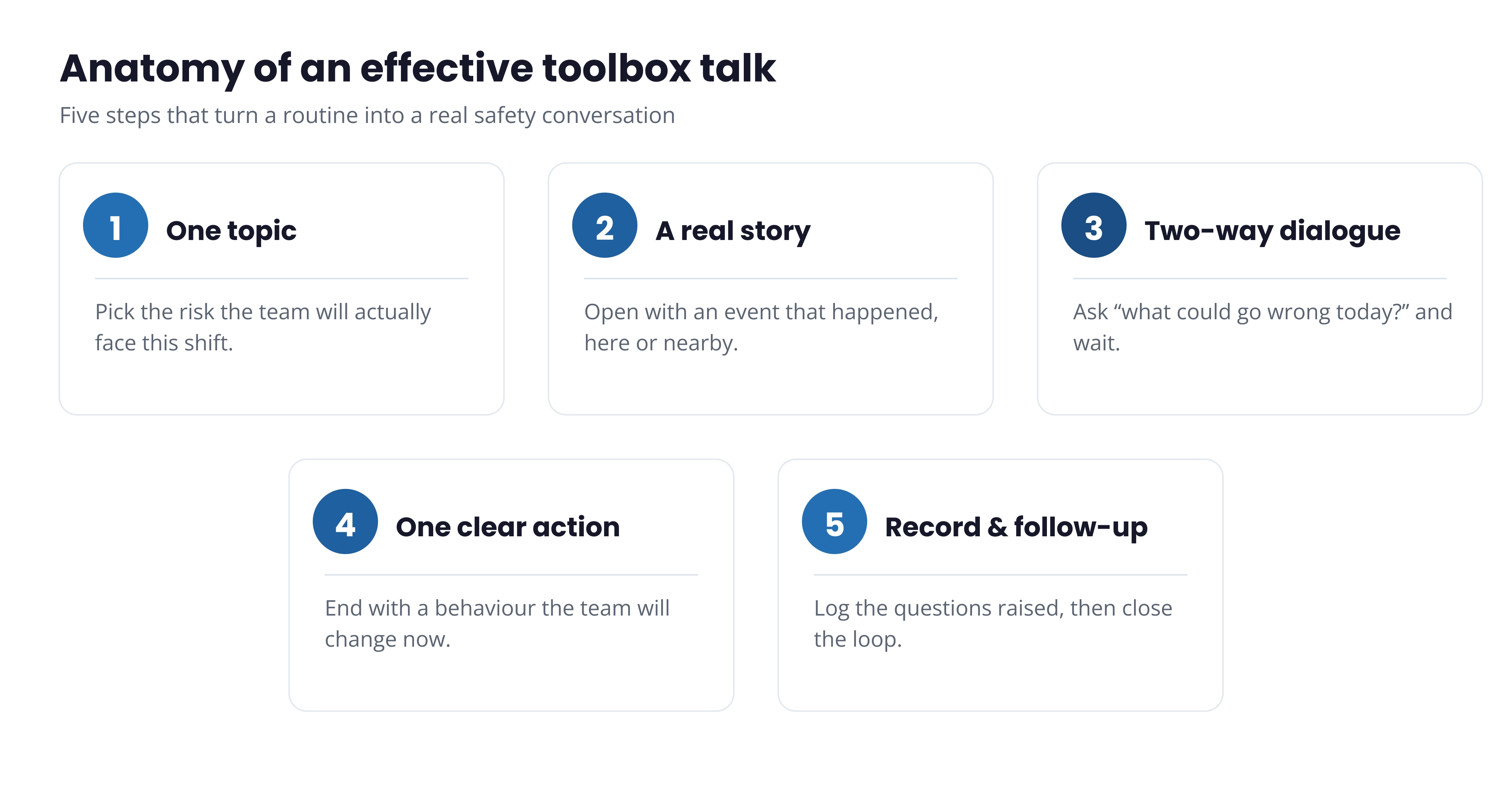
The difference between a toolbox talk that changes behaviour and one that merely fills a few minutes lies in structure, not duration. The evidence is consistent: what makes safety training effective is how much people engage, not how much information is transmitted. A NIOSH study found that adding real narratives and discussion questions to a toolbox talk significantly increased the knowledge participants retained. A good toolbox talk follows five steps.
A toolbox talk dies when it becomes a ritual. The failure patterns repeat across operations and all point to the same cause: treating the talk as an audit obligation rather than a safety conversation.
Before a shift involving line maintenance, a talk on lockout/tagout (LOTO) that walks through the specific machine to be serviced that day, who applies the lock and how the absence of stored energy is confirmed. The focus is not the LOTO policy in the abstract, but the equipment the team is about to open.
For a field crew about to work near live lines, a talk on safe approach distances and the day's work permit, reviewing what changes if the weather deteriorates. In dispersed work with no signal, the talk is often the last point of alignment before the crew spreads across the territory.
Before a product transfer operation, a talk on the specific substance involved, the signs of overpressure and the immediate response to a small release. Tying the topic to the procedure and the safety data sheet for that substance makes the conversation actionable rather than theoretical.
On a shift near boilers and steam lines, a talk on steam and hot-liquor burns, reviewing the points where exposure is most likely and the PPE required for that specific zone of the plant. The value is in naming the concrete point, not the generic hazard.
Before an operation with a high-potency active substance, a talk on containment, the sequence for donning and doffing PPE and what to do in the event of a contained release. The precision of the procedure is the topic of the conversation itself.
On a shift maintaining the ammonia refrigeration system, a talk on leak detection and evacuation that crosses safety and quality: the same team discussing the ammonia risk is the one that reports a hygiene non-conformity in the same routine. It is the point where the "S" and the "Q" in EHSQ meet in the frontline conversation.
Reporting accidents measures the past. Counting and qualifying toolbox talks measures the prevention effort before any injury, which is why the toolbox talk belongs to the family of leading indicators. OSHA explicitly lists the number of workers participating in toolbox talks as an example of a leading indicator, alongside attendance at safety meetings. The logic is direct: an organisation that can raise the participation and quality of its toolbox talks is acting on the causes before the negative outcome appears.
The simplest way to turn the toolbox talk into a metric is the participation rate, which measures the programme's real coverage:
Toolbox talk participation rate = (Number of workers attending toolbox talks ÷ Total number of expected workers) × 100
Coverage alone does not tell the whole story: a programme can have 100% attendance and no real dialogue. That is why the participation rate should be read alongside quality indicators, such as the number of observations and questions workers raise. To understand how leading and lagging indicators work together and how to balance them, refer to the full page: [Leading and lagging indicators].
For decades the toolbox talk lived on a clipboard: a hand-written topic, a signed attendance sheet and, in the end, a pile of paper nobody consults again. That format proves the meeting happened, but keeps nothing of what matters, which is the questions raised and their resolution.
EHSQ software changes the nature of the record. The topic can be pulled from the real risk of the task, attendance is confirmed on a phone or tablet in seconds, and every observation the team raises goes straight into the same system where near misses, risk assessments and corrective actions already live. What used to be lost on the clipboard starts feeding the improvement cycle.
The bigger gain is correlation. When toolbox talk participation, reported near misses and corrective actions sit in the same base, the organisation can see whether the proactive effort translates into fewer events, and anticipate where risk is growing. This is the moment the toolbox talk stops being a compliance archive and becomes management data. In field operations with no signal, offline capture with later synchronisation ensures none of this depends on connectivity at the site.

A toolbox talk is a short conversation about a single safety topic, held at the workplace before or during a shift. It is known in Brazil as DDS (diálogo diário de segurança) and in Spanish as charla de seguridad.
No jurisdiction analysed mandates toolbox talks by name. What the law requires is the substance they deliver: informing workers about risks, consulting them and providing training (for example, Articles 10–12 of the EU Framework Directive 89/391/EEC). The toolbox talk is the practical method that meets those duties.
There is no duration fixed in regulation. Market practice points to a few minutes, enough to cover a single topic with focus. What matters is short, regular frequency, not the length of each session.
Formal training teaches complete competences on a subject and tends to be longer and periodic. The toolbox talk does not replace training; it reinforces it, keeping a specific risk present in the daily routine, at the moment and place the team faces it.
Usually the supervisor, foreman or team leader, because they are closest to the task. The person running it does not need to be an expert in everything; they need to be able to lead a dialogue and give room to the team's experience.
The most relevant risk of that day's task. Common topics include PPE, working at height, energy isolation, hazardous substances, ergonomics and lessons from recent near misses. The topic should follow the task, not a fixed calendar.
Record the topic, attendance and, above all, the questions and observations the team raised, along with the actions that followed. The signature proves the meeting happened, but the management value lies in what the team brought and what was done next.
Direct evidence is still limited: the specific effectiveness of toolbox talks has not been systematically established in peer-reviewed studies. What research shows robustly is that participative training and genuine worker engagement are associated with more knowledge and safer behaviour. A talk built on real dialogue is worth more than one built on passive reading.
A safety committee is a formal, statutory body that meets periodically to review incidents and policy. A toolbox talk is an informal, short, daily team conversation. They are complementary: one is governance, the other is field routine.
Glartek is EHSQ software that digitises the toolbox talk record and links it to the rest of the safety system. The topic is pulled from the task risk, attendance is confirmed in seconds on a phone even offline, and every team observation flows into the same stream as near misses and corrective actions, turning the toolbox talk into a leading indicator management can track.
Request your demo
Start your EHSQ software journey with Glartek and become a leader in your industry.
Schedule Demo
Discover the power of the only AI-Native EHSQ software built for the frontline