
A near miss is an unplanned event that did not result in injury, illness or damage, but had the potential to do so if the circumstances had been slightly different. It is the same kind of event as an accident, without the consequence: a free warning, captured before anyone gets hurt.
A near miss, also called a near hit or close call, is an unplanned event that did not result in injury, illness or property damage, but had the potential to do so had the conditions been slightly different. A tool falling from a scaffold and missing everyone, a forklift stopping centimetres from a worker, a relief valve opening before a vessel ruptures: none of these produced a casualty, yet each exposes a real barrier failure already present in the process.
ISO 45001:2018 does not treat a near miss as a separate category. The standard defines an incident (clause 3.35) as an "occurrence arising out of, or in the course of, work that could or does result in injury and ill health". A note to the clause clarifies that an incident where injury occurs is sometimes called an accident, and that an incident where no injury occurs but has the potential to do so may be referred to as a near miss, near hit or close call. Accident and near miss are therefore the same phenomenon, separated only by a consequence that is often a matter of luck.
At European level, near miss reporting is good practice rather than an explicit legal mandate. Directive 89/391/EEC, the Framework Directive, requires employers to assess risks and to keep records and reports of occupational accidents that leave a worker unfit for work for more than three days, but it frames the recording duty around accidents, not near misses. EU-OSHA guidance recommends investigating near misses precisely because they let organisations identify and control hazards "before they cause a more serious incident".
The reporting picture is uneven across the regions Glartek serves. In the UK, near misses as such are not reportable under RIDDOR 2013, yet a defined set of high-potential events called dangerous occurrences must be reported even when no one is hurt. In the UAE, Abu Dhabi's OSH framework goes further: the ADOSH-SF guidance explicitly requires that all work-related incidents, including near misses and dangerous occurrences, be investigated internally and not used to assign blame.
An accident answers the question "what went wrong?". A near miss answers a far more valuable one: "what almost went wrong, and still will, unless something changes?". Because there is no casualty, no injury and no production stoppage, a near miss is the only safety data an organisation receives without paying the price of harm. Ignoring it wastes the cheapest warning available.
Near misses are the leading indicator par excellence. Where the accident rate only moves after someone is hurt, the volume and quality of reported near misses show where barriers are failing before the outcome materialises. A spike in near misses on a given line, shift or task is a risk heat map that lets teams act weeks ahead of the injury that would otherwise be inevitable.
The financial case is direct. According to NSC Injury Facts (2022 data), the average cost of a work injury requiring medical consultation is around US$40,000, and a work-related death reaches US$1.39 million. The ISSA/DGUV Return on Prevention report estimates a return of 2.2 for every unit invested in prevention. Near miss reporting is the mechanism that turns these figures into decisions: act on the precursor, which costs a fix, rather than on the fatality, which costs lives and millions.
A healthy near miss programme is one of the most reliable thermometers of organisational trust. When people report without fear of blame, the culture is mature; when reports fall to zero, it is rarely because the site became safe, it is because people stopped believing it was worth speaking up. For operations, every near miss resolved is an unplanned stoppage, a rework or an investigation that will not happen.
Confusing these terms drives under-reporting and misleading metrics. The distinction is always about the consequence and the legal reporting duty, not about the severity of the underlying risk, which can be identical.
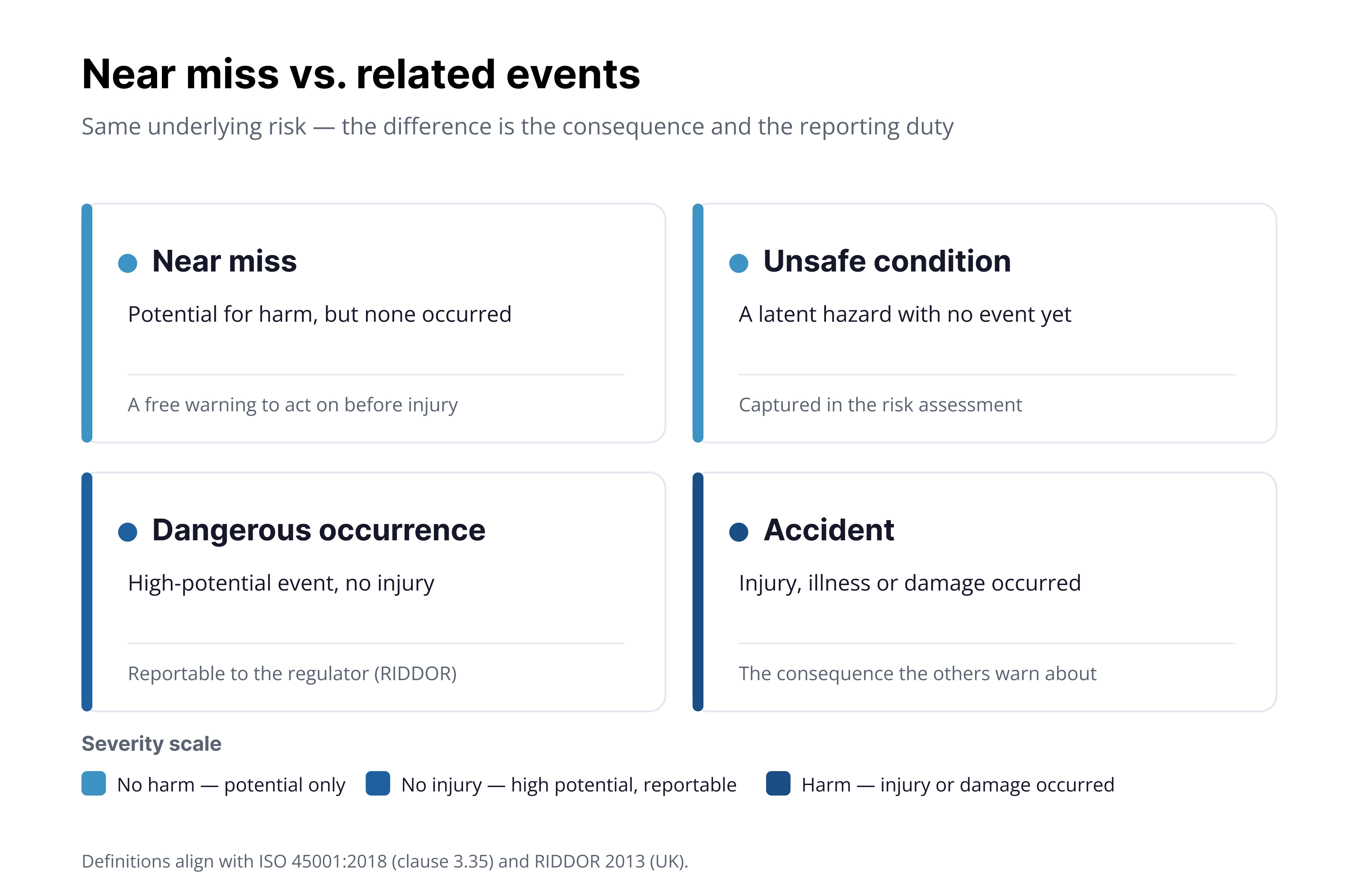
The practical boundary is RIDDOR in the UK. A near miss is generally not reportable to the regulator, but a dangerous occurrence, such as the failure of lifting equipment, the failure of a pressure system, a scaffold collapse over five metres, a structural collapse or a release of a dangerous substance, must be reported even when nobody is hurt. This is the clearest reminder that a subset of near misses carries such high potential that regulators treat them as serious in their own right.
The idea that many minor events precede each serious one began with Herbert William Heinrich, then an inspection officer at the Travelers insurance company, who in 1931 proposed a ratio of 300 no-injury events to 29 minor injuries and 1 serious injury. Heinrich drew on more than 75,000 accident reports and attributed 88% of accidents to "unsafe acts". Decades later, Frank E. Bird Jr. expanded the model using roughly 1.7 million accidents reported by around 300 companies, arriving at a ratio of 1 serious injury to 10 minor injuries, 30 property-damage events and 600 near misses.
The modern reading is more cautious, and rigour matters here. Heinrich's original data was lost and never independently reproduced, and authors such as Fred Manuele (Professional Safety, 2011) showed that the fixed ratio is not universal: it varies enormously by industry and hazard type. More importantly, reducing the frequency of minor incidents does not automatically reduce the likelihood of serious ones, because they often have different precursors. Research on Serious Injuries and Fatalities (SIF), such as Martin and Black (2015), analysing more than 1,000 incidents across seven multinationals, found that only around 21% of recordable injuries shared circumstances with SIF potential.
The practical conclusion is not to abandon the pyramid but to use it correctly: near misses remain essential warnings, but what matters is not simply counting them, it is filtering those with the potential for a serious consequence. A low-potential near miss and one that almost became a fatality are not worth the same, and treating them as equivalent is the mistake the SIF approach corrects.

A report that only says "a part almost fell" is noise; a good report is actionable. The difference lies in capturing enough context to allow root cause analysis without turning the record into paperwork nobody wants to complete. A useful report answers, at a minimum, the following:
1. What happened, in factual language and without fault-finding — the event, not the person.
2. Where and when — exact location, task under way, shift and conditions at the time.
3. What the potential was — the worst plausible outcome had the circumstances been slightly different. This field is what lets teams prioritise high-potential near misses.
4. Which barrier failed — the guard, the procedure, the permit to work, the training or the equipment condition.
5. What immediate action was taken and what corrective action is proposed — linking the report to the CAPA (corrective and preventive action) cycle.
Clause 10.2 of ISO 45001 closes the loop: it requires the organisation to react to the incident in a timely way, investigate the root cause with worker participation, assess whether similar incidents could occur, implement actions following the hierarchy of controls and verify the effectiveness of those actions. A near miss that is reported but generates no action is a wasted report, and it teaches the team not to report again.
The biggest enemy of a near miss programme is not a shortage of events, it is silence. Safety culture research identifies a consistent set of barriers. Because, by definition, a near miss "leaves no injury, no damage, not even evidence that it occurred", it is easy and often convenient to ignore. To this are added the fear of punishment or of being seen as a troublemaker, the absence of feedback (nothing demotivates more than reporting and never learning what happened), peer pressure and the friction of long forms.
Under-reporting is real and measurable. A study by Probst and Estrada (Accident Analysis & Prevention, 2010) of 425 workers across five high-hazard industries found that the number of unreported accidents was significantly higher than the number reported, and that under-reporting was worse where the organisational safety climate was weaker. If accidents themselves are under-reported, near misses, which leave no trace, suffer the problem even more acutely.
Raising the number of reported near misses is counter-intuitive: a rising number is almost always good news. It means people trust the system. The elements that consistently work are few and well known.
OSHA reinforces, in its incident investigation guidance, that the goal is to identify and correct root causes, "not on finding fault or blame". This principle, more than any poster campaign, is what opens the door to honest reporting.
Reporting near misses only generates management value when the volume becomes a metric comparable over time and across units. The most common indicator for this is the Near Miss Frequency Rate (NMFR), which normalises the number of reported near misses against a standard volume of hours worked, typically 200,000 or 1,000,000 person-hours.
Near Miss Frequency Rate = (Number of reported near misses × 200,000) ÷ Total person-hours worked
The counter-intuitive part of this metric is that, unlike TRIR or LTIFR, a higher NMFR is usually desirable: it points to an active reporting culture, not a more dangerous site. It should therefore always be read alongside lagging indicators and the quality of the reports, never in isolation.
For the detailed calculation, benchmarks and sector interpretation, refer to the full page: [NMFR — Near Miss Frequency Rate].
For decades, near miss reporting relied on suggestion boxes, paper forms and spreadsheets. The result was predictable: reports that got lost, arrived late or were never analysed, and an operator in the field with no signal simply had no way to log the event at the moment it happened. Analogue friction is the simplest explanation for chronic under-reporting.
EHSQ software changes the economics of reporting. When an operator can log a near miss from a phone in seconds, even offline, with automatic sync when the network returns, the cost of reporting falls close to zero, and the volume of quality data rises. The same system routes the report, automatically opens a CAPA cycle with an owner and a deadline, and gives the EHS manager real-time visibility, eliminating the gap between the event and the action.
The next leap is predictive. By treating near misses as structured leading indicators, and correlating them with permits to work, inspections and observations, it becomes possible to anticipate where a serious event is forming before it happens. This is the logic behind SIF prevention: stop counting only what has already gone wrong and start acting on the precursors that remain invisible to anyone looking only at completed accidents.
.webp)
Both are the same type of event; the difference is the consequence. An accident resulted in injury, illness or damage; a near miss had the same potential but, through circumstance or luck, produced no consequence. That is why a near miss is treated as a warning: it exposes the failure without charging the price.
Not quite. A dangerous occurrence is a specific, high-potential subset of near miss listed in RIDDOR Schedule 2 that must be reported to the UK regulator even with no injury. Most near misses are not dangerous occurrences, but every dangerous occurrence is a very high-potential near miss.
Near misses in general are not reportable under RIDDOR, and the EU Framework Directive frames its recording duty around accidents. However, RIDDOR dangerous occurrences must be reported, and good practice, reinforced by EU-OSHA, is to capture all near misses internally so they can drive prevention.
Abu Dhabi's OSH framework is explicit: the ADOSH-SF guidance requires that all work-related incidents, including near misses and dangerous occurrences, be investigated internally, with the stated aim of not assigning blame. Federal MoHRE rules focus on injuries and occupational diseases rather than near misses.
It is the idea, originated by Heinrich and expanded by Bird, that many no-injury events precede each serious one. It remains useful as a reminder that warnings exist in large numbers, but the fixed ratio is not universal and reducing minor events does not automatically reduce serious ones. Modern practice therefore focuses on identifying high-potential near misses, not simply counting them all.
It is a near miss whose worst plausible outcome would have been a serious injury or a fatality had the circumstances been slightly different. Distinguishing these from trivial near misses is what allows teams to concentrate resources where the SIF risk is real.
Because they leave no trace and are easy to ignore, and because many cultures still associate reporting with blame or with extra work for no return. Research shows that fear of punishment, lack of feedback and form friction are the main barriers. A non-punitive, fast system with visible feedback reverses that behaviour.
Almost always the opposite. A rise in reports usually indicates greater trust in the safety culture, not more danger. That is why the Near Miss Frequency Rate should be read as a leading indicator, and a sudden drop to zero is often a warning sign, not a success.
A good report identifies the barrier that failed and feeds directly into a corrective and preventive action, with an owner and a deadline. Clause 10.2 of ISO 45001 requires investigating the root cause, acting according to the hierarchy of controls and verifying effectiveness. Without that loop closure, the report does not turn into prevention.
Glartek is EHSQ software that lets an operator report a near miss from a phone in seconds, even offline, syncing automatically when the network returns. From there it opens the CAPA cycle with an owner and a deadline, gives the EHS manager real-time visibility and treats near misses as leading indicators, helping anticipate serious events instead of only recording the ones that already happened.
Request your demo
Start your EHSQ software journey with Glartek and become a leader in your industry.
Schedule Demo.webp)
Discover the power of the only AI-Native EHSQ software built for the frontline

.webp)