Um quase-acidente (near miss) é um evento nãoplanejado que não causou lesão, doença ou dano, mas que teria potencial paracausar se as circunstâncias fossem ligeiramente diferentes. É o mesmo tipo deevento que um acidente, sem a consequência: por isso funciona como um avisogratuito, capturado antes de alguém se machucar.
Um quase-acidente, também chamado near miss ou quase-perda, é um eventonão planejado que não resultou em lesão, doença ou dano material, mas que teriapotencial para causar se as condições fossem ligeiramente diferentes. Umaferramenta que cai de um andaime e não atinge ninguém, uma empilhadeira quetrava a centímetros de um trabalhador, uma válvula de alívio que atua antes deo vaso romper: nenhum desses eventos gerou uma vítima, mas todos revelam umafalha real de barreira que já está no processo.
A ISO 45001:2018 não trata o quase-acidente como uma categoria separada.A norma define incidente (cláusula 3.35) como a "ocorrência decorrente dotrabalho, ou no decurso do trabalho, que poderia resultar ou resulta em lesão eproblema de saúde". A própria norma esclarece, em nota, que um incidenteonde ocorre lesão é por vezes chamado acidente, e que um incidente sem lesão,mas com potencial para a causar, pode ser designado como near miss, near hit ouclose call. Ou seja: acidente e quase-acidente são o mesmo fenômeno,distinguidos apenas pela consequência que, muitas vezes, é uma questão desorte.
No Brasil, a legislação trabalhista não usa a expressão"quase-acidente". O correlato mais próximo aparece na NR-1, queestrutura o Gerenciamento de Riscos Ocupacionais (GRO) e o Programa deGerenciamento de Riscos (PGR). A norma trabalha com o conceito de eventoperigoso, definido como "ocorrência ou acontecimento com o potencial decausar lesões ou agravos à saúde", e determina, no item 1.5.5.5.1.1, que"deve ser realizada a análise de eventos perigosos que poderiam ter consequênciasgraves". Na prática regulatória brasileira, é essa a formulaçãofuncionalmente equivalente ao near miss de alto potencial.
Um acidente responde à pergunta "o que deu errado?". Um quase-acidente responde a uma pergunta muito mais valiosa: "o que quase deu errado, e ainda vai dar, se nada mudar?". Como não há vítima, ferimento nem parada de produção, o quase-acidente é o único dado de segurança que uma organização recebe sem pagar o preço de uma lesão. Ignorá-lo é desperdiçar o aviso mais barato que existe.
O quase-acidente é o indicador proativo por excelência. Enquanto a taxade acidentes só se move depois de alguém se machucar, o volume e a qualidadedos quase-acidentes reportados mostram onde as barreiras estão falhando antesde o resultado se materializar. Um pico de quase-acidentes numa determinadalinha, turno ou tarefa é um mapa de calor de risco que permite agir com semanasde antecedência sobre a lesão que, de outra forma, seria inevitável.
O argumento financeiro é direto. Segundo o NSC Injury Facts (dados de2022), o custo médio de uma lesão de trabalho que exige cuidado médico ronda osUS$ 40.000, e o de uma morte relacionada com o trabalho chega a US$ 1,39milhão. O relatório Return on Prevention da ISSA/DGUV estima um retorno de 2,2para cada unidade investida em prevenção. O reporte de quase-acidentes é omecanismo que converte estes números em decisão: age no precursor, que custauma correção, em vez de na fatalidade, que custa vidas e milhões.
Um programa de quase-acidentes saudável é um dos termômetros maisconfiáveis de confiança organizacional. Quando as pessoas reportam sem medo deculpa, é sinal de uma cultura madura; quando o número de reportes cai a zero,raramente é porque o local ficou seguro — é porque as pessoas deixaram deacreditar que vale a pena falar. Para operações, cada quase-acidente resolvidoé uma parada não planejada, um retrabalho ou uma investigação que não vaiacontecer.
Confundir esses conceitos leva a subnotificação e a métricas enganosas.A distinção é sempre sobre a consequência e sobre a obrigação legal de reporte,não sobre a gravidade do risco subjacente, que pode ser idêntica.
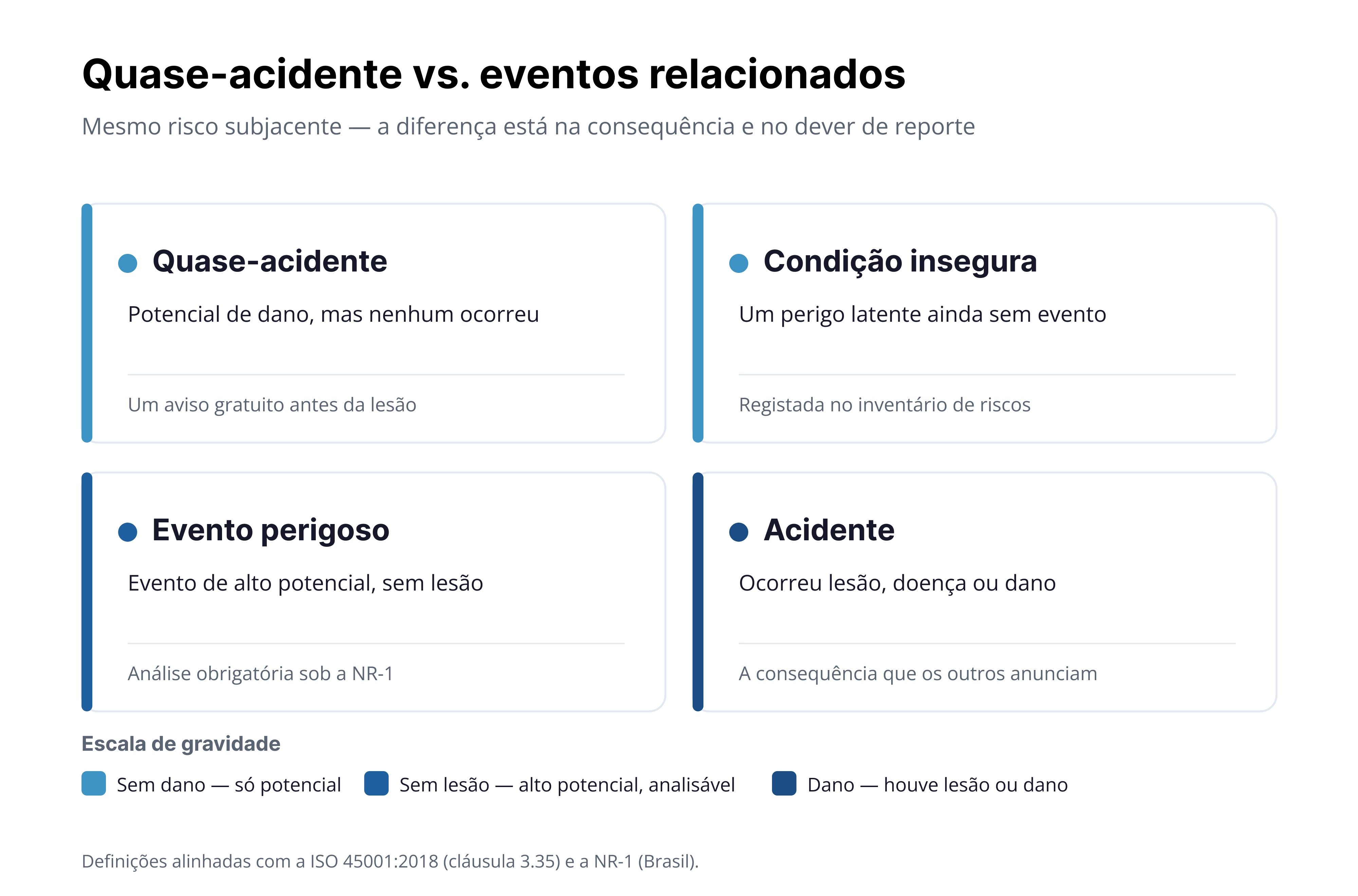
A fronteira prática no Brasil é a CAT. A Comunicação de Acidente deTrabalho existe para acidentes na acepção do Art. 19 da Lei 8.213/1991, queexige lesão corporal ou perturbação funcional. Um quase-acidente, pordefinição, não produz lesão e, portanto, não é comunicável ao INSS via CAT nempelos eventos de SST do eSocial (S-2210, S-2220, S-2240). Isso reforça o pontocentral: o quase-acidente vive fora do reporte legal obrigatório, o que otorna, precisamente, um dado que só existe se a organização decidir capturá-lo.
A ideia de que muitos eventos menores precedem cada evento grave nasceucom Herbert William Heinrich, então responsável de inspeção na seguradoraTravelers, que em 1931 propôs a proporção de 300 eventos sem lesão para 29lesões menores e 1 lesão grave. Heinrich se baseou em mais de 75.000 relatóriosde acidentes e atribuiu 88% dos acidentes a "atos inseguros". Décadasdepois, Frank E. Bird Jr. ampliou o modelo com uma base de aproximadamente 1,7milhão de acidentes reportados por cerca de 300 empresas, chegando à proporçãode 1 lesão grave para 10 lesões menores, 30 danos materiais e 600quase-acidentes.
A leitura moderna é mais cautelosa, e é importante ser rigoroso aqui. Osdados originais de Heinrich se perderam e nunca foram reproduzidos de formaindependente, e autores como Fred Manuele (Professional Safety, 2011)demonstraram que a proporção fixa não é universal: ela varia enormemente porindústria e por tipo de risco. Mais importante, reduzir a frequência deincidentes menores não reduz automaticamente a probabilidade de eventos graves,porque muitas vezes têm precursores diferentes. Estudos sobre Serious Injuriesand Fatalities (SIF), como o de Martin e Black (2015), analisando mais de 1.000incidentes em sete multinacionais, apontam que apenas cerca de 21% dosincidentes registráveis compartilhavam circunstâncias com potencial de SIF.
A conclusão prática não é abandonar a pirâmide, mas usá-la corretamente:os quase-acidentes continuam a ser avisos essenciais, mas o que importa não éapenas contá-los, é filtrar os que têm potencial de consequência grave. Umquase-acidente de baixo potencial e um near miss que quase resultou numafatalidade não valem o mesmo, e tratá-los como equivalentes é um erro que aabordagem SIF veio corrigir.
.webp)
Um reporte que apenas diz "quase caiu uma peça" é ruído; umbom reporte é acionável. A diferença está em capturar contexto suficiente parapermitir análise de causa raiz sem transformar o registro numa tarefaburocrática que ninguém quer fazer. Um reporte útil responde, no mínimo, aoseguinte:
1. O que aconteceu, em linguagem factual e sem busca deculpado — o evento, não a pessoa.
2. Onde e quando — local exato, tarefa em curso, turno econdições no momento.
3. Qual o potencial — o pior resultado plausível se ascircunstâncias tivessem sido ligeiramente diferentes. É este campo que permitepriorizar os near misses de alto potencial.
4. Que barreira falhou — o resguardo, o procedimento, apermissão de trabalho, a formação ou a condição do equipamento.
5. Que ação imediata foi tomada e que ação corretiva sepropõe — ligando o reporte ao ciclo de CAPA (ações corretivas e preventivas).
A cláusula 10.2 da ISO 45001 fecha o ciclo: exige que a organizaçãoreaja ao incidente de forma oportuna, investigue a causa raiz com participaçãodos trabalhadores, avalie se incidentes semelhantes podem ocorrer, implementeações segundo a hierarquia de controles e verifique a eficácia dessas ações. Umquase-acidente que é reportado mas não gera ação é um reporte desperdiçado — eensina a equipe a não voltar a reportar.
O maior inimigo de um programa de quase-acidentes não é a falta deeventos, é o silêncio. A investigação sobre cultura de segurança identifica umconjunto consistente de barreiras. Como, por definição, o near miss "nãodeixa lesão, nem dano, nem sequer prova de que ocorreu", é fácil e muitasvezes conveniente ignorá-lo. A isto somam-se o medo de punição ou de ser vistocomo criador de problemas, a ausência de retorno (nada desmotiva mais do quereportar e nunca saber o que aconteceu), a pressão dos pares e a burocracia deformulários longos.
O sub-reporte é real e mensurável. Um estudo de Probst e Estrada(Accident Analysis & Prevention, 2010) com 425 trabalhadores de cincoindústrias de risco elevado concluiu que o número de acidentes não reportadosera significativamente superior ao dos reportados, e que a subnotificação erapior em ambientes com clima de segurança mais fraco. Se os próprios acidentessão subnotificados, os quase-acidentes — que não deixam rasto — sofrem oproblema de forma ainda mais aguda.
Aumentar o número de quase-acidentes reportados é contraintuitivo: umnúmero que sobe é, quase sempre, boa notícia. Significa que as pessoas confiamno sistema. Os elementos que consistentemente funcionam são poucos econhecidos.
A OSHA reforça, na sua orientação de investigação de incidentes, que oobjetivo é identificar e corrigir causas raiz, "não encontrar culpados ouatribuir culpa". Este princípio, mais do que qualquer campanha decartazes, é o que abre a porta ao reporte honesto.
Reportar quase-acidentes só gera valor de gestão quando o volume setransforma numa métrica comparável ao longo do tempo e entre unidades. Oindicador mais usado para isso é a Near Miss Frequency Rate (NMFR), quenormaliza o número de quase-acidentes reportados por um volume padrão de horastrabalhadas, tipicamente 200.000 ou 1.000.000 de horas-homem.
Near Miss Frequency Rate = (Número de quase-acidentes reportados ×200.000) ÷ Total de horas-homem trabalhadas
O contraintuitivo desta métrica é que, ao contrário da TRIR ou da LTIFR,uma NMFR mais alta costuma ser desejável: indica uma cultura de reporte ativa,não um local mais perigoso. Por isso ela deve ser lida sempre em conjunto comindicadores reativos e com a qualidade dos reportes, não isoladamente.
Para o cálculo detalhado, benchmarks e interpretação por setor, consultea página completa: [NMFR — Near Miss Frequency Rate].
Durante décadas, o reporte de quase-acidentes dependeu de caixas desugestões, formulários em papel e planilhas. O resultado era previsível:reportes que se perdiam, chegavam tarde ou nunca eram analisados, e um operadorno campo sem rede simplesmente não tinha como registrar o evento no momento emque ele acontecia. O atrito analógico é a explicação mais simples para asubnotificação crônica.
Um software EHSQ muda a economia do reporte. Quando o operador consegueregistrar um quase-acidente a partir do celular, em segundos, mesmo offline,com sincronização automática quando a rede volta, o custo de reportar cai paraperto de zero — e o volume de dados de qualidade sobe. O mesmo sistemaencaminha o reporte, abre automaticamente o ciclo de CAPA com responsável eprazo, e dá visibilidade em tempo real ao gestor de SST, eliminando o intervaloentre o evento e a ação.
O salto seguinte é preditivo. Ao tratar os quase-acidentes como leadingindicators estruturados, e ao correlacioná-los com permissões de trabalho,inspeções e observações, é possível antecipar onde um evento grave está seformando antes de ele acontecer. É esta a lógica por trás da prevenção de SIF:parar de contar apenas o que já deu errado e começar a agir sobre osprecursores que ainda são invisíveis a quem só olha para os acidentesconsumados.
.webp)
Ambos são o mesmo tipo de evento; a diferença reside na consequência. Um acidente resulta em ferimentos, doenças ou danos; um quase acidente teve o mesmo potencial, mas, por circunstância ou sorte, não produziu consequências. É por isso que um quase acidente é tratado como um aviso: expõe a falha sem cobrar o preço.
São conceitos próximos, mas não idênticos. "Quase-acidente" é o termo técnico consagrado para o evento sem lesão com potencial de dano. "Evento perigoso" é a expressão que a NR-1 usa no Brasil, definida como a ocorrência com potencial de causar lesões ou agravos à saúde; na prática, corresponde ao quase-acidente de alto potencial, que o item 1.5.5.5.1.1 manda analisar quando poderia ter consequências graves. Ou seja, todo evento perigoso é um quase-acidente, mas nem todo quase-acidente alcança o grau de severidade que a norma destaca.
Não de forma direta. A NR-1 exige a análise de eventos perigosos quepoderiam ter consequências graves, o que abrange o near miss de alto potencialdentro do PGR, mas não existe uma obrigação de comunicação externa equivalenteà CAT. O quase-acidente não é comunicável via CAT nem pelo eSocial, porque nãohá lesão. Capturá-lo é boa prática de gestão, não um requisito de reportelegal.
Não. A CAT (Lei 8.213/1991) aplica-se a acidentes de trabalho, queexigem lesão corporal ou perturbação funcional. Como o quase-acidente, pordefinição, não produz lesão, ele fica fora do âmbito da CAT e dos eventos deSST do eSocial.
É a ideia, originada em Heinrich e ampliada por Bird, de que muitoseventos sem lesão precedem cada evento grave. Continua útil como lembrete deque os avisos existem em grande número, mas a proporção fixa não é universal ereduzir eventos menores não reduz automaticamente os graves. Por isso a práticamoderna se foca em identificar os quase-acidentes de alto potencial, não apenasem contá-los todos.
É um quase acidente cujo pior resultado plausível teria sido um ferimento grave ou uma fatalidade, caso as circunstâncias tivessem sido ligeiramente diferentes. Distingui-los de quase acidentes triviais é o que permite às equipas concentrar recursos onde o risco de SIF é real.
Quase sempre o contrário. Um aumento de reportes normalmente indicamaior confiança na cultura de segurança, não mais perigo. Por isso a Near MissFrequency Rate deve ser lida como um indicador proativo, e uma queda súbita azero costuma ser um sinal de alerta, não de sucesso.
Um bom reporte identifica a barreira que falhou e alimenta diretamenteuma ação corretiva e preventiva, com responsável e prazo. A cláusula 10.2 daISO 45001 exige investigar a causa raiz, agir segundo a hierarquia de controlese verificar a eficácia. Sem esse fechamento de ciclo, o reporte não se converteem prevenção.
Um bom relatório identifica a barreira que falhou e alimenta diretamente uma ação corretiva e preventiva, com um responsável e um prazo. A cláusula 10.2 da ISO 45001 exige a investigação da causa raiz, a atuação de acordo com a hierarquia de controlos e a verificação da eficácia. Sem esse fecho de ciclo, o relatório não se transforma em prevenção.
O Glartek é um software EHSQ que permite ao operador reportar umquase-acidente a partir do celular em segundos, mesmo offline, e sincronizaautomaticamente quando a rede volta. A partir daí, abre o ciclo de CAPA comresponsável e prazo, dá visibilidade em tempo real ao gestor de SST e trata osquase-acidentes como leading indicators, ajudando a antecipar eventos graves emvez de apenas registrar os que já aconteceram.
Solicite uma demonstração
Inicie sua jornada em EHSQ (SSMA) com a Glartek e torne-se um líder no seu setor.
Agende uma demonstração.webp)
Descubra o poder da única Solução EHSQ (SSMA) nativa em IA desenvolvida para a linha de frente

.webp)