Safety culture is the product of the individual and group values, attitudes, perceptions, competencies and patterns of behaviour that determine an organisation's commitment to health and safety, and the style and proficiency of its management. Organisations with a positive safety culture are characterised by communication founded on mutual trust, shared perceptions of the importance of safety, and confidence in the efficacy of preventive measures.
Safety culture, sometimes called a culture of prevention, is how an organisation treats safety when no one is checking. It is the set of shared values, attitudes and behaviours that define what counts as normal and acceptable in day-to-day work. The most widely quoted shorthand describes it as “the way we do things around here”: culture is the context in which each person judges whether their behaviour is appropriate, which is why it can influence safety outcomes as much as the management system itself.
The term originated in the nuclear industry. After the Chernobyl accident in 1986, the IAEA's International Nuclear Safety Advisory Group formally introduced the concept in its INSAG-4 report of 1991, describing it as the assembly of characteristics and attitudes that ensures safety receives the attention its significance warrants. The reference definition for occupational safety was consolidated by the ACSNI committee and is reproduced by the UK Health and Safety Executive: the product of values, perceptions, competencies and patterns of behaviour that determine an organisation's commitment to, and the proficiency of, its safety management.
In Europe and the UAE the regulatory anchor is ISO 45001:2018, which is widely adopted across both regions. The standard does not define “safety culture” as a term, but it makes two of its foundations mandatory: clause 5.1 requires top management to develop, lead and promote a culture that supports the intended outcomes of the OH&S management system, and clause 5.4 requires the consultation and participation of workers at all levels. The EU Framework Directive 89/391/EEC sits beneath this, establishing the employer's general duty to ensure safety and the workers' right to information, consultation and balanced participation, the legal foundation of a participative culture across the EU.
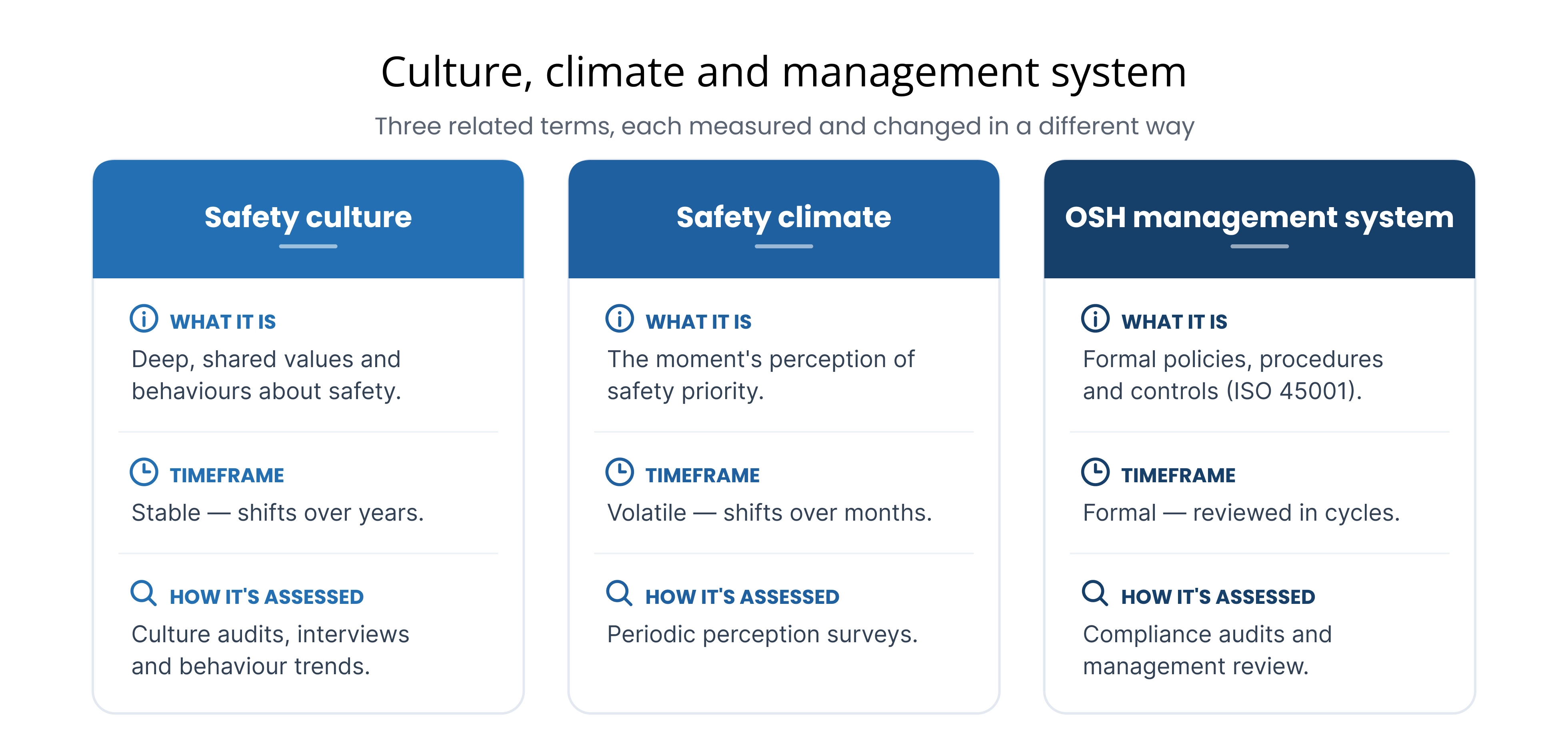
The two terms are used interchangeably, but they describe different things, and the distinction is practical. Safety culture is deep and stable: the values and behaviours that have settled over years. Safety climate is the snapshot of those values, that is, the perception people hold about safety at a given moment. Climate is the visible, measurable manifestation of culture.
The consequence is methodological. You do not measure culture directly, you measure climate, usually through perception surveys that ask teams whether leadership takes safety seriously, whether it is safe to report an error, and whether they trust the preventive measures in place. The HSE provides its Safety Climate Tool for exactly this purpose. A climate survey is the starting point, not the destination: the value lies in acting on the results, not in filing them away.
A safety management system defines what people should do. Culture defines what they actually do when the procedure is inconvenient, when production is under pressure, or when no one is watching. This is why the HSE states that an organisation's culture can have as big an influence on safety outcomes as the management system itself, and that a poor culture has contributed to many major incidents.
Culture is what separates a safety programme that works on paper from one that works on the shop floor. Without a reporting culture, near misses never reach the system, investigations stay incomplete and risk assessments rest on guesswork. A mature culture turns every operator into a sensor, giving the EHS manager the real-time visibility that no periodic audit can match.
The argument is one of risk and return. Every disabling injury and every fatality carries a high human and financial cost, and a weak culture is a latent risk factor that does not appear on the balance sheet until the day of the incident. OSHA and the ISSA hold that investing in prevention pays back, and culture is the multiplier on that investment: the same technology and the same procedures produce very different results depending on whether people adopt them or work around them.
Safety culture is one of the most reliable thermometers of organisational trust. When people report without fear, they signal that they trust their managers and feel part of the solution. That trust correlates with retention, engagement and operational quality, because the same culture that makes someone stop an unsafe machine also makes that person flag a quality issue or an inefficiency.
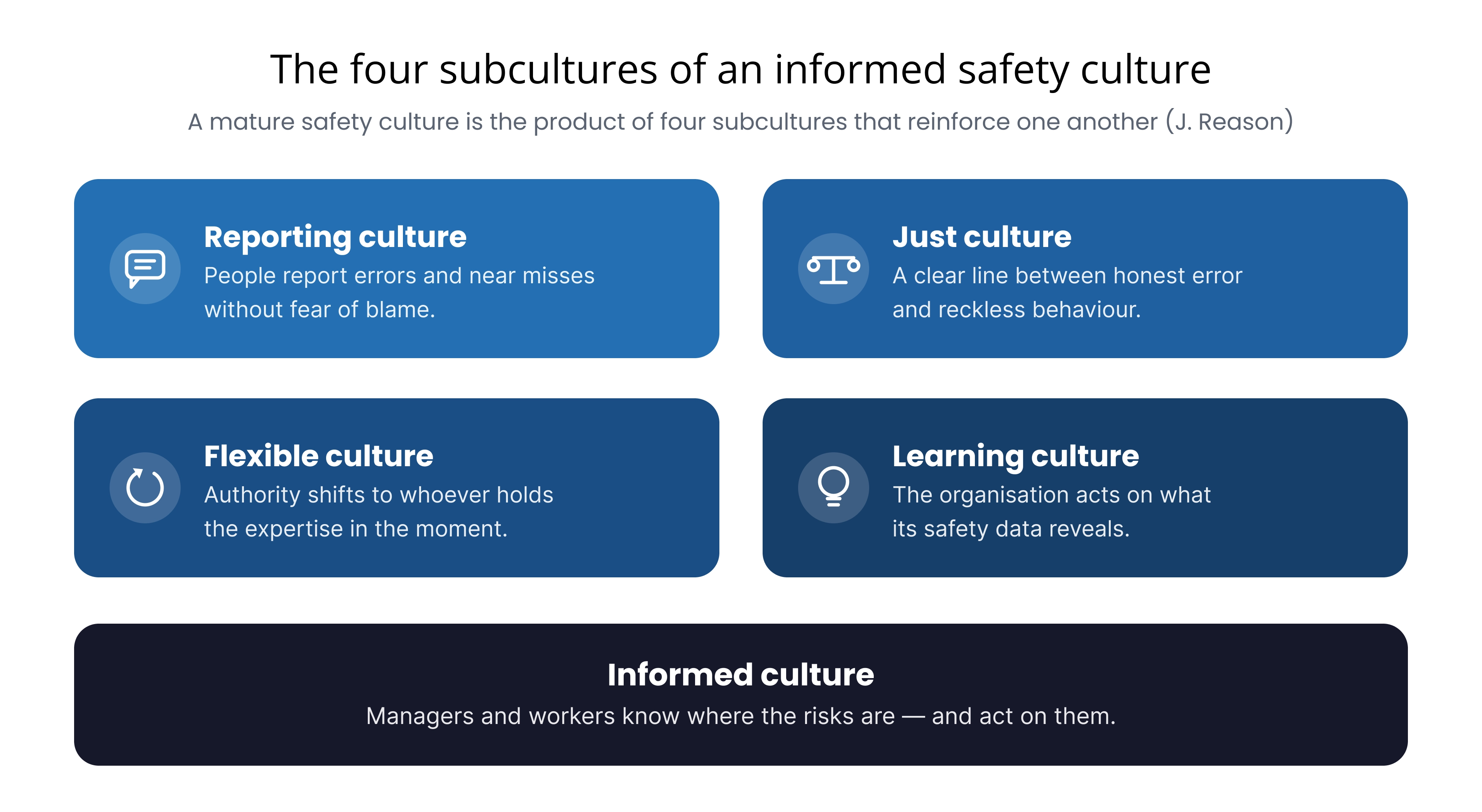
The most widely used model for breaking down a safety culture is James Reason's, which describes an “informed culture” as the product of four interdependent sub-cultures, underpinned by visible leadership commitment and genuine worker participation. None works in isolation: a reporting culture without a just culture collapses the first time an error is punished.
The HSE adds to this base the dimensions that most influence culture in practice: management commitment and style, employee involvement, training and competence, communication, compliance with procedures, and organisational learning. ISO 45001:2018 formalises two of these as a requirement: clause 5.1 obliges top management to develop and promote a culture that supports the outcomes of the management system, and clause 5.4 requires the consultation and participation of workers, including non-managerial staff.
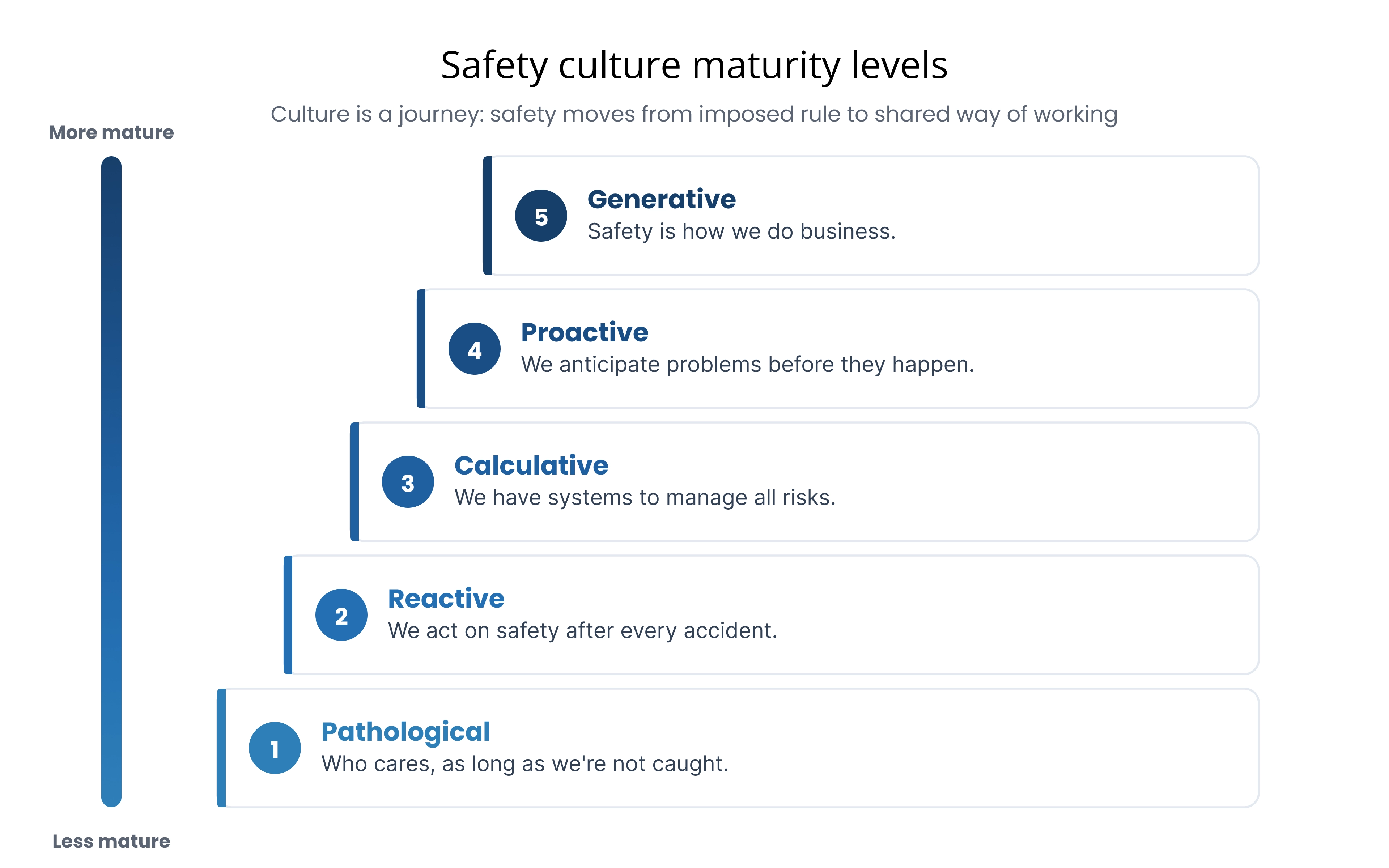
Safety culture is not a switch that is either on or off; it evolves in stages. Several models describe this progression and all share the same trajectory: from a reactive stance, in which safety exists only after the accident and someone is blamed, to a generative stance, in which safety is built into everything the organisation does. The Hudson and Parker model, widely used in the energy sector, describes five stages.
The best-known model in management is the Bradley Curve, which describes four stages (reactive, dependent, independent and interdependent) and links cultural progression to falling injury rates. For a detailed explanation of the stages and how to use the model as a diagnostic tool, refer to the full page: [Bradley Curve]
On a mature line, an operator stops the machine and reports a removed guard without waiting for a supervisor, and a quality non-conformity is flagged by the same person, in the same flow. Weak culture appears when “we have always done it this way” wins over the procedure and shortcuts are tolerated under production pressure.
In distributed field work, often without on-site supervision, culture is what ensures the permit to work is respected even when no one is checking. A mature team refuses to start a task at height or in a confined space without a validated permit, and reports a near contact with an overhead line rather than hiding it.
Process safety depends on a culture that values weak signals. An overpressure event in which the relief valve acted before the vessel ruptured is a valuable warning, and a strong culture investigates it with the same rigour as a real accident, rather than dismissing it because “nothing happened”.
The hazards of steam, hot liquor and roller nips require the team to speak openly about what nearly went wrong. A mature culture treats a report of a near contact with a moving roller as a valued contribution, not as an admission of personal failure.
Where the risk is a fatal accident, culture is the last barrier when procedure and supervision fail. In a mature operation, the contractor themselves stops the task and reports an unstable slope or a misplaced vehicle without fear of reprisal, and a near miss with mobile plant is logged rather than kept quiet. It is culture that makes safety survive distance, the night shift and the turnover of contractor crews.
Here quality culture and safety culture converge: the operator who reports an ammonia leak from the refrigeration system is the same one who flags a contamination risk. A strong culture is what makes a BRC or IFS audit a permanent state rather than a last-minute scramble.
Building culture is hard; destroying it is easy. The most common mistakes are well known and avoidable.
There is no shortcut, but there is a recognisable path. These actions move culture in the right direction and reinforce one another.
Culture cannot be captured in a single number, but it reveals itself in the balance between lagging and leading indicators. Lagging indicators, such as TRIR (Total Recordable Incident Rate) and LTIFR (Lost Time Injury Frequency Rate), count what has already gone wrong. They are necessary, but they arrive late and can be distorted by under-reporting, that is, by a weak culture. An organisation that looks only at these numbers is driving by the rear-view mirror.
Leading indicators reveal the health of the culture before the accident. The most telling is the near-miss reporting rate, because a high value signals confidence to report, not more danger. Other useful signals are the percentage of corrective actions closed on time, participation rates in training and observations, and the results of safety climate surveys. The near-miss reporting rate is often normalised in the same way as lagging indicators:
Near-miss reporting rate = (Number of reported near misses × 200,000) ÷ Total hours worked
Unlike TRIR, a higher value is usually desirable, because it points to a living reporting culture. For the detailed calculation, benchmarks and sector interpretation, refer to the full page: [NMFR — Near Miss Frequency Rate].
For decades, safety culture relied on suggestion boxes, paper forms and meetings. The result was predictable: reporting was slow, information was lost, and the operator rarely saw any consequence of what they reported. Technology does not create culture, but it removes the friction that stops culture from growing.
EHSQ (Environment, Health, Safety & Quality) software changes the economics of reporting and response. When an operator can log a near miss from a mobile phone, in seconds and even offline, reporting stops competing with the work. When each report automatically generates a corrective action with an owner and a deadline, and the team sees the loop close, the trust that sustains culture is reinforced with every iteration. This is how technology makes culture visible and traceable, instead of leaving it dependent on memory and goodwill.
The next step is predictive. By treating near misses and observations as structured leading indicators, and correlating them with permits to work, training and incident history, EHSQ software helps anticipate where the next serious event is most likely, moving management from reaction to prevention.

It is how an organisation treats safety day to day, especially when no one is checking. It is captured by “the way we do things around here”: the set of shared values and behaviours that determine whether people act safely out of conviction or only out of obligation.
Culture is deep and stable, built over years. Climate is the snapshot of that culture, that is, the perception people hold about safety right now. You measure climate, usually through a survey, to infer the state of the culture.
It originated in the nuclear industry after the Chernobyl accident in 1986. The IAEA's International Nuclear Safety Advisory Group formalised the term in its INSAG-4 report in 1991, and it was later adopted by occupational safety through the ACSNI committee definition reproduced by the UK HSE.
Not directly. It is assessed through a set of indicators: safety climate surveys, the near-miss reporting rate, the percentage of corrective actions closed on time, and participation in training and observations. The balance between lagging and leading indicators reveals the maturity of the culture.
They are ladders that describe how culture evolves in stages, from reactive to generative. The best known are the Hudson and Parker model, with five stages (pathological to generative), and the Bradley Curve, with four (reactive to interdependent).
It is a climate of trust in which honest error is treated as a learning opportunity, without punishment, while keeping a clear line for gross negligence. It is what allows people to report, and so it is the foundation of any reporting culture.
Because they are lagging indicators: they only move after someone is hurt and can be distorted by under-reporting. Managing them in isolation creates a false sense of safety. They must be combined with leading indicators that reveal risk before the accident.
Almost always the opposite. A rise in reports usually indicates greater confidence in the culture, not more danger. A site with few reports is rarely safe; it is usually just silent.
The whole organisation, but the primary responsibility lies with top management. Culture descends from the top: ISO 45001 goes as far as requiring, in clause 5.1, that management actively develop and promote a supportive safety culture.
Glartek is EHSQ software that removes the friction from reporting: the operator logs a near miss or an observation from a mobile phone, in seconds and offline, and each report automatically generates a corrective action with an owner and a deadline. By closing the loop visibly and turning field data into leading indicators, Glartek makes safety culture measurable and helps management act before the incident.
Request your demo
Start your EHSQ software journey with Glartek and become a leader in your industry.
Schedule Demo
Discover the power of the only AI-Native EHSQ software built for the frontline