CAPA (Corrective Action and Preventive Action, ou ação corretiva e preventiva) é a abordagem sistemática que elimina as causas de não conformidades já ocorridas (ação corretiva) e de não conformidades potenciais (ação preventiva), de modo a evitar respetivamente, a recorrência e a ocorrência de problemas de segurança, saúde, ambiente e qualidade.
CAPA, sigla de Corrective Action and Preventive Action (ação corretiva e preventiva), é o processo estruturado que uma organização usa para tratar as causas de problemas de segurança, saúde, ambiente e qualidade (EHSQ), e não apenas os seus sintomas. A ação corretiva elimina a causa de uma não conformidade que já ocorreu, para que ela não se repita. A ação preventiva elimina a causa de uma não conformidade que ainda não ocorreu, mas que os dados indicam ser provável.
Na prática, o CAPA é o elo que transforma um evento isolado, seja uma reclamação, um desvio, uma não conformidade de auditoria, um incidente ou um quase-acidente, numa ação com responsável, prazo, causa raiz identificada e eficácia comprovada. Sem CAPA, as organizações tendem a apagar incêndios repetidamente, corrigindo o mesmo problema vez após vez sem nunca eliminar a sua origem.
O conceito nasceu na indústria regulada, sobretudo farmacêutica e de dispositivos médicos, mas hoje é central em qualquer sistema de gestão baseado no ciclo PDCA (Planejar, Fazer, Verificar, Agir). Em segurança do trabalho, o CAPA é a resposta natural exigida pela cláusula 10.2 da ISO 45001 e alimenta o Plano de Ação do Programa de Gerenciamento de Riscos (PGR) previsto na NR-1 brasileira.
O CAPA é a ferramenta que fecha o ciclo entre identificar um risco e eliminá-lo de forma duradoura. Um sistema de CAPA maduro permite mostrar, com evidência documentada, que cada incidente ou não conformidade gerou uma ação de causa raiz e que essa ação foi verificada quanto à sua eficácia. É exatamente isto que um auditor de ISO 45001 procura na cláusula 10.2, e o que separa uma cultura reativa de uma cultura preventiva.
Problemas que se repetem custam dinheiro: refugo, retrabalho, paradas de produção, recalls, multas e prêmios de seguro. Cada CAPA que elimina uma causa raiz corta um custo recorrente na origem, em vez de o pagar repetidamente. Uma taxa de recorrência baixa e uma taxa de encerramento saudável são sinais objetivos de que o sistema de gestão está a reduzir risco, e não apenas a documentá-lo.
A qualidade das ações corretivas depende de quem está na linha de frente. Quando as equipes de operação participam da investigação de causa raiz e veem as suas sugestões implementadas, a confiança no sistema cresce e o reporte de problemas aumenta. Um CAPA que ignora o conhecimento de quem opera o processo tende a produzir ações superficiais que não resistem ao dia a dia.
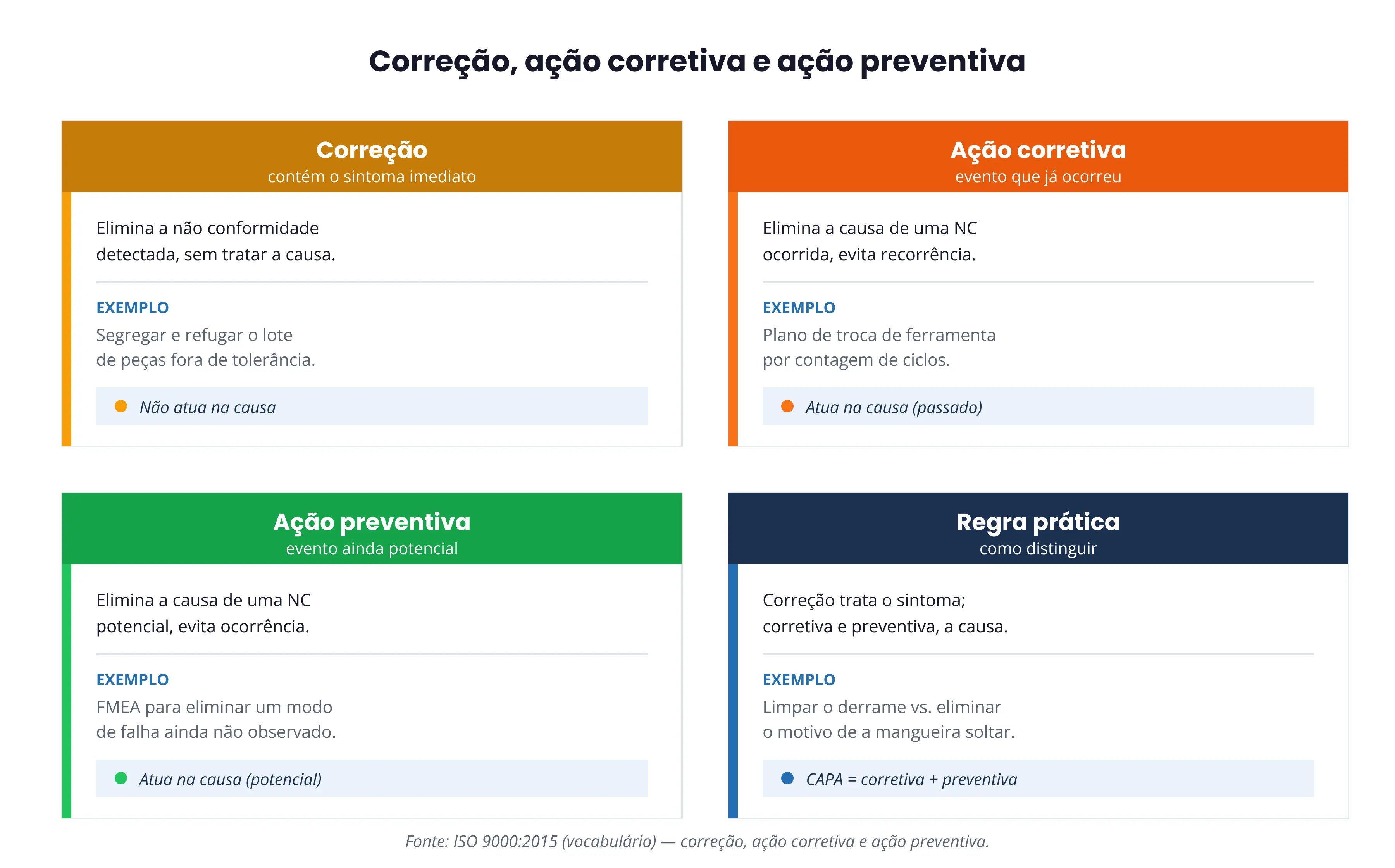
Esta é a distinção mais confundida em todo o tema, e a que mais gera não conformidades em auditoria. As três respostas atuam em momentos e profundidades diferentes. O vocabulário oficial está na ISO 9000:2015.
A distinção mais crítica é entre correção e ação corretiva. Limpar um derrame é correção; descobrir por que a mangueira se soltou e tornar o acoplamento à prova de erro é ação corretiva. Um CAPA que fica apenas na correção nunca reduz risco de forma permanente, porque o problema volta assim que as condições se repetem.
O CAPA aparece, com nomes e ênfases diferentes, em várias das principais estruturas normativas de qualidade e de segurança. Conhecer o enquadramento evita interpretações erradas, sobretudo quanto ao termo ação preventiva.
A ISO 9001:2015 mantém a ação corretiva na cláusula 10.2 (não conformidade e ação corretiva), mas deixou de ter uma cláusula separada de ação preventiva, que existia na versão de 2008. O conceito de prevenção foi absorvido pelo pensamento baseado em risco (risk-based thinking) da cláusula 6.1, que trata as ações para abordar riscos e oportunidades. Na prática, a prevenção deixou de ser um procedimento isolado e passou a ser uma característica de todo o sistema de gestão.
Em segurança e saúde ocupacional, a cláusula 10.2 exige que, perante um incidente ou não conformidade, a organização reaja e controle, trate as consequências, avalie com a participação dos trabalhadores a necessidade de ação corretiva para eliminar a causa raiz, verifique se existem não conformidades semelhantes noutros pontos, implemente as ações segundo a hierarquia de controlos e reveja a eficácia das ações tomadas. É a definição operacional de um bom CAPA em SST.
Na indústria de dispositivos médicos, o CAPA é um requisito formal do 21 CFR 820.100, que exige procedimentos para analisar fontes de dados de qualidade, investigar a causa das não conformidades, verificar ou validar as ações, implementar as mudanças e submeter tudo à revisão pela gestão. Na farmacêutica, o ICH Q10 define o sistema CAPA como um dos quatro elementos do sistema de qualidade, com nível de esforço proporcional ao risco. Nota de atualidade: a regra QMSR da FDA, que harmoniza a Part 820 com a ISO 13485:2016, torna-se efetiva em fevereiro de 2026.
Não existe um número de etapas imposto por lei; as normas definem requisitos e as organizações traduzem-nos em modelos de seis a oito passos. O ciclo consolidado abaixo, com sete etapas, cobre o que auditores e reguladores esperam encontrar.
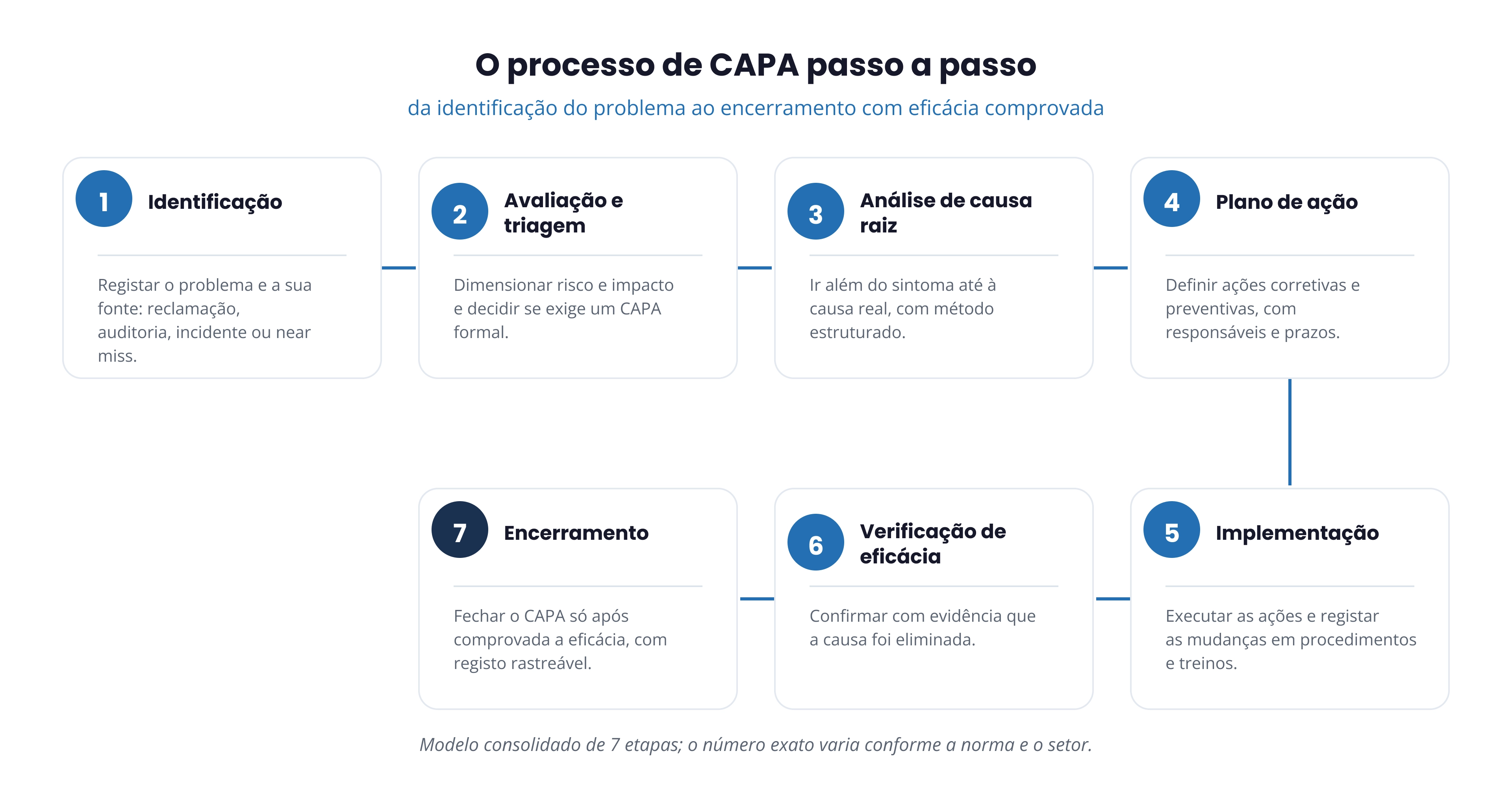
1. Identificação. Registar e descrever o problema ou a não conformidade, com a sua fonte: reclamação, auditoria, desvio, incidente, quase-acidente ou inspeção.
2. Avaliação e triagem. Dimensionar magnitude, risco e impacto para decidir se o caso exige um CAPA formal. A triagem baseada em risco evita abrir CAPA para tudo.
3. Investigação e análise de causa raiz. Ir além do sintoma até à causa real, com uma metodologia estruturada (ver secção 6).
4. Plano de ação. Definir as ações corretivas e, quando aplicável, preventivas, com responsáveis e prazos claros.
5. Implementação. Executar as ações e registar as mudanças em procedimentos, equipamentos ou treinos.
6. Verificação de eficácia. Confirmar, com evidência, que a causa foi eliminada e que a ação não introduziu novos problemas. É a etapa mais negligenciada e a mais fiscalizada.
7. Encerramento e documentação. Fechar o CAPA apenas depois de comprovada a eficácia, mantendo a informação documentada rastreável.
Um CAPA vale o que vale a sua análise de causa raiz. Se a investigação para no primeiro sintoma, a ação corretiva será superficial e o problema volta. As quatro ferramentas seguintes são as mais usadas e escolhem-se conforme a complexidade do caso.
Método iterativo, criado na Toyota, que pergunta por que sucessivamente até chegar à causa fundamental. Simples e rápido, ideal para problemas de causa relativamente linear. O risco é parar cedo demais e confundir uma causa intermédia com a causa raiz.
Diagrama de causa e efeito que organiza as causas potenciais em categorias, tipicamente os 6 M: Máquina, Método, Material, Mão de obra, Medição e Meio ambiente. Útil quando o problema pode ter várias causas concorrentes e é preciso estruturar a discussão da equipe.
Metodologia da Ford para problemas complexos e recorrentes, com oito etapas que vão da formação da equipe e da contenção provisória até à ação corretiva permanente e à prevenção de recorrência. Muito usada na indústria automóvel e na relação com fornecedores.
Ferramenta essencialmente preventiva, que antecipa modos de falha e prioriza ações antes de o problema ocorrer. Tradicionalmente usava o número de prioridade de risco (severidade × ocorrência × deteção); a edição AIAG-VDA de 2019 substituiu-o pela priorização por ação (Action Priority). É a ponte natural entre CAPA e ação preventiva.
Um lote de peças sai fora de tolerância. A correção é segregar e refugar o lote. A investigação revela que o desgaste da ferramenta não tinha plano de troca. A ação corretiva é instituir a substituição por contagem de ciclos; a ação preventiva é um FMEA de processo que estende o mesmo controlo a máquinas semelhantes.
Uma proteção de subestação dispara indevidamente e interrompe o fornecimento. A correção é repor o serviço. A causa raiz é uma parametrização de relé desatualizada. A ação corretiva revê os ajustes desse relé; a preventiva aplica gestão da mudança para atualizar setpoints em toda a frota de equipamentos equivalentes.
Ocorre um derrame durante a transferência de um reagente. A correção é conter e limpar. A causa raiz é um procedimento sem verificação do acoplamento da mangueira. A ação corretiva acrescenta checklist e treino; a preventiva substitui os acoplamentos por engates à prova de erro (poka-yoke).
A máquina de papel para por quebra de folha. A correção é reenfiar e retomar. A causa raiz é a variação de humidade não controlada. A ação corretiva introduz controlo estatístico de processo; a preventiva instala um sensor de humidade em malha fechada.
Um ensaio devolve um resultado fora de especificação (OOS). A correção é reter o lote. A investigação estruturada, exigida pelo ICH Q10, identifica uma calibração de equipamento fora de prazo. A ação corretiva recalibra e reanalisa; a preventiva cria alertas automáticos de calibração e revê a periodicidade.
Um detetor de metais acusa a presença de corpo estranho. A correção é reter e, se necessário, recolher o produto. A causa raiz é um ponto crítico de controlo (CCP) do plano HACCP mal ajustado. A ação corretiva reajusta e reverifica o detetor; a preventiva institui verificação por turno e revê o plano HACCP.
O erro mais frequente: tratar o sintoma e dar o caso por encerrado. Sem eliminar a causa, o problema regressa e o histórico enche-se de ocorrências repetidas.
Parar cedo demais nos 5 Porqués ou aceitar erro humano como causa final. Quase sempre há um fator de sistema por trás, um procedimento ambíguo, uma ferramenta inadequada ou um treino em falta.
Fechar o CAPA sem comprovar que a ação resolveu o problema. É um dos achados mais recorrentes em cartas de advertência da FDA e uma falha grave em auditoria ISO.
Abrir CAPA formal para cada pequeno desvio sobrecarrega o sistema, gera backlog e faz com que os casos verdadeiramente críticos percam prioridade. A triagem baseada em risco é o antídoto.
Registos dispersos em planilhas e e-mails tornam impossível demonstrar o ciclo completo a um auditor e dificultam a análise de recorrência entre áreas.
A gestão de CAPA só se torna estratégica quando é medida. A métrica mais direta é a taxa de encerramento de CAPA (CAPA Closure Rate), que mostra a capacidade da organização de fechar as ações que abre, dentro do prazo.
CAPA Closure Rate (%) = (CAPAs encerradas no período ÷ CAPAs abertas no período) × 100
Uma taxa de encerramento saudável é um indicador reativo (lagging): mede o desempenho do que já aconteceu. Deve ser lida em conjunto com indicadores proativos (leading), como o tempo médio de encerramento e, sobretudo, a taxa de recorrência, que revela se as ações estão de fato a eliminar causas raiz ou apenas a fechar registos. Uma taxa de encerramento alta com recorrência alta é um sinal de alerta: fecham-se muitos CAPA, mas os problemas voltam.
Durante décadas, o CAPA viveu em formulários de papel e, mais tarde, em planilhas. O modelo funcionava para volumes baixos, mas ruía com a escala: prazos perdidos, registos dispersos, dificuldade em provar a eficácia e quase nenhuma visibilidade sobre recorrência entre áreas ou plantas.
A digitalização muda o jogo quando toda a equipe, da linha de frente à gestão, usa um sistema EHSQ integrado. Uma não conformidade, um incidente ou um quase-acidente reportado no chão de fábrica abre automaticamente um fluxo de CAPA, com triagem por risco, responsável, prazo e lembretes. A análise de causa raiz, a verificação de eficácia e o encerramento ficam registados no mesmo lugar, com trilha de auditoria completa.
Com os dados centralizados, a gestão passa da reação à antecipação: correlaciona CAPA com leading indicators, deteta padrões de recorrência antes que se tornem incidentes graves e prioriza os recursos onde o risco é maior. O CAPA deixa de ser um arquivo de conformidade e torna-se um motor de melhoria contínua.
.webp)
CAPA significa Corrective Action and Preventive Action, ou ação corretiva e preventiva. Designa o processo estruturado que elimina as causas de não conformidades já ocorridas e de não conformidades potenciais.
A correção elimina o sintoma imediato de uma não conformidade detectada, por exemplo segregar um lote defeituoso. A ação corretiva vai à causa desse problema para evitar que ele se repita, por exemplo alterar o procedimento que o originou.
A ISO 9001:2015 deixou de ter uma cláusula separada de ação preventiva. O conceito foi incorporado no pensamento baseado em risco da cláusula 6.1. A ação corretiva permanece na cláusula 10.2. Na prática, a prevenção passou a ser uma característica de todo o sistema de gestão.
Não há um número fixo imposto por norma. Os modelos mais comuns têm entre seis e oito etapas. Um ciclo consolidado inclui identificação, triagem, análise de causa raiz, plano de ação, implementação, verificação de eficácia e encerramento.
O CAPA formal é um requisito regulatório na indústria de dispositivos médicos e farmacêutica. Fora dela, o conceito é igualmente exigido de forma equivalente pela ISO 45001 (cláusula 10.2) e pela ISO 9001 (ação corretiva), e é boa prática em qualquer sistema de gestão.
A análise de causa raiz é uma etapa dentro do CAPA, a que identifica a origem do problema. O CAPA é o processo completo, que inclui ainda o plano de ação, a implementação, a verificação de eficácia e o encerramento.
É a etapa que confirma, com evidência, que a ação implementada eliminou de facto a causa do problema e não introduziu novos riscos. Sem ela, não é possível saber se o CAPA funcionou, e é um dos pontos mais fiscalizados em auditoria.
As não conformidades, os incidentes e os quase-acidentes alimentam o Plano de Ação do Programa de Gerenciamento de Riscos (PGR) exigido pela NR-1, com medidas de prevenção, responsáveis, prazos e acompanhamento da eficácia. É o mesmo princípio do CAPA aplicado à gestão de riscos ocupacionais.
As principais são a taxa de encerramento (CAPA Closure Rate), o tempo médio de encerramento, a taxa de encerramento no prazo e, sobretudo, a taxa de recorrência, que mostra se as ações estão realmente a eliminar as causas raiz.
Um software EHSQ como a Glartek automatiza o fluxo do CAPA de ponta a ponta: abre a ação a partir do reporte, aplica triagem por risco, atribui responsáveis e prazos, guarda a análise de causa raiz e a verificação de eficácia com trilha de auditoria, e correlaciona os dados para revelar padrões de recorrência antes que se tornem incidentes graves.
Solicite uma demonstração
Inicie sua jornada em EHSQ (SSMA) com a Glartek e torne-se um líder no seu setor.
Agende uma demonstração.webp)
Descubra o poder da única Solução EHSQ (SSMA) nativa em IA desenvolvida para a linha de frente

.webp)