November 18, 2026
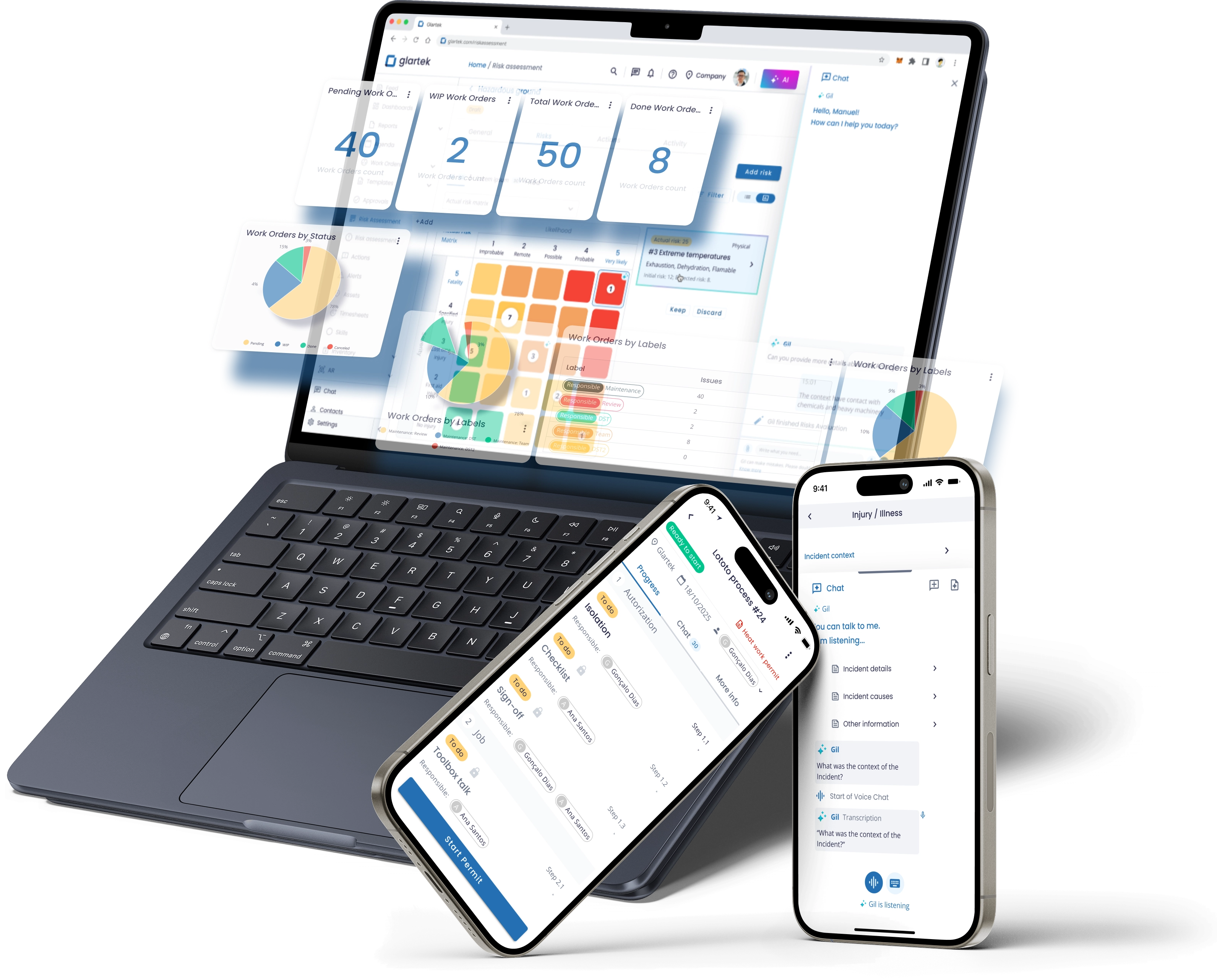
AI for workplace safety has become one of the most crowded phrases in the EHS market, and much of what it promises never actually touches the shop floor, which is why the useful question is narrower than the pitch: what can artificial intelligence really do with the health and safety data your team already captures, and where does it still need a person to decide? This article answers that across three verbs that, taken together, describe how the technology earns its place rather than merely borrowing the label, predict, prevent and protect.
It helps to read those three as a sequence rather than a slogan, because each one depends on the one before it: prediction turns scattered field data into early signals, prevention acts on those signals before an incident has the chance to form, and protection keeps both the people who do the work and the judgement of the professionals who manage them at the centre of every call the software recommends.
AI for workplace safety is the use of machine learning and related techniques to read the data an operation already collects about its own risks, from observations, near misses and inspections to permits to work and corrective actions, and to surface the patterns a person would struggle to see in time.
In an EHSQ software context that distinction matters, because the technology works on the records your team enters rather than on cameras watching the floor or wearables tracking bodies, and keeping it there is what separates a safety tool from a surveillance one.
A good deal of what is sold as AI-powered safety is really marketing wrapped around a dashboard, so the honest test is whether the model is anchored to a concrete problem and a measurable result, and when a vendor cannot name the decision the AI is meant to improve, the label deserves caution. Analysts have landed on much the same point, since Gartner's market guide for EHS software highlights the value of AI in serious injury and fatality precursor detection and in data quality analysis far more than in automation pursued for its own sake.
Most safety data exists to describe the past, and a model changes what that data is for by turning a record of what happened into a warning about what might. Reading across thousands of observations, near misses, inspections and permits, AI can group the weak signals that tend to precede a serious event and show where they are clustering, whether around a particular site, task, shift or contractor, so the analysis stops being case by case and becomes a reading of pattern.
This matters because the events that hurt people most are rarely the ones a recordable rate is tracking, a gap we explore in our article on why reducing accidents is not the same as reducing serious injuries and fatalities, and detecting those patterns over data you have already captured is what brings an operation closer to the right precursors without ever reaching for surveillance. It is also where the market's priorities now sit, since reducing SIFs has become the single top operational priority for EHS functions, and prediction grounded in real field data is precisely where that ambition pays off.
A prediction that no one acts on changes nothing, which is why prevention is the point where operational AI has to meet the frontline rather than the back office. In the flow of work the software can flag a likely error as a form is being filled in, suggest the control or procedure that fits the hazard at hand, and prioritise which of a hundred open risks deserves attention first, so that for the EHS manager a corrective action arrives already routed to an owner with a due date instead of languishing in a spreadsheet, and for the operator it shows up as guidance in the moment rather than a reprimand after the fact.
Programmes that set proactive targets, more observations and faster near-miss capture, have consistently shown sharp falls in injury rates, and AI reinforces that shift by lifting some of the administrative weight that pulls EHS teams away from prevention in the first place, the hours otherwise lost to audits, reports and closing out corrective actions. The focus here is deliberately different, because what earns the technology its place is not the faster report but the prevention decision taken before the harm.
The last verb is the one the market talks about least and the one that matters most, and protecting a workforce with AI starts from a single rule: the software recommends, and people decide. A model that cannot explain why it flagged a task is a model your team can neither defend to a regulator nor trust on a bad day, so explainability stops being a nice-to-have and becomes a requirement, and in Europe frameworks such as the EU AI Act are moving in the same direction by expecting higher-risk AI to remain explainable and under human supervision.
Protection also means refusing to let safety AI become an instrument of blame, so that when the data points to a failure the useful question is which barrier was missing rather than which individual slipped, which is simply the logic of a just culture applied to a new tool. It means, finally, that the data has to serve the person who generated it, because the operator who reports a near miss should see something improve rather than feel watched, and any AI that quietly drifts from helping the worker to monitoring the worker has stopped protecting the workforce and started policing it.
Before any model can help, you need field data that is consistent, structured and actually captured, because AI amplifies the quality of what your team records and cannot compensate for a near miss that was never reported or an inspection done on paper and filed in a drawer. Seen that way, the prerequisite is less a data-science project than a culture in which reporting is easy and safe, supported by frictionless capture under ISO 45001 and the processes your team already runs every day.
The organisations that get real value from AI in safety, then, are not the ones with the most advanced model but the ones whose field data is good enough to trust and whose managers stay in the loop on every call the software makes. Predict, prevent and protect is far less a product than a discipline, and the software will only ever be as good as the three habits standing behind it.
The hidden cost of a silent workforce
2026-11-11
The hidden cost of manual audit preparation
2026-10-14
The hidden cost of reactive safety
2026-09-30
The EHSQ software your whole team actually uses, from the frontline to management