
October 14, 2026
%20(1).webp)
Few operational routines feel as inevitable to EHS teams as the rush that precedes an audit. As the date approaches, technicians interrupt their ongoing field work to gather scattered evidence, locate pending signatures and reconstruct on paper or in spreadsheets data that should have been available all year round.
Because it recurs cyclically with every surveillance audit or recertification, this emergency mobilisation has ended up normalised as an unavoidable cost of keeping certifications active.
That tacit acceptance, however, hides a considerable financial and operational expense. Every hour a qualified technician spends looking for old records or formatting reports for the auditor is time not devoted to the direct prevention of accidents.
Because this effort rarely appears clearly on a specific budget line, understanding the mechanics behind these invisible costs becomes essential to calculating the real impact that manual preparation imposes on the plant.
Diluted into the operational routine, the cost of preparing by hand goes unnoticed, because there is no explicit "audit preparation" invoice. The effort fragments into whole afternoons split among several people, checklist reviews and the reconstruction of reports whose correct versions were lost.
Taken individually, each of these tasks seems too small to draw the attention of financial management. Yet it is precisely through their silent accumulation over the months that these hours weigh on the year-end accounts.
Alongside this dispersion, the time invested in compiling documentation almost never enters safety performance indicators. Operations measure the audit outcome, assessing how many non-conformities were raised and the deadline to close them, but overlook the cost of the technical hours needed to get there.
Because it is treated as an indisputable obligation, the bureaucratic upkeep of certification comes to be seen as a natural part of the work, rather than a waste of resources the company could recover.
Added to this scenario is the opportunity cost, which represents the most silent and damaging impact of the entire cycle. Every day the EHS team spends compiling records of the past is a day less devoted to observing the front line, handling near misses and strengthening preventive barriers.
Manual compilation does not merely consume budget in working hours. It directly diverts technical talent away from the activities that genuinely reduce the risk of accidents.
To quantify these losses, we begin with the volume of audits and the hours each cycle consumes before the auditor arrives. An industrial plant certified to standards such as ISO 45001, ISO 14001 or ISO 9001 faces regular internal audits, annual surveillance audits and recertification processes every three years.
When we add to this calendar the inspections required under frameworks such as the EU Occupational Safety and Health Framework Directive (89/391/EEC), the multiplication of these cycles by the cost of the technical hour involved reveals a significant amount. It is precisely this recurring expense that the digitalisation of field processes helps to reduce directly.
This relationship between hours dedicated, volume of audits and the value of specialised labour serves as the basis for quantifying the return on investment in technology. By estimating the hours saved in replacing paper with integrated platforms, Glartek's impact calculator projects the tangible gain generated when evidence is no longer assembled by hand.
Around this measurable core orbit indirect costs that, although difficult to pin to an isolated accounting line, press on the operation throughout the year. The rework of searching for data lost between systems, the exposure to non-conformities for lack of the right evidence at the moment of inspection and the strain on the team all weigh on results.
Recognising these factors as indispensable operational context makes it possible to focus the financial analysis on verifiable variables, avoiding artificial projections that do not reflect the plant's real routine.
The scale of the loss becomes evident when the operation projects its own audit calendar onto the hours spent on repetitive bureaucratic tasks. This is not a theoretical estimate but the arithmetic imposed by management: the more standards and active sites, the greater the number of audits per year, and each one drags with it whole days of compilation that repeat with every cycle.
What changes this dynamic lies in the origin and structure of the data collected on the shop floor. When evidence is born digital, standardised and traceable at the exact moment the activity happens, preparation stops being a historical reconstruction and becomes an instant lookup.
The time once consumed searching for physical files and formatting spreadsheets falls significantly. This shows that keeping evidence ready all year costs only a fraction of the investment needed to rebuild it on the eve of each audit.
Abandoning manual preparation does not require changing the management system or rewriting all operational procedures. The practical change consists of replacing paper and loose spreadsheets with structured capture at the point of execution, through digital forms, mobile checklists and workflows with conditional logic.
When data already enters organised at the source, the audit finds the information ready, eliminating the need for emergency reconstructions by the team.
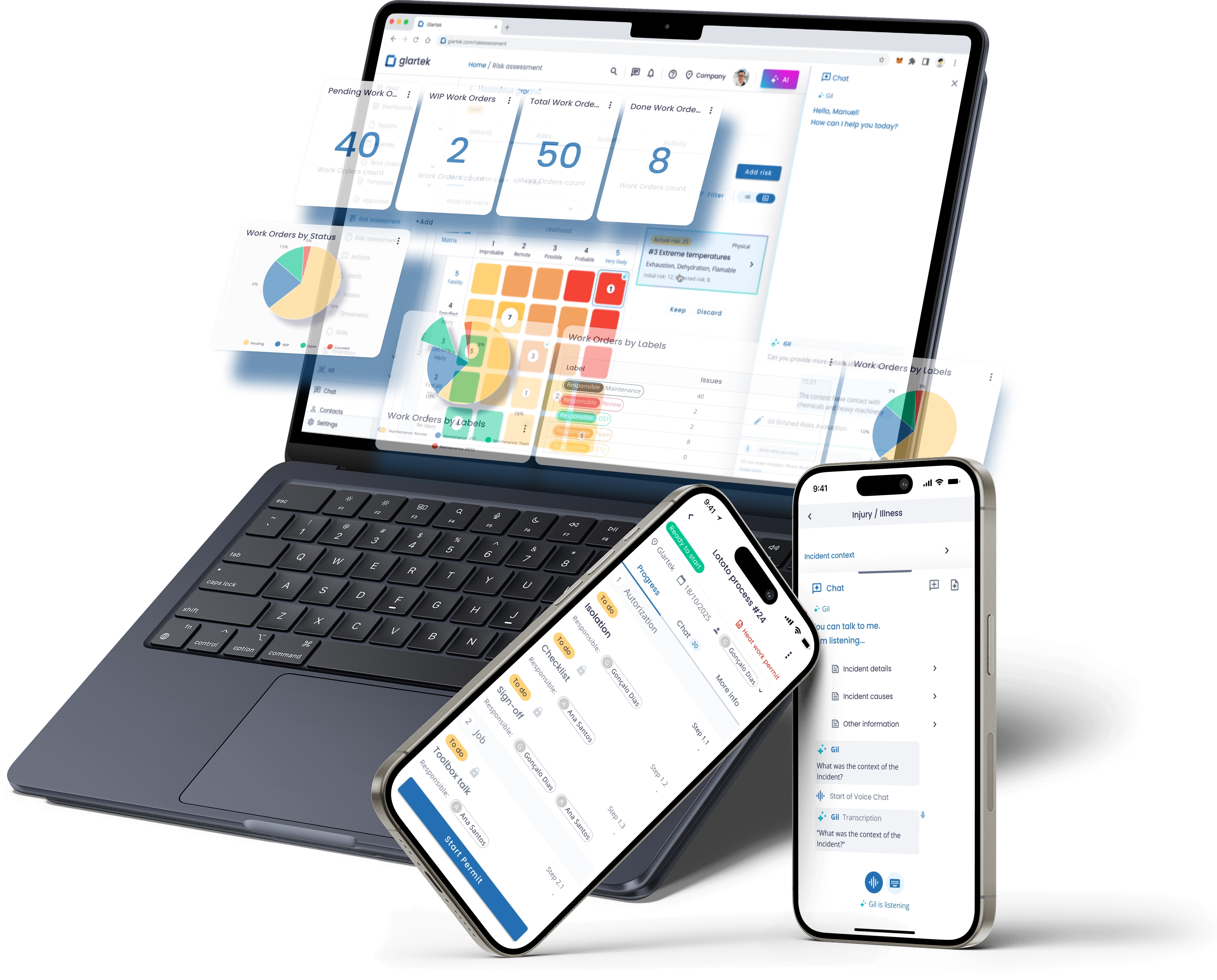
This is where Glartek's EHSQ software comes in as an enabler, and not as one more layer of work, integrating compliance data capture into operators' routine without creating bureaucratic friction. The same records filled in during routine inspections feed a centralised, auditable repository, ensuring that the compliance file stays permanently up to date.
In the end, the main question for industrial leadership is not whether manual preparation is expensive, because that impact is visible. The decisive point is to discover how much the operation loses each cycle while this inefficiency is tolerated as the unavoidable price of keeping certifications current.
The hidden cost of manual audit preparation
2026-10-14
The hidden cost of reactive safety
2026-09-30
The EHSQ software the whole team actually uses, from the front line to management

.webp)