
September 30, 2026

Most EHS programmes live with reactive safety without ever naming it as such, limiting themselves to investigating each occurrence after it happens, filing the report and closing the corrective action plan until the next deviation. Even though this routine gives an initial impression of diligence, it is an expensive approach whose bill rarely appears clearly in the company's accounts.
Rather than showing up as a single line in the budget, the cost of always acting after the damage is done dissolves into day-to-day productivity and into the repetition of the same operational deviations. Making that impact visible means understanding the mechanics behind the invisible costs and, from there, estimating with rigour the value the operation loses by acting only once the harm is already done.
Diluted into the routine, the cost of acting late goes unnoticed before anyone thinks to add it up. The losses do not arrive as a single, visible outlay; they fragment into hours of investigation here, a line stoppage there, rework caused by a non-conformity that happened again.
On their own, none of these portions is large enough to draw attention, and it is precisely because they add up quietly that they weigh on the year-end without anyone having decided to spend them.
Add to this the fact that this cost sits in no one's KPI. Because operations tend to measure mainly the recordable incident rate, the time spent reacting ends up becoming an expected part of the work, rather than a value the company is losing month after month.
Looking only at what has already happened leaves out most of the signals that precede serious accidents, and that is precisely where the traditional lens fails, as analyses by the Campbell Institute on serious injuries and fatalities indicate that only a small share of recordable incidents shares a cause with fatal outcomes, so that only around 20% of the precursors of those outcomes remain on the radar of anyone tracking accidents alone.
There is also the opportunity cost, the quietest of the three, because every hour spent responding to today's incident is an hour not devoted to preventing tomorrow's.
Locating the losses of reactive safety starts with what is most concrete and easiest to measure, namely the volume of incidents and the working hours their response consumes over the year. Each recordable occurrence carries measurable costs, ranging from production line stoppages and investigation to the occasional replacement of operators and indirect charges, and that value multiplies by the number of incidents the operation records per year.
To that total you must still add the time of the EHS team itself which, trapped in reaction, hardly ever gets directed towards strengthening prevention.
In this scenario of late action, the most critical outcome is also the one that most escapes control, since the precursors of serious injuries and fatalities (SIF) tend to precede the accident without drawing attention. These events are almost always preceded by near misses and by minor deviations which, because they cause no immediate harm, rarely get recorded in paper-based processes.
Treating a near miss as an early signal turns out to be the most effective way to correct a failure before it becomes a human loss, avoiding along the way the prolonged stoppage that almost always accompanies it.
Beyond the direct damage, there are equally real indirect costs which, even if hard to measure honestly, pressure the operation all year round. The turnover of those working under constant strain, the erosion of trust between the front line and management and the exposure in regulatory inspections all weigh on the result. Recognising them as context, rather than pinning a number to each one, is what keeps the financial estimate on data you can actually verify.
The scale of the loss becomes clear when the company projects industry averages onto its own annual history of occurrences. The average cost of a lost-time injury, which brings together compensation, lost production and associated expenses, is a known reference value and multiplies by each event of the year.
Adding the temporary replacement of specialised labour and the delivery delays that tend to follow, you reach totals that weigh concretely on the result of an industrial site.
On the other side of the equation is the return on moving resources to prevention, and the comparison is revealing. While programmes with proactive targets show significant drops in injury rates, studies on the return on investment in prevention point to gains above two to one.
More than memorising each figure, what matters is seeing the asymmetry behind them, because preventing costs a fraction of what reacting costs. To determine that value at the scale of your operation, Glartek's impact calculator estimates in minutes the technical hours saved and the losses avoided based on your plant's real data.
Transitioning to a sustained preventive model does not require rebuilding safety programmes entirely from scratch. The decisive step lies in shifting management's attention to the weak signals that appear before the incident, making their capture simple and accessible on the shop floor.
Systematically carrying out field observations, recording near misses without friction and monitoring proactive indicators turn preventive intent into a measurable practice, in full alignment with the risk-assessment duties set out in the EU Framework Directive (89/391/EEC) and echoed across national occupational safety law.
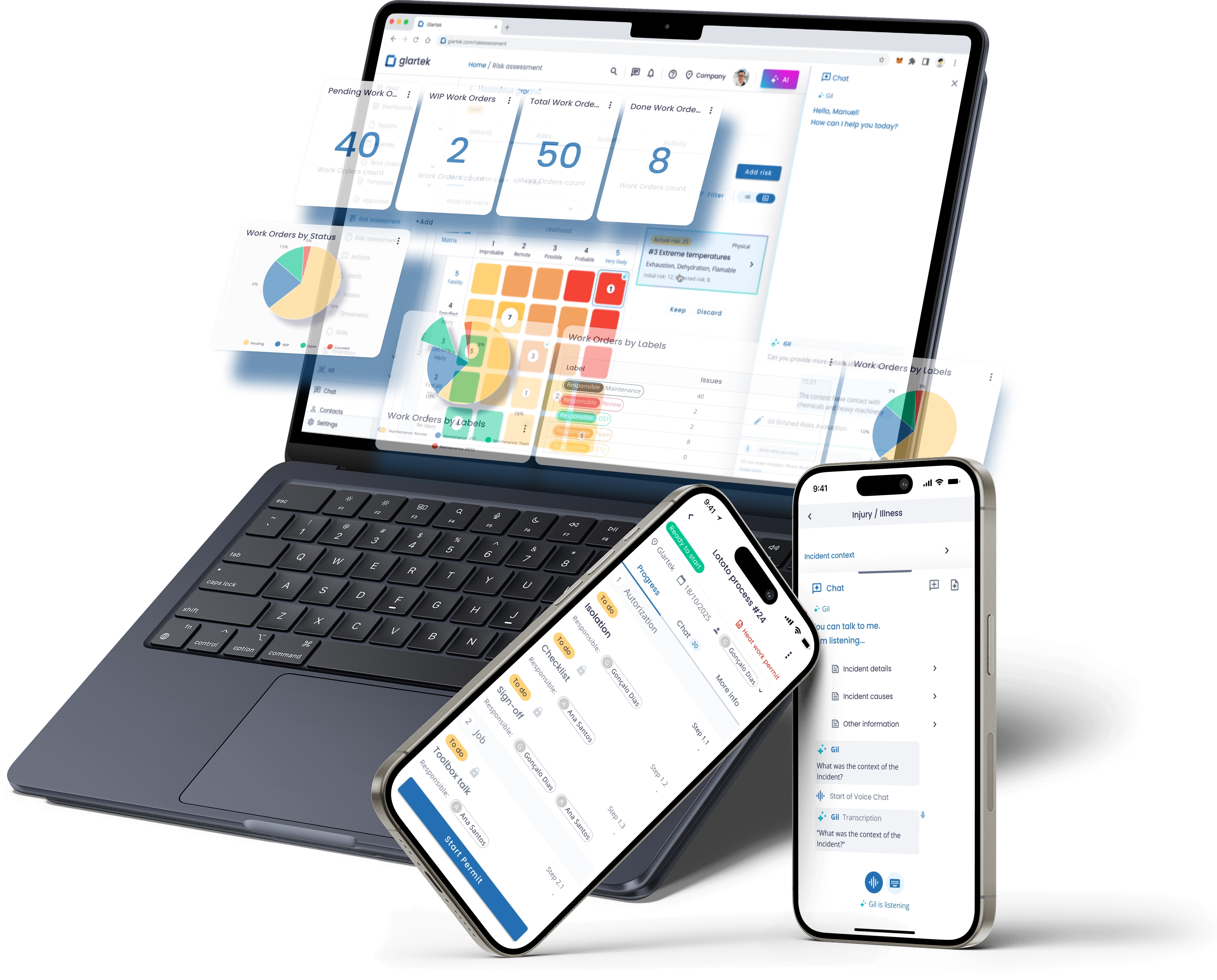
This is where Glartek's EHSQ software comes in as an enabler, not as one more layer of work. The same data the field team already captures starts to feed anticipation instead of merely documenting the past, and preparation stops depending on manual compilation.
In the end, the question that remains is not whether reactive safety costs, because we already know it does, but how much it is costing your operation right now, while the traditional model still looks merely normal.
The hidden cost of manual audit preparation
2026-10-14
The hidden cost of reactive safety
2026-09-30
The EHSQ software the whole team actually uses, from the front line to management

.webp)