October 28, 2026

Every industrial operation knows how to record an accident once it has happened, yet few give the same care to the event that came just before. That event is the near miss, the deviation that came within a step of causing injury and ended with no one hurt. And because no one was hurt, nothing is recorded, so the episode ends up treated as luck when it was, in fact, information.
That seemingly harmless event, however, carried exactly what the operation most needs to know: which barrier failed, which procedure was bypassed and what condition almost triggered the serious accident. When it never gets reported, that warning is lost. And the company only meets the same failure again later, once it charges full price.
Under-reporting, it is worth noting, rarely comes from bad faith. It stems instead from the friction of reporting, the fear of looking at fault and the sense that flagging a mere "near" is not worth the effort. That is why, throughout this article, we show why this cost stays invisible, where it hides and how to estimate how much the operation loses with every precursor it lets slip.
Taken on its own, a near miss does look irrelevant, because it ended with no one hurt, no stoppage and no visible cost. For that reason, it dissolves into the routine before anyone thinks to log it. The problem is that these same signals repeat without anyone capturing them, until they converge on the serious accident the operation never saw coming.
Added to this is the fact that the near miss sits in nobody's metric. Operations tend to measure what has already caused harm, whether the frequency rate, the lost days or the TRIR, and those numbers only move after the damage is done. Because the precursor appears in none of these counts, it has neither owner nor target, even though it is the cheapest data to capture before an accident.
Legislation itself reinforces this blind spot, since what must be reported, such as the injuries notifiable under RIDDOR 2013, is always the accident that has already caused harm. The near miss, by definition without injury, falls outside the legal duty and depends on the reporting culture that the EU Occupational Safety and Health Framework Directive (89/391/EEC) assumes but cannot impose on its own.
This invisibility, in turn, is backed by the data. The Campbell Institute's analyses of serious injuries and fatalities indicate that only a small fraction of recordable incidents shares the same cause as the most serious outcomes. In other words, most of the precursors of a serious accident stay off the radar of anyone who tracks only the accidents already done.
To size this loss, the safest route is to start from what the operation can already measure: the recordable incident and the cost it carries. Every lost-time injury has a known average cost. And behind nearly all of them lies a sequence of near misses that pointed that way and that no one captured.
This is precisely the bucket that Glartek's impact calculator prices. It cross-references the number of recordable incidents per year, the average cost of each and the reduction that becomes possible once precursors stop being invisible and start being handled in time. In this way, bringing the near miss onto the radar turns a reactive indicator into a prevention lever whose return can be estimated.
Around this measurable core lie losses that are harder to pin to a figure, and which enter here only as context. The same failure returns because it was never logged, trust erodes when the team feels that reporting changes nothing, and the risk grows of an investigation that discovers, too late, that the signal existed and was ignored. None of these losses fits a single line item, yet all of them weigh on the operation.
The size of the loss becomes clearer when the operation cross-references its own number of recordable incidents per year with the average cost of each. This is not a made-up case, but the sum the company already holds: how many recordable events occur per year, how much each costs on average across lost time, replacement, investigation and lost production, and what share of them could have been avoided had the precursor been handled in time.
Market references help to place the order of magnitude. In Injury Facts 2024, the National Safety Council estimates an average cost of around 48,000 US dollars per lost-time injury and roughly 1.54 million US dollars per fatality. These are figures that explain why every untreated precursor comes dear, even when the near miss itself cost nothing on the day it happened.
More than fixing a single percentage, what truly matters is seeing the asymmetry, since capturing and handling the precursor costs a fraction of the accident it foretold. The exact number for your operation is what Glartek's impact calculator estimates in a few minutes, from your recordable incidents, the average cost and the reduction possible once near misses stop slipping by unnoticed.
Bringing the near miss onto the radar calls for neither an awareness campaign nor one more form at the end of the shift. It calls, rather, for removing the friction that makes the operator give up on reporting. The record has to be quick, to happen at the point of work itself and, above all, to give something back. After all, no one reports twice to a system that never shows what it did with the first report.
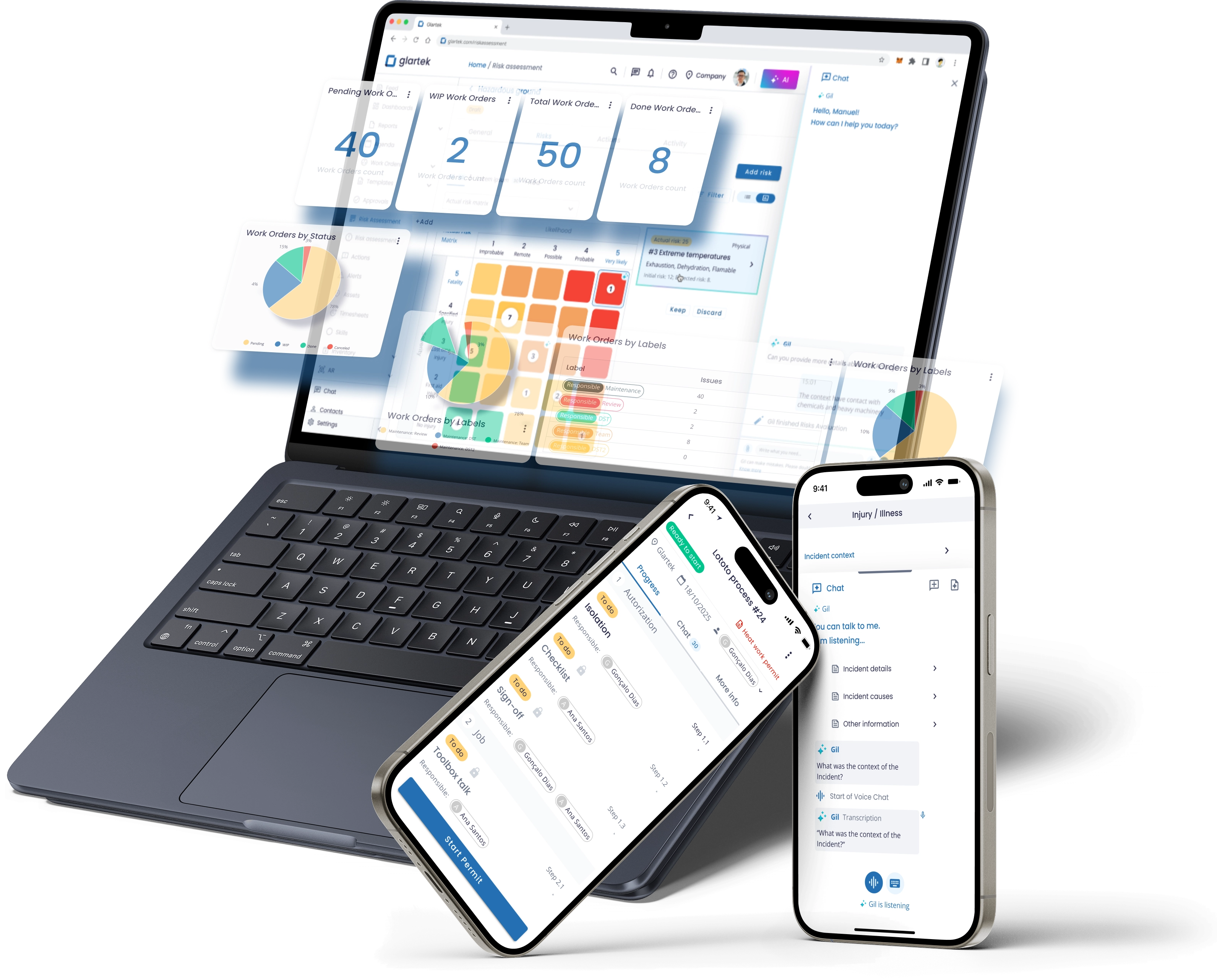
This is where Glartek's EHSQ software acts as an enabler, not as one more layer of work. When reporting a near miss fits into a few taps, inside the same app the team already uses, and when each report gives rise to an analysis and a visible action, under-reporting falls, simply because reporting has become worth the effort.
In the end, the question is not whether under-reported near misses have a cost, since the serious accident they foretell already carries a known price. The question is how much your operation pays for every precursor it lets slip, while the silence still looks, misleadingly, like the absence of risk.
The hidden cost of manual audit preparation
2026-10-14
The hidden cost of reactive safety
2026-09-30
The EHSQ software that every team actually uses, from the front line to management