September 23, 2026

Industrial safety management often revolves around process compliance, the deployment of personal protective equipment and the sophistication of technical procedures. Although these elements are indispensable for mitigating operational risks, true resilience on the shop floor frequently stems from intangible human factors that escape conventional metrics.
On the factory floor, an attentive colleague spots signs of danger with a speed and contextual sensitivity that no mechanical system can match. While technological tools quantify isolated parameters, operators read the operation as a whole, noticing a colleague's physical fatigue, an unrecorded shortcut or a slight change in a machine's usual sound.
Industrial camaraderie is precisely this web of trust and shared responsibility, grounded in the tacit commitment to mutual protection among those who share the same production space day after day. Small everyday gestures, such as a visual confirmation before a lifting manoeuvre, a discreet intervention to slow the pace of work or the voluntary adjustment of a harness, give shape to this constant care.
Contrary to the usual prejudice, a close-knit team is not tolerant of negligence, nor does it encourage the concealment of failures among peers. True operational camaraderie is the opposite of complacency, expressed in the courage needed to step in and warn a colleague before unsafe conduct results in a serious injury. Even though these preventive attitudes never appear on dashboard charts, they form the strongest primary barrier against incidents in the operation.
The benefits of a cohesive workforce reach far beyond social wellbeing in the factory. Specialist research on safety climate confirms that teams marked by high levels of mutual trust show greater consistency in following safe procedures, culminating in a substantial reduction in accident rates.
This preventive effectiveness rests essentially on two complementary operational mechanisms:
The decisive moment for the safety of a factory installation comes down to the fraction of a second in which a worker spots an irregularity and decides to raise it openly with a supervisor or the colleague beside them. In organisational environments dominated by blame, any near miss tends to be hidden for fear of disciplinary sanctions or of harming the team's production pace.
As Amy Edmondson, a Harvard researcher, demonstrates, psychological safety rests on the shared conviction that voicing concerns and mistakes honestly will not be punished. Empirical studies on the under-reporting of incidents reinforce this premise, showing that a lack of trust inevitably leads to a decline in preventive records.
Within this framework, warning a nearby colleague to put a machine guard back in place calls for a considerable degree of interpersonal commitment. This direct intervention embodies genuine care among peers and, at the same time, meets the regulatory requirements that place worker participation at the heart of risk management, such as the EU Framework Directive 89/391/EEC, the role of health and safety committees and the management of psychosocial risks.
When an environment of mutual trust prevails, operational deviations surface at an early stage in the form of valuable alerts, proving that a rising volume of reports reflects the maturity of the safety culture and the freedom the team feels to speak up.
Even though operational camaraderie may seem an intangible variable, it is reflected concretely in the indicators the organisation already tracks routinely. Rather than limiting this assessment to periodic climate surveys, leadership can gauge the level of cohesion through the behaviours observed day to day.
There are specific signs that clearly reveal the strength of these relationships in the operation:
Analysed together, these indicators show whether workers feel empowered to act on the deviations they witness in the operation. When preventive communication spreads across the whole factory and anomalies are corrected quickly, mutual help fulfils its protective role by strengthening shared trust.
Conversely, a slowdown in the pace of reports or reliance on isolated voices signals the weakening of working relationships, allowing operational risks to accumulate in silence.
Solidarity and collaboration on the shop floor cannot be imposed through decrees or disciplinary rules. It falls to leadership to design the conditions and routines that encourage these bonds of cooperation to develop naturally. To embed this dynamic into the industrial routine, it is worth structuring the effort along three essential fronts:
None of these initiatives becomes sustainable without an unequivocal demonstration of commitment from direct supervisors. Psychological safety is conditioned from the top, so that the stance of a supervisor who openly acknowledges a mistake of their own or thanks someone for reporting a problem conveys legitimacy to the whole team. This openness from management authorises operators to adopt the same transparent behaviour, consolidating mutual help as a shared and protected practice.
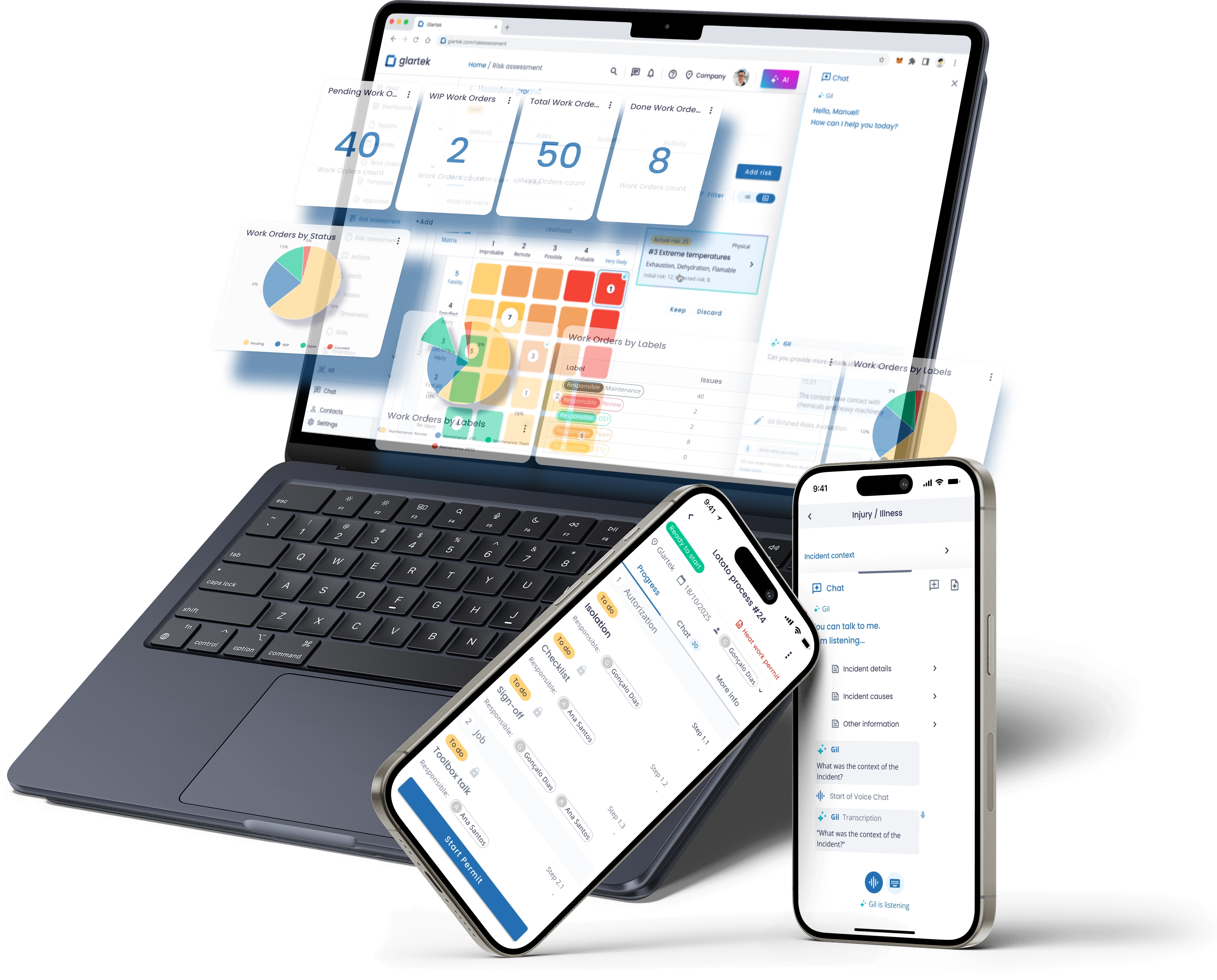
Embedding new behavioural habits depends directly on the level of operational friction present in the company's everyday tools. If reporting a near miss requires filling in slow paper forms or resorting to hard-to-access systems, spontaneous preventive attitudes end up fading away.
Adopting intuitive mobile tools removes this obstacle by allowing any record to be completed in seconds in the operation, triggering visible corrective responses that prove the practical relevance of the worker's participation.
At the same time, connected digital platforms extend these bonds of cooperation across different shifts and remote workstations, mitigating the isolation of technicians who operate alone. Through interactive instructions on mobile devices and digital assistance channels, experienced professionals can guide junior operators with precision and safety, ensuring the continuous transfer of good practices.
The role of technology is precisely to extend the reach of human relationships, ensuring that mutual protection remains active throughout the production structure.
Explore Glartek's EHSQ software and discover how connected teams work more safely

.webp)