
September 16, 2026

Most industrial operations still treat safety and quality as strictly separate departments, splitting responsibilities across different teams, incompatible tools and parallel meetings that only give the appearance of order.
This artificial divide runs against the very architecture of the international management standards, since ISO 9001, ISO 45001 and ISO 14001 were designed to run under a common management structure, aligned by the same high-level organisational principles. The barrier that isolates these areas comes, therefore, from historical cultural and organisational choices, not from any technical constraint or requirement.
Managing occupational health and safety without a link to quality creates the illusion of sustained compliance, while the same operational weaknesses keep generating waste, manufacturing defects and audit failures.
By narrowing the field of view to only half of the shop-floor reality, leadership ends up duplicating investigations for the same incident, applying point fixes that tackle only the visible symptoms. As a result of this fragmentation, the underlying weakness stays active at the point of execution, perpetuating deviations exactly where the organisation was not paying attention.
The root of industrial anomalies rarely sits within a single department; in most cases it shares the same root cause in the field. A classic example is a worn seal on a filling line that maintenance did not inspect in time: the faulty component contaminates the final product, creating a quality non-conformity, while at the same time it releases fluid into the walkway, creating an immediate slip-and-fall risk.
Although this is strictly a single event, traditional organisations tend to open two parallel investigation processes run by teams that rarely talk to each other. The real point of convergence lies precisely in that dynamic, where the incident that causes a physical injury and the anomaly that invalidates a production batch stem from exactly the same process failure.
Bringing safety and quality together on the production floor is a deep strategic shift in how management sees and acts on daily operations. Instead of splitting one occurrence into redundant reports, multiple owners and misaligned deadlines, converging into a single EHSQ ecosystem (environment, health, safety and quality) consolidates the response into one coherent flow.
This shared perspective creates structural advantages that directly reduce recurring operational failures:
The soundness of this model also rests on economic evidence from sector research. A widely cited ISSA and DGUV study estimated a return of around EUR 2.2 for every euro invested in occupational prevention. The exact figure varies with context, but it points to a consistent conclusion: prevention tends to pay for itself.
When management adopts an integrated EHSQ approach, those same preventive records start feeding compliance and quality indicators, increasing the efficiency of every field intervention.
To estimate this impact for each plant, Glartek's EHS Impact Calculator helps quantify the audit-preparation and reporting hours that an integrated approach can save, as well as the incidents avoided through earlier visibility over precursors.
The obstacle to integration rarely comes from the standards themselves, since ISO 45001 and ISO 9001 share the same high-level structure (Annex SL), which makes it easier to harmonise requirements and processes.
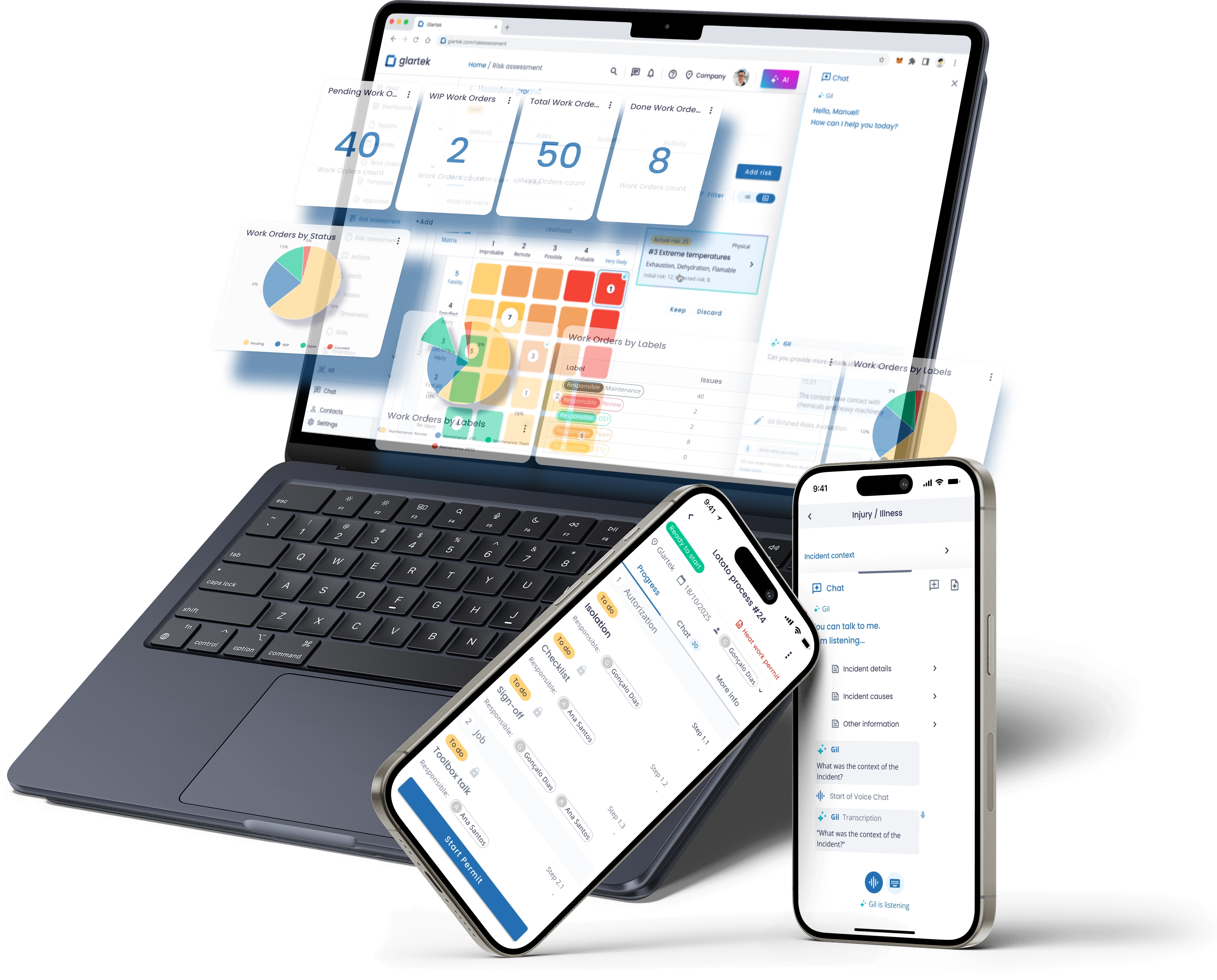
The real bottleneck is the sprawl of analogue or outdated tools that keep data separated in drawers and scattered spreadsheets. Modern EHSQ software overcomes that barrier by centralising incident reporting, standard operating procedures (SOPs) and field evidence in a single source of truth shared across every area.
This way, the frontline technician logs any anomaly only once from a mobile device, making the information available in real time to both the safety team and the quality owners, who then run the same CAPA cycle in one place.
This unification is what sets a native EHSQ software apart from suites assembled from disparate modules bought from different vendors. When safety and compliance disciplines are designed from the outset under the same data architecture, information flows without technical friction, preventing shared root causes from getting lost in imperfect system integrations.
Moving to an integrated system does not require abruptly replacing the existing quality controls that already work well. The most effective path is to start unifying at the touchpoints where both disciplines already meet naturally, especially in mobile incident reporting and the subsequent management of the CAPA cycle.
By setting up a single initial record for joint triage and resolution, the organisation builds the foundation it needs to progressively extend integration to compliance audits and risk assessment across the whole operation.
While EHS measures how effectively the company protects its workers, quality measures the level of excellence delivered to the end customer. Assessing these two variables separately gives only an incomplete reading of operational maturity and limits leadership's ability to react.
Consolidating an EHSQ mindset replaces the isolated management of metrics with a whole-plant view, making sure that failures with common causes benefit from shared solutions, supported by software built from the ground up to unify the operation.
The hidden cost of manual audit preparation
2026-10-14
The hidden cost of reactive safety
2026-09-30
Helps unify your safety andquality processes into a single source of truth


.webp)



.webp)