
September 9, 2026

Every day, millions of frontline workers step into critical zones to carry out routines that digital systems could already take over or streamline. This reality runs from filling in paper checklists to climbing elevated structures, entering confined spaces or reproducing complex procedures from memory alone.
In industry, this cluster of operational demands is usually summed up in the matrix of the 4 Ds: Dull, Dirty, Dangerous and Difficult. Recognising these four axes is the first step in deciding which tasks should no longer sit under a person's direct responsibility.
Far from an attempt to replace the operator, the careful integration of technology aims to remove them from direct physical exposure. The purpose is to lift their role towards the work where human judgement remains irreplaceable, such as interpreting events, deciding in the face of the unexpected and solving problems no script anticipates. This is exactly where reading operations through the 4 Ds becomes a practical way to set priorities.
The 4 Ds are the matrix that classifies the most punishing industrial tasks into four categories, Dull, Dirty, Dangerous and Difficult, in order to identify which of them should no longer be carried out directly by a human.
Leaving these conditions in place imposes daily wear that, over the medium term, turns into execution errors, workplace accidents and the early loss of skilled professionals. Each D describes a distinct form of exposure, and most field roles carry more than one of them at the same time.
The overlap of these four variables wears the team down without offering proportional support, driving a turnover that drains operational experience precisely in the most critical roles.
Removing the worker from the task protects more than reinforcing their equipment because it acts on the hazard itself, not on human behaviour at the moment of exposure, which is the core logic of the hierarchy of controls.
The hierarchy of controls, a NIOSH model, ranks safety measures from the most effective to the least effective. Elimination, substitution and engineering controls protect more because they control exposure without depending on a correct human action at the moment of the task, whereas administrative controls and PPE, at the base, demand constant effort and fail when attention slips. Reading the 4 Ds through this lens makes the path clear, since every dull, dirty, dangerous or difficult task is a natural candidate for elimination or substitution before PPE is used as the last resort.
Paper-based management keeps the worker exposed because it locks information in paper and scattered spreadsheets, forcing them to stay in risk areas only to record data and deferring prevention until the hazard has already been confirmed. Legacy systems were designed to archive data, not to prevent hazards actively, and when an anomaly reaches managers only hours later, the unnecessary exposure repeats shift after shift.
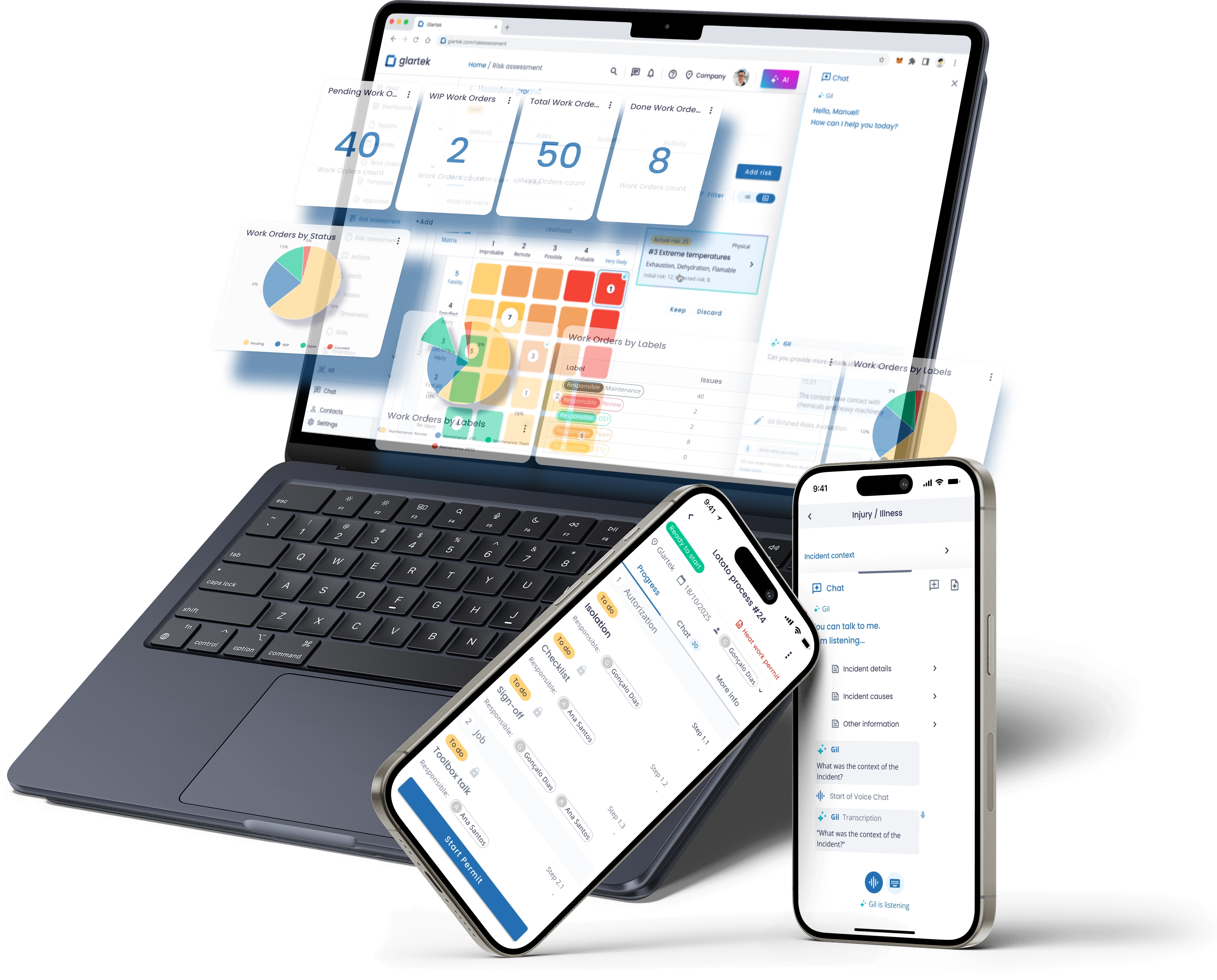
Getting past this bottleneck relies on digital platforms that capture and process data directly at the point of execution, with mobile apps that work even without a connection. Within this, EHSQ software (Environment, Health, Safety and Quality), such as Glartek's, centralises safety processes so that a technician reporting a non-conformity receives immediate guidance and active safeguards, connecting the frontline to management in the same tool.
In practice, technology removes workers from risk by replacing on-site rounds, manual records and memory-based procedures with guided mobile workflows, digital validations and traceable permits that only release the intervention when it is truly needed.
At an energy utility, for example, the traditional model forces a technician into lengthy rounds every shift to check instruments and live panels, accumulating monotony, prolonged presence near the hazard and delay in transcribing notes. With mobile workflows and dynamic validation flows, the check becomes fast and structured, and the system alerts supervisors the moment it records a deviation, cutting exposure time and reserving physical presence for when intervention is genuinely required.
Automating operational workflows gives the worker back the capacity to concentrate by simplifying checks that once demanded exhausting manual writing beside the equipment. Dynamic forms with conditional logic, pre-filled fields and immediate validations remove the repetitive effort in the field, so human attention focuses on what creates real value: analysing the data, anticipating anomalies and acting on unexpected deviations.
The reduction of physical exposure is clearest in the combination of prior validations and digital control at the point of intervention. The digital permit to work (PTW) is the electronic authorisation that only releases a high-risk task once all safety conditions are verified and traceable in the app, and interactive risk assessments follow the same logic. In parallel, lockout and tagout checklists ensure no one intervenes in an unhealthy or dangerous environment without proper isolation, giving practical effect to EU rules on confined-space entry and electrical work.
Carrying out complex interventions no longer depends on the technician's memory when it is supported by digital, interactive work instructions, available on smartphones or industrial tablets, guiding the operator step by step through the correct sequence. By reducing cognitive load, these guides standardise technical quality across shifts and prevent errors born of forgetting, averting unplanned downtime and accidents in demanding operations such as those covered by the Machinery Directive (2006/42/EC).
Daily life with the 4 Ds reflects processes that still lean too heavily on paper and physical effort. By shifting the repetitive, unhealthy, hazardous and cognitively heavy tasks into digital workflows, traceable permits and mobile guides, the organisation begins to reap three gains that reinforce one another.
The first is the reduction of risk at the source, acting on exposure to dust, chemical agents, physical strain and injury, which are among the factors linked to the roughly 1.9 million work-related deaths estimated by the WHO and the ILO in 2016.
The second is the retention of skilled technicians, sustained by a more modern working environment for generations that do not accept the wear of the 4 Ds as an inevitable part of the job. The third comes from the flow of real-time data, which removes analogue bottlenecks and speeds up decisions at every level.
The question that drives modernisation stops being which PPE to hand out and becomes why a person still performs a given task. Prioritising the activities that repeat the same risk every day is where the protection of people and the productivity of the operation move together.
The hidden cost of manual audit preparation
2026-10-14
The hidden cost of reactive safety
2026-09-30
See how it helps you keep workers away from the risks behind the 4 Ds


.webp)




.webp)