November 25, 2026

In an industrial operation, the problem is rarely a lack of EHS data, because it exists and is collected every day, yet it lives scattered across one team's spreadsheets, another team's paper forms and systems that never came to talk to each other. When EHS data sits in silos, each area sees only its own piece, and the operation loses precisely what it needs most, which is a single, current view of risk.
Siloed EHS data is not data that is missing, but data that exists and cannot be found, because it is fragmented across people, departments and tools that do not share the same base. The result is an operation that has the information it needs in order to act and, even so, cannot use it in time, since bringing it together demands a manual effort that almost never happens at the pace at which risk moves.
These silos, it is worth noting, rarely stem from ill will, since they result from years of systems added one by one, each solving a specific problem without anyone ever having designed the whole. That is why, throughout this article, we show why the cost of siloed data stays invisible, where it hides and how to estimate how much the operation loses with every hour spent bringing together what should already have been together.
The cost of silos is hard to see because it does not look like a problem, but like normal work, since compiling spreadsheets, asking another team for figures and reconciling different versions of the same data has become part of the routine of whoever looks after EHS. Nobody records those hours as waste, and it is precisely because they pass for legitimate work that they never enter the account.
Added to this is the fact that silos leave no trace in any safety indicator, because the TRIR, the lost days and the other figures only measure the result, never the effort spent to reach them. An operation can have beautiful dashboards and, underneath, a whole team copying data from one system to another on the eve of every meeting. Because that backstage work appears nowhere, nobody questions it, even though it consumes an enormous slice of the time of those who should be preventing.
There is also the effect of the lag, because when data has to be brought together by hand it always arrives late, and a decision made on last week's snapshot is not the same thing as a decision made on what is happening now. The very logic of the EU Occupational Safety and Health Framework Directive (89/391/EEC) assumes a living management of risk, one that updates as the operation changes. When the data sits in silos, that management comes to depend on whoever has time to consolidate the information, and risk waits not for the hazard, but for the next time someone manages to put the spreadsheet together.
At bottom, silos are the same disease as manual reporting seen from another angle, since the effort of compiling reports and the effort of reconciling fragmented data share the same origin, which is information not being born already connected. That is why the real cost of silos is measured, above all, in time, exactly what our article on the hidden cost of manual EHS reporting sets out in detail.
To size up that loss, the most concrete starting point is time, namely the hours the team spends every month collecting, consolidating and reconciling EHS data scattered across several systems and formats. It is this volume of hours that Glartek's impact calculator uses to translate silos into a number, by comparing today's manual compilation effort with what is left over when the data becomes centralised and updated in real time.
These hours almost never show up as a cost, but they are the salary of qualified people applied to copying and pasting instead of analysing and preventing, which is why every report put together by hand is time that does not come back to the operation. It is this difference, between what the team spends to bring the data together and what it would spend if it were already together, that the tool helps to make visible.
Around that countable core there are losses harder to pin to a number, which enter here only as context, from the decisions made on out-of-date data to the same occurrence recorded in three different ways in three systems that do not talk to each other. Trust in the data itself also wears down, because when each source says something different the discussion stops being about risk and becomes about which spreadsheet is right, and, although none of these losses fits into a single line item, they all weigh on the operation.
The cost of silos materialises, above all, in the time lost bringing together what should already be together, and that time has a direct price, which is the salary of the hours spent on compilation multiplied by every time the exercise repeats over the year. Behind that number there is also the cost of deciding late or badly, because data that arrives late is worth less than data that arrives on time.
More than fixing a single figure, what matters is seeing the asymmetry, since unifying the data into a single source costs a fraction of what it costs to keep it dispersed and to pay, month after month, for the effort of reconciling it. The exact figure for your operation is what Glartek's impact calculator estimates in a few minutes, from the hours the team spends today compiling data and the room there is to reduce them.
Solving silos is not about buying one more system to add to the ones that already exist, but about making the data born in a single place, so that there is no longer anything to reconcile. For that, the information needs to be collected once, at the point of work, and become immediately available to whoever needs it, without the intermediate step of someone putting the spreadsheet together afterwards.
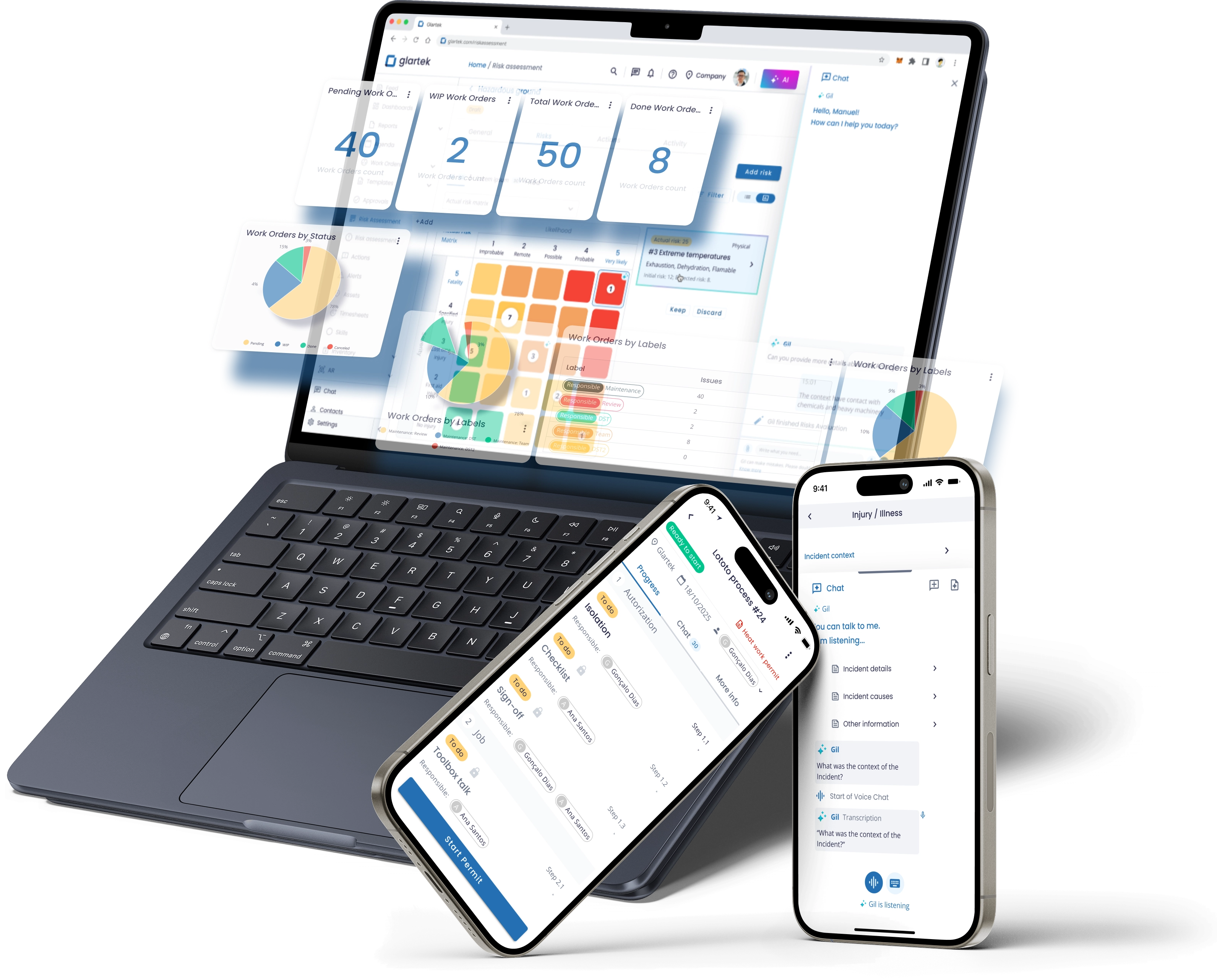
This is where Glartek's EHSQ software acts as an enabler, by bringing together into a single base what used to live in spreadsheets, paper and separate systems. When the observation, the inspection and the incident are recorded in the same app and feed the same dashboard, manual compilation simply stops being necessary, and the time that went into bringing the data together comes back to where it makes a difference, which is analysing and acting. An operation with its data connected comes to decide on what is happening, and not on what happened two weeks ago.
In the end, the question is not whether siloed EHS data costs, since the time spent reconciling it already has a known price and shows up at every month-end close. The question is how much your operation loses with every hour spent bringing together what should already be together, while the silos still look like merely the normal way of working.
The hidden cost of siloed EHS data
2026-11-25
The hidden cost of a silent workforce
2026-11-11
The hidden cost of manual audit preparation
2026-10-14
The hidden cost of reactive safety
2026-09-30
The EHSQ software that brings observations, inspections and incidents together in a single source, from the frontline to management